HelloGrowthCRM software
Built for real small-business sales teams
HelloGrowthCRM helps reps qualify faster, follow up on time, and close more deals—with practical automation in one place.
- AI lead scoring and pipeline visibility
- Built-in dialer, WhatsApp, and email automation
- Sales forecasting and RevOps-ready reporting
AI CRM vs Traditional CRM: Choosing the Right CRM for Your Business
AI CRM uses artificial intelligence to automate tasks like lead scoring and follow-ups, while traditional CRM relies on manual data entry and management. For Indian small businesses, AI CRM can speed up sales processes and prioritize leads, but traditional CRM may suit those preferring simpler setups. This article compares both on key criteria to help you decide.
Why this comes up / what goes wrong
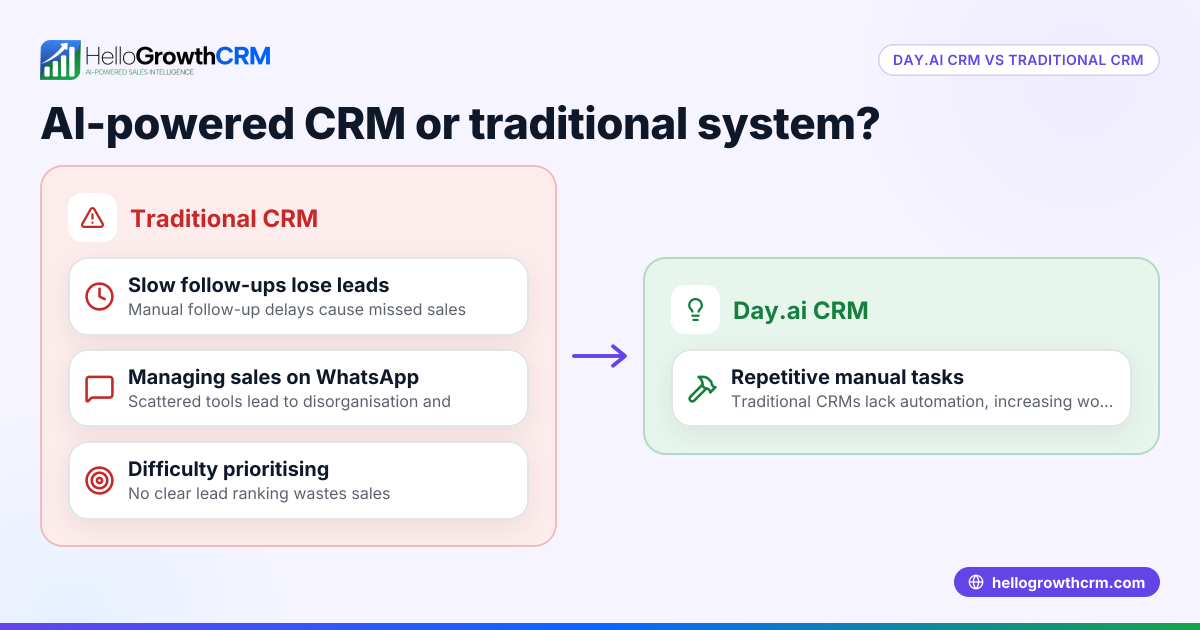
If you run a small or mid-sized business in India, choosing the right CRM can be confusing. You may be losing leads because of slow follow-up or managing sales on WhatsApp and spreadsheets. Traditional CRMs often require manual updates and separate tools for messaging, which can slow down your sales team. On the other hand, AI CRMs promise automation and better lead prioritization but may seem complex or costly. Understanding the differences helps you pick a CRM your team will actually use and that fits your budget and workflow.
Step-by-step
| Criteria | AI CRM | Traditional CRM | Which suits whom? |
|---|---|---|---|
| Lead Scoring | Automated AI lead scoring helps call high-potential leads first | Manual or rule-based scoring | AI CRM for busy teams needing focus |
| Follow-up Automation | AI agents draft follow-ups after calls for quick review and send | Manual follow-ups, templates or reminders | AI CRM if you want to save time |
| Messaging Integration | WhatsApp and SMS logged in CRM, sequences possible | Often requires separate apps or manual logging | AI CRM for WhatsApp-heavy sales |
| Ease of Use | May need some training; AI automates tasks | Usually simpler interfaces but more manual work | Traditional CRM if you want simple setup |
| Cost | Can be higher due to AI features | Usually lower, basic plans available | Traditional CRM if budget is tight |
| Customization | AI workflows can be customized (Beta features) | Standard workflows, less automation | AI CRM if you want automation flexibility |
| Reporting & Forecasting | AI helps forecasting with lead data | Basic reporting, manual forecasting | AI CRM for data-driven decisions |
Who should pick which?
- Choose AI CRM if your sales team handles many leads, uses WhatsApp extensively, and wants to automate repetitive tasks.
- Choose traditional CRM if your team is small, prefers simplicity, and manual control over processes.
See more on CRM features and compare CRMs.
Example (fictional figures)
Consider "Sharma Electronics," a Delhi-based small business with 5 telecallers handling 1,000 leads monthly. They want to improve follow-up speed and call the best leads first.
- Using traditional CRM, telecallers manually score leads, spending 20 minutes per lead on average for follow-up prioritization.
- With AI CRM, AI lead scoring prioritizes leads instantly, saving 15 minutes per lead.
Calculations:
Manual follow-up time per lead = 20 minutes AI CRM follow-up time per lead = 5 minutes Time saved per lead = 20 - 5 = 15 minutes
Total time saved per month = 1,000 leads × 15 minutes = 15,000 minutes Convert to hours: 15,000 ÷ 60 = 250 hours saved
If each telecaller works 160 hours/month, 250 hours saved equals over 1.5 telecallers' monthly time.
This time can be used to call more leads or close deals faster, showing how AI CRM can boost productivity.
Common mistakes
- Ignoring team readiness: Buying an AI CRM without training your sales team can lead to underuse. Prevent this by planning training sessions.
- Overlooking WhatsApp integration: Not checking if the CRM supports WhatsApp messaging can cause extra manual work. Choose a CRM with native WhatsApp and SMS features.
- Skipping lead prioritization: Without AI lead scoring, teams may waste time on low-potential leads. Use AI lead scoring to focus efforts.
- Choosing complex features unnecessarily: Some AI CRMs have beta features that may be too advanced. Start with core features and scale up.
- Neglecting follow-up automation: Manual follow-ups cause delays. AI agents drafting follow-ups save time and reduce errors.
Learn more about avoiding these in AI CRM and WhatsApp and SMS CRM.
Doing this in HelloGrowthCRM
HelloGrowthCRM offers AI lead scoring so telecallers call the leads most likely to convert first. Its AI agents draft follow-up messages after calls, requiring only review and send from reps. WhatsApp conversations with leads are logged on the lead record, and follow-ups can be sent as WhatsApp or SMS messages. These features help Indian SMBs speed up sales and keep all communication in one place. Explore these capabilities at HelloGrowthCRM for India.
Frequently asked questions
What is the main difference between AI CRM and traditional CRM? AI CRM uses artificial intelligence to automate tasks like lead scoring and follow-ups, while traditional CRM relies on manual data entry and processes. AI CRM can speed up sales cycles by prioritizing leads and automating messaging.
Is AI CRM suitable for small Indian businesses? Yes, especially if your business handles many leads and communicates via WhatsApp. AI CRM helps prioritize leads and automate follow-ups, saving time for small teams.
How does AI lead scoring work compared to traditional methods? AI lead scoring analyses multiple data points to predict lead quality automatically, unlike traditional methods that use fixed rules or manual scoring. This helps sales teams focus on leads with higher chances of conversion.
Can AI CRM integrate with WhatsApp for sales communication? Yes, AI CRMs like HelloGrowthCRM log WhatsApp conversations on lead records and allow sending follow-ups via WhatsApp and SMS, keeping communication streamlined.
Is AI CRM more expensive than traditional CRM? AI CRMs may have higher costs due to advanced features, but they can save time and improve sales efficiency. Traditional CRMs might be cheaper but may require more manual work.
How to decide between AI CRM and traditional CRM? Consider your sales volume, team size, communication channels, and budget. If automation and lead prioritization matter, AI CRM is better. For simple needs and tight budgets, traditional CRM works.
See more about AI CRM and compare CRMs.
Key takeaways
- AI CRM automates lead scoring and follow-ups, speeding up sales processes.
- Traditional CRM relies on manual updates and simpler workflows.
- WhatsApp and SMS integration in AI CRM keeps communication in one place.
- Choose AI CRM for higher lead volumes and automation needs.
- Choose traditional CRM for simplicity and lower upfront costs.
- Training and team readiness are crucial for successful CRM adoption.
Start improving your sales follow-up today with HelloGrowthCRM. Start on the Free Forever plan (200 leads, no credit card).
Ready to put this into practice?
Set up your pipeline, WhatsApp follow-ups, and AI lead scoring in minutes — free, no credit card.
Try HelloGrowthCRM freeGet CRM tips in your inbox
Join thousands of sales professionals who get weekly insights on CRM strategy, AI automation, and pipeline optimization.

The HelloGrowthCRM team publishes guides on CRM strategy, AI sales tools, and revenue operations for small business sales teams.