HelloGrowthCRM software
Built for real small-business sales teams
HelloGrowthCRM helps reps qualify faster, follow up on time, and close more deals—with practical automation in one place.
- AI lead scoring and pipeline visibility
- Built-in dialer, WhatsApp, and email automation
- Sales forecasting and RevOps-ready reporting
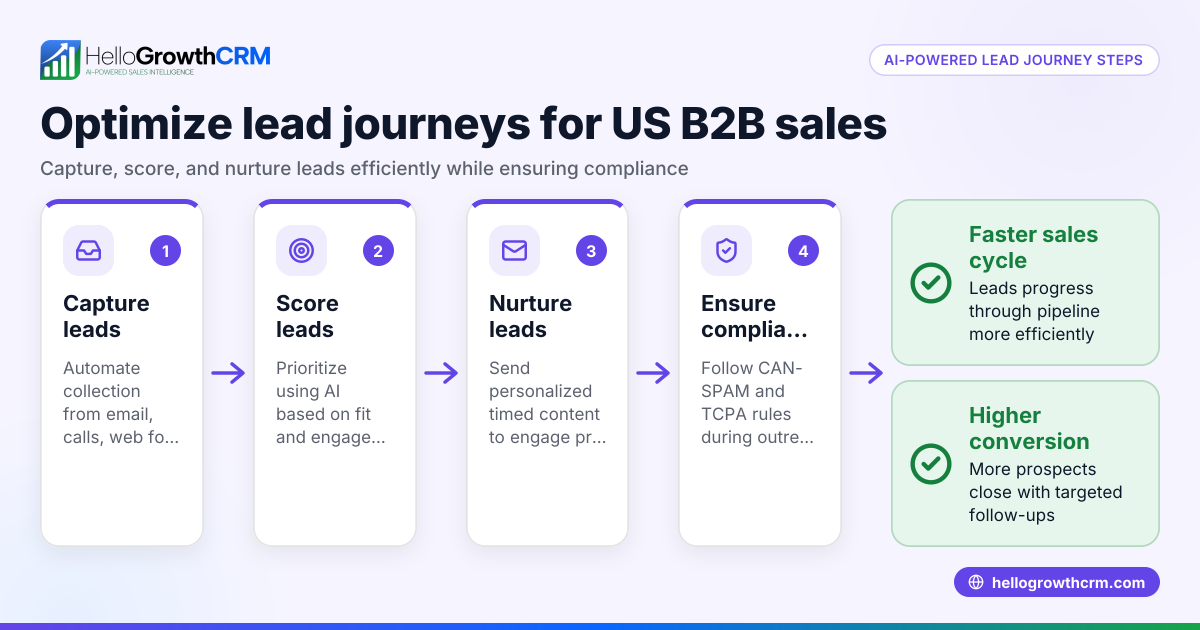
The AI lead score calculation method assigns a numerical value to each lead based on various data points such as lead source, engagement level, demographic fit, and past interactions. This score predicts the likelihood that a lead will convert into a customer, helping sales teams focus on the most promising prospects first. This article covers why Indian SMBs need AI lead scoring, the step-by-step calculation process, a realistic example with Indian currency, common mistakes to avoid, and how HelloGrowthCRM facilitates AI lead scoring.
Why this comes up / what goes wrong
Small and mid-sized business owners in India often receive many enquiries from sources like IndiaMART, JustDial, WhatsApp, and web forms. Without a system to prioritise leads, sales teams waste time calling low-potential leads first, resulting in lost sales and slow follow-up. Running sales manually on WhatsApp and spreadsheets makes it hard to track lead status or next steps, causing leads to slip through the cracks. Business owners search for the AI lead score calculation method to understand how to rank leads by their chance to convert and improve sales efficiency.
Step-by-step
- Collect lead data: Gather all relevant information about each lead, including contact details, enquiry source, product interest, and interaction history.
- Identify key factors: Determine which factors indicate a higher chance of conversion. These may include lead source quality, engagement frequency, company size, budget, and urgency.
- Assign weights to factors: Give each factor a weight based on its importance. For example, leads from trusted platforms like IndiaMART may get higher weight than cold calls.
- Score each lead on factors: Rate each lead's attributes against the factors. For example, assign a score from 0 to 10 on engagement level or budget fit.
- Calculate weighted scores: Multiply each factor score by its weight and sum these to get the lead's raw AI lead score.
- Normalize scores: Adjust scores to a consistent scale (e.g., 0 to 100) to compare leads easily.
- Set thresholds for action: Define score ranges for follow-up urgency, such as above 80 for immediate calls, 50-80 for scheduled follow-ups, and below 50 for nurturing.
- Review and update regularly: Continuously refine factor weights and scoring criteria based on sales outcomes and feedback.
Check that your CRM or lead management tool supports capturing these data points and updating scores dynamically. For Indian SMBs, integrating AI lead scoring with WhatsApp and call workflows is especially useful.
Example (fictional figures)
On 01/04/2024, a small electronics supplier wants to score a lead from IndiaMART who enquired about LED lights.
- Lead source weight = 40 (IndiaMART leads are high quality)
- Engagement level score = 8/10
- Budget fit score = 7/10
- Company size score = 6/10
Step 1: Multiply each factor score by weight (weights sum to 100 for simplicity):
Engagement weighted = 8 × 30 = 240 Budget weighted = 7 × 40 = 280 Company size weighted = 6 × 30 = 180
Step 2: Sum weighted scores:
240 + 280 + 180 = 700
Step 3: Normalize to 0-100 scale:
700 ÷ (10 × 100) × 100 = 70
The AI lead score is 70 out of 100, indicating a medium-high priority lead.
The sales team decides to call leads scoring above 65 within 24 hours.
Common mistakes
- Ignoring data quality: Poor or incomplete lead data leads to inaccurate scores. Prevent by verifying and updating lead information regularly.
- Using too many factors: Overcomplicating scoring with irrelevant factors dilutes focus. Prevent by selecting only the most predictive factors.
- Not updating weights: Market changes can affect factor importance. Prevent by reviewing and adjusting weights quarterly.
- Manual score calculation: Doing this in spreadsheets wastes time and causes errors. Prevent by using AI CRM tools with automated lead scoring.
- Not acting on scores: Scoring is useless if sales teams don’t prioritise calls accordingly. Prevent by training teams on score interpretation and follow-up protocols.
- Not integrating with communication channels: Leads scattered across WhatsApp, calls, and forms delay action. Prevent by using a CRM that unifies lead capture and scoring.
Doing this in HelloGrowthCRM
HelloGrowthCRM offers AI lead scoring that helps telecallers call the leads most likely to convert first. Every enquiry from a form, call, or WhatsApp lands as a lead with an owner and a next step, replacing notebooks and spreadsheets. The pipeline forecast and AI insights show the owner which stage deals are stalling in, without building spreadsheets. This integration with WhatsApp and calls suits Indian SMBs managing leads across multiple channels. Learn more about AI lead scoring and how HelloGrowthCRM supports your sales process.
Frequently asked questions
What is AI lead score calculation methodology? It is a process where AI analyses multiple lead attributes to assign a score indicating the likelihood of conversion. The method involves weighting factors like engagement, source, and budget, calculating a composite score, and using it to prioritise leads.
What does AI lead score value mean? The AI lead score is a numerical value, often on a scale from 0 to 100, representing how likely a lead is to become a customer. Higher scores mean higher priority for follow-up.
How is AI lead score calculated? AI lead score is calculated by collecting lead data, assigning weights to key factors, scoring each lead on those factors, multiplying scores by weights, summing them, and normalising the result to a consistent scale.
Can AI lead scoring work with WhatsApp leads? Yes. AI lead scoring works well with WhatsApp leads if the CRM captures these enquiries as leads with ownership and next steps. HelloGrowthCRM integrates WhatsApp leads directly into the scoring and pipeline.
How often should I update AI lead scores? Regular updates are important. Scores should be recalculated whenever new lead data arrives or at least weekly to reflect changes in engagement or lead status.
Is AI lead scoring suitable for small businesses? Absolutely. AI lead scoring helps small and mid-sized businesses prioritise limited sales resources, reduce follow-up delays, and increase conversion rates without complex spreadsheets.
Key takeaways
- AI lead score calculation assigns a numerical value to leads based on weighted factors predicting conversion.
- Prioritising leads by AI score improves sales efficiency and reduces lost opportunities.
- Use only relevant factors, update weights regularly, and ensure data quality for accurate scores.
- Avoid manual scoring; use AI CRM tools like HelloGrowthCRM that integrate lead capture and scoring.
- Regularly review scores and train sales teams to act on them promptly.
- HelloGrowthCRM supports AI lead scoring with WhatsApp-native lead capture and pipeline insights.
Start managing your leads smarter today. Start on the Free Forever plan (200 leads, no credit card) with HelloGrowthCRM and see how AI lead scoring helps your sales team call leads most likely to convert first.
Ready to put this into practice?
Set up your pipeline, WhatsApp follow-ups, and AI lead scoring in minutes — free, no credit card.
Try HelloGrowthCRM freeGet CRM tips in your inbox
Join thousands of sales professionals who get weekly insights on CRM strategy, AI automation, and pipeline optimization.

The HelloGrowthCRM team publishes guides on CRM strategy, AI sales tools, and revenue operations for small business sales teams.