HelloGrowthCRM software
Built for real small-business sales teams
HelloGrowthCRM helps reps qualify faster, follow up on time, and close more deals—with practical automation in one place.
- AI lead scoring and pipeline visibility
- Built-in dialer, WhatsApp, and email automation
- Sales forecasting and RevOps-ready reporting
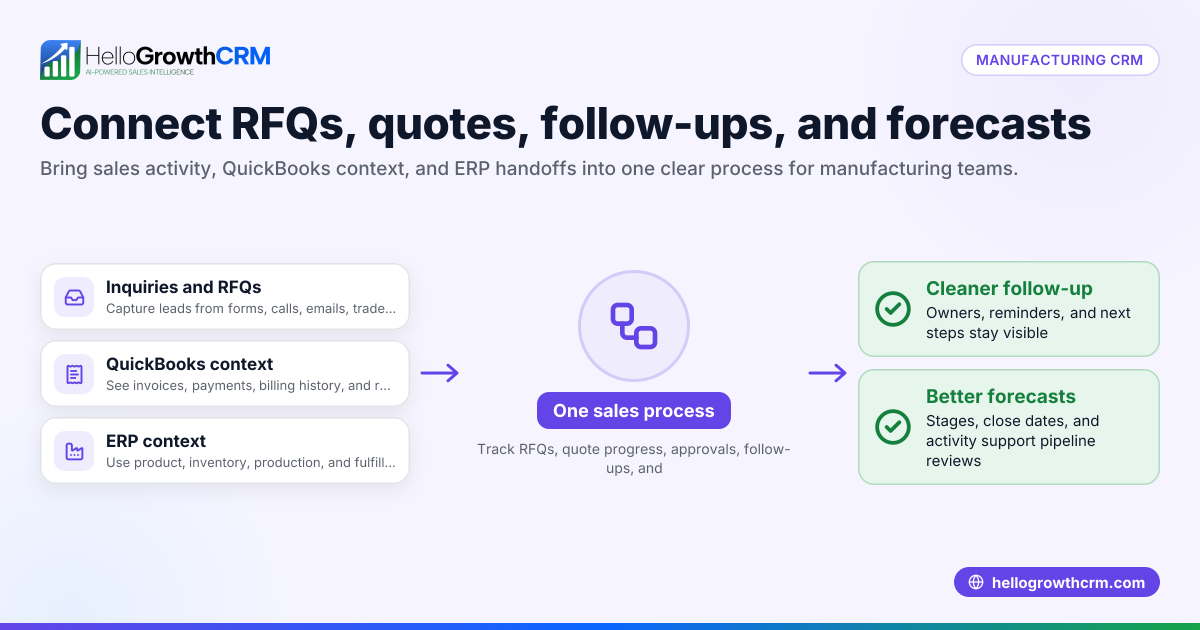
An AI CRM agent for manufacturers helps your team sort inbound RFQs, qualify accounts, and push the right follow-ups to the right rep without waiting for manual data entry. In the United States, that matters because sales teams often juggle email, web forms, calls, distributors, and long buying cycles across plants, buyers, engineers, and finance.
Key takeaways
- An ai crm agent for manufacturers can triage RFQs faster and route them by plant, product line, territory, or deal size.
- Lead scoring works best when it combines fit, buying intent, source, and rep activity in one system.
- Rep follow-up queues should prioritize speed to lead, existing account history, and next best action.
- US manufacturers need clean records, clear ownership, and audit-friendly process steps for forecasting and reporting.
- The biggest gains usually come from fewer missed RFQs, better handoffs, and more consistent follow-up.
- Start with one workflow first, then expand to quoting, renewals, channel sales, and reactivation.
Why manufacturers in the United States need an AI CRM agent
Manufacturing sales is messy by default. One RFQ may arrive through a website form. Another may come from a buyer in Houston by email. A third may come from a distributor call after a trade show in Chicago. If your team uses inboxes, spreadsheets, and memory to hold it all together, good opportunities get buried.
That is where an ai crm agent for manufacturers helps. It acts like a front-line coordinator inside your CRM. It reads inbound requests, captures key details, scores the opportunity, and places the next action in the right rep’s queue. That does not replace your sales team. It gives them a cleaner starting point.
For US manufacturers, this matters for a few practical reasons:
- Sales cycles often involve several stakeholders.
- Quotes may depend on specs, volumes, lead times, and plant capacity.
- Buyers expect fast follow-up and organized communication.
- Leadership needs realistic forecasting, not hopeful spreadsheets.
- Existing ERP, QuickBooks, and Stripe workflows need cleaner CRM inputs.
When people say they want “AI” in the sales process, they usually want fewer dropped balls. They want a system that notices urgency, flags high-fit accounts, and keeps reps moving. A strong AI CRM should do exactly that.
What does an AI CRM agent actually do for a manufacturer?
It captures inbound requests, summarizes what matters, scores the account, and tells the right rep what to do next. For manufacturers, that usually means triaging RFQs, matching ownership rules, and creating a clean follow-up queue.
In practice, the agent sits between raw inbound activity and rep action. It turns unstructured messages into usable CRM records. That includes RFQs from web forms, emails with drawings attached, phone notes, and replies from old opportunities.
Core jobs an AI CRM agent can handle
- Capture inbound inquiries
- Pull in web form submissions.
- Parse email requests sent to sales inboxes.
- Log call outcomes and missed call notes.
- Match contacts to existing accounts. - Extract useful details
- Product category.
- Requested quantity.
- Delivery timing.
- Location and shipping state.
- Industry or use case.
- Buyer role and company size. - Triage RFQs
- Mark urgent requests.
- Separate standard quotes from custom work.
- Flag incomplete submissions for clarification.
- Route by territory, product family, or key account owner. - Score leads
- Fit based on firmographic data.
- Intent based on behavior.
- Buying stage based on request type.
- Engagement based on response activity. - Queue follow-ups
- Set a next best action.
- Recommend email, call, or task.
- Escalate stale deals.
- Remind reps before quote deadlines.
This is where an ai-powered workflow becomes useful. Instead of asking reps to read every message and decide from scratch, the system does the first pass. Reps spend more time selling and less time sorting.
Use case 1: Triage inbound RFQs without slowing down your team
RFQs are often the most important inbound signal in a manufacturing pipeline. They also create the most operational noise. Some are ready for a quote today. Some are price checks. Some are incomplete. Some are existing customers asking for a reorder under a new part number.
An AI CRM agent can standardize the first response and the first decision.
How RFQ triage works in a CRM
A practical RFQ triage flow usually looks like this:
- Capture the request
The system ingests the form fill, email, or logged call. - Identify the account
It checks whether the company is already in the CRM. It also checks open opportunities, past orders, and assigned ownership. - Classify the request
The system labels it as a new quote, reorder, custom project, distributor inquiry, service issue, or low-fit request. - Extract quote-critical fields
It pulls quantity, material, timeline, location, part references, and any attached specs. - Check completeness
If key data is missing, it prompts for the exact fields needed before a rep wastes time. - Route to the correct owner
It applies rules for region, product line, account owner, named accounts, or house accounts. - Set urgency
A hot request with a short deadline gets a same-day follow-up. A lower-priority request gets a normal SLA.
Good triage rules for US manufacturers
A manufacturer in Detroit may route automotive requests differently from industrial supply requests. A fabricator in Texas may split work by plant capacity and outside sales territory. A packaging manufacturer may route enterprise accounts to account managers and small orders to inside sales.
Useful triage rules often include:
- State or sales territory.
- Existing customer versus net-new account.
- Standard product versus custom quote.
- Deal size threshold.
- Channel partner versus direct buyer.
- Response time target.
- Required documentation.
This is a smart place to use ai automation because the logic can be consistent every time. That consistency matters when multiple reps share one inbound queue.
What to avoid
Do not ask the AI to make every final judgment. It should support process, not hide it. If routing rules are unclear, fix the rules first. If reps disagree on what counts as a qualified RFQ, define it in writing. AI improves a process faster than it invents a good one.
How should lead scoring work for manufacturers?
Lead scoring for manufacturers should combine fit, urgency, and buying behavior. A good model looks at company type, request quality, product match, timing, and rep engagement, then updates the score as new activity comes in.
Build a scoring model around fit and action
Many manufacturing teams score leads too loosely. They assign points for opening an email, but ignore whether the account can actually buy. A better model starts with fit.
Fit signals
Fit tells you whether the account matches your ideal customer profile.
Examples include:
- Industry segment.
- Company size.
- Plant count.
- Job title or department.
- Product fit.
- Geography and service coverage.
- Existing customer status.
Intent signals
Intent tells you whether the account is actively moving.
Examples include:
- RFQ submitted.
- Multiple visits to product or quote pages.
- Replying with specs.
- Asking for lead times.
- Scheduling a call.
- Forwarding additional stakeholders into the thread.
Friction or risk signals
Scoring should also reduce points for warning signs.
Examples include:
- Missing required specs.
- Personal email instead of company domain.
- No response after repeated outreach.
- Product request outside your manufacturing capability.
- Unclear volume or timeline.
Make scores useful to reps, not just leadership
A score only matters if it changes rep behavior. The score should answer three simple questions:
- Is this account worth fast attention?
- What makes it a good or weak fit?
- What should the rep do next?
That is why the best systems do more than show a number. They show the reason behind the score. For example:
- High fit because the company matches target segment and requested a core product.
- Urgent because the buyer asked for delivery this month.
- At risk because no one responded after quote delivery.
This is where AI lead scoring can help, especially when your team has many inbound sources and limited rep capacity.
Keep scoring tied to your sales stages
Scoring should reflect how your team actually sells. For manufacturers, that often means aligning scores to stages such as:
- New inquiry.
- Qualified RFQ.
- Discovery complete.
- Quote in progress.
- Quote sent.
- Technical review.
- Negotiation.
- Closed won or closed lost.
A score should not float separately from the pipeline. It should help reps and managers know where to focus next.
Use case 2: Queue rep follow-ups by priority, not by guesswork
Most missed revenue in manufacturing does not come from bad products. It comes from slow follow-up, weak handoffs, and unclear ownership. Reps work what they can see. If the queue is messy, priorities get distorted.
An AI CRM agent can create a daily action list based on urgency and value.
What a strong follow-up queue looks like
A useful queue should show:
- Who owns the account.
- Why this follow-up is important now.
- Recommended action.
- Due time.
- Last touch.
- Open quote value.
- Stalled days in stage.
Examples of queued actions:
- Call buyer within 2 hours because RFQ deadline is near.
- Send clarification request because dimensions are missing.
- Follow up on quote sent 5 days ago with no reply.
- Escalate to account manager because account has prior annual spend.
- Re-engage after plant tour request came through email.
This is not just task creation. It is a ranking system. The best tasks rise to the top.
What inputs should determine priority?
Priority should reflect both revenue potential and timing.
Useful inputs include:
- New RFQ received.
- Existing customer with open quote.
- High-fit account score.
- Fast-approaching requested ship date.
- Lack of rep response inside SLA.
- Buyer engagement after quote sent.
- Opportunity age and stage movement.
- Product line importance.
An ai tool can combine those inputs faster than a manager reviewing inboxes at 7:00 AM. But the rules still need to match your business.
Pair follow-up queues with templates and automation
Manufacturing reps often send similar messages over and over:
- “Thanks for the RFQ. We need a few details.”
- “Your quote is attached.”
- “Checking on timing.”
- “Can we review specifications?”
When those replies are standardized, the queue becomes easier to execute. This is a good use of email automation, especially for first-touch acknowledgment, missing-info requests, and quote follow-up reminders.
Just make sure any outreach process respects US rules like CAN-SPAM for commercial email and TCPA considerations when your process involves calls or texts. Your legal team should confirm how your workflow applies in your specific case.
What data does an AI CRM agent need to work well?
It needs clean account records, clear ownership rules, consistent sales stages, and enough activity history to spot patterns. If your CRM is full of duplicates, missing fields, and mixed processes, the agent will still help, but not as much.
Start with data that reps already trust
Manufacturing teams do not need a perfect data warehouse to get value. They need a few basics in good shape:
- Account names and domains.
- Contact roles.
- Product categories.
- Territories.
- Sales stages.
- Source tracking.
- Activity history.
- Quote values and expected dates.
If your company uses ERP software for order history, use CRM fields and integrations carefully so reps can see context without leaving their workflow. The goal is not to copy every ERP field into the CRM. The goal is to support better sales action.
Clean ownership rules matter more than fancy models
A simple, reliable routing rule beats a complex model nobody understands. Before adding more intelligence, define:
- Who owns named accounts.
- How house accounts are assigned.
- How distributor leads are handled.
- How service issues are separated from sales opportunities.
- What counts as an SLA breach.
Many teams discover that their real problem is not lack of AI. It is lack of process clarity. AI works best when the handoffs are already visible.
Use case 3: Improve forecasting with cleaner qualification and activity data
Manufacturing forecasts often go wrong because pipelines contain too many soft opportunities. An RFQ enters the CRM and gets treated like probable revenue. Then the quarter ends and leadership wonders what happened.
An AI CRM agent helps by improving the quality of entry into the pipeline.
Better inputs lead to better forecasts
If every opportunity starts with structured data, your forecast gets stronger:
- Better stage entry criteria.
- More consistent qualification.
- More realistic expected close dates.
- Fewer stale opportunities left untouched.
- Clearer activity history by rep and account.
For example, if the system can tell the difference between a budgetary request and a quote-ready RFQ, your stages become more honest. If it notices that high-value deals with no buyer reply for 21 days rarely close on time, managers can coach earlier.
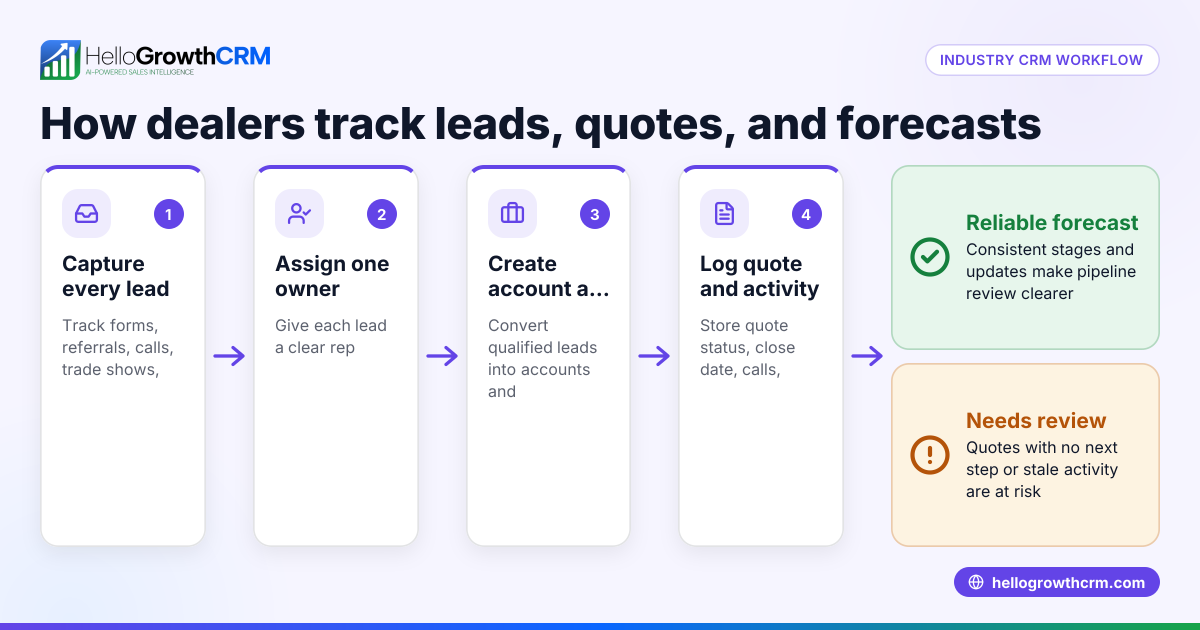
This is where sales forecasting becomes more useful. Forecasting gets better when the day-to-day sales process is cleaner.
Watch for leading indicators, not just pipeline totals
Manufacturing leaders should track indicators such as:
- RFQ-to-qualified conversion rate.
- Time to first response.
- Quote turnaround time.
- Quote acceptance rate.
- Stalled deals by stage.
- Rep follow-up SLA performance.
- Reactivation wins from old accounts.
Those metrics are often more actionable than total open pipeline alone.
How do you roll this out without disrupting the sales team?
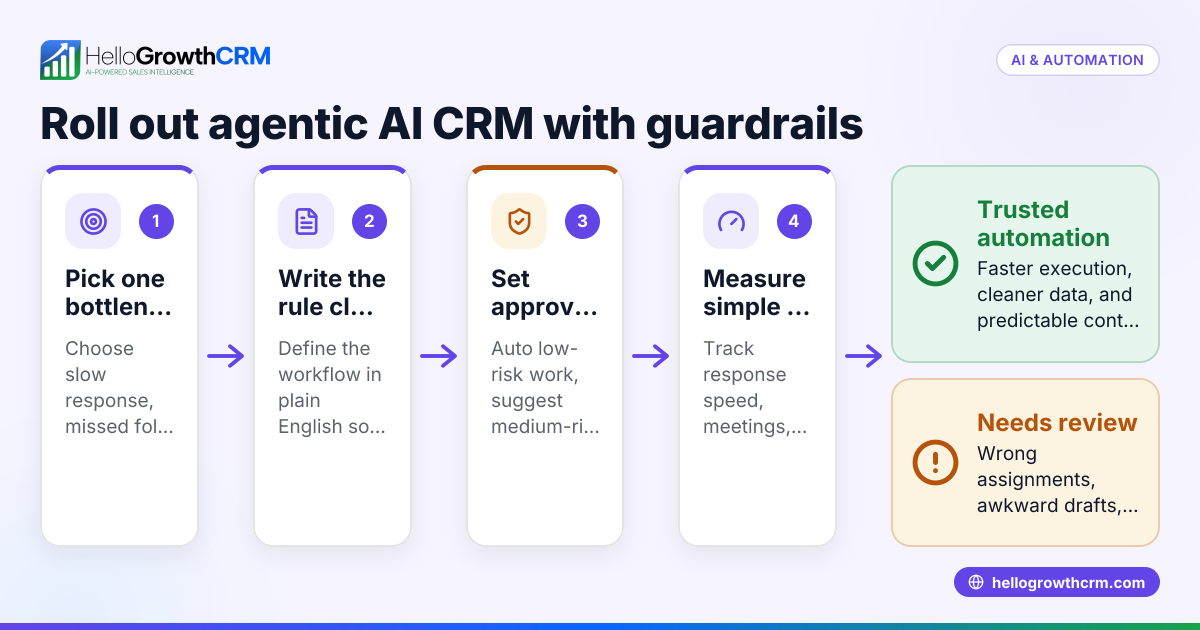
Start with one workflow, one team, and clear success metrics. Most manufacturers should begin with RFQ triage or follow-up queueing, then expand after reps trust the process.
A practical rollout plan
- Choose one use case
Start with RFQ triage, lead scoring, or rep queueing. Do not launch all three at once. - Map your current process
Document how leads arrive, who owns them, what fields matter, and where delays happen. - Define success
Pick a few metrics such as first-response time, qualified RFQ rate, or quote follow-up completion. - Clean the minimum required data
Fix duplicates, ownership gaps, and stage confusion. - Launch with a small group
Use one product line, one region, or one inside sales pod. - Review every week
Look at wrong routes, weak scores, and ignored tasks. Adjust rules quickly. - Expand carefully
Add more sources, territories, and automations only after the first workflow works.
Change management matters
Reps will use the system if it helps them close business. They will ignore it if it creates extra admin work. So keep the rollout focused on visible wins:
- Fewer missed RFQs.
- Less manual sorting.
- Better account context.
- Clear next actions.
- Faster responses.
That is also why many growing teams need both software and process help. A system with managed RevOps can be useful when leadership wants the workflow maintained, not just installed.
Choosing the right system for a US manufacturing sales team
The right CRM setup should support the way manufacturers actually sell. That means inbound capture, account history, routing logic, rep tasks, reporting, and easy adoption.
Look for:
Read next
This article covers one part of a bigger topic. For the complete picture, read our guide to ai crm agent.
Ready to put this into practice?
Set up your pipeline, WhatsApp follow-ups, and AI lead scoring in minutes — free, no credit card.
Try HelloGrowthCRM freeGet CRM tips in your inbox
Join thousands of sales professionals who get weekly insights on CRM strategy, AI automation, and pipeline optimization.

The HelloGrowthCRM team publishes guides on CRM strategy, AI sales tools, and revenue operations for small business sales teams.