HelloGrowthCRM software
Built for real small-business sales teams
HelloGrowthCRM helps reps qualify faster, follow up on time, and close more deals—with practical automation in one place.
- AI lead scoring and pipeline visibility
- Built-in dialer, WhatsApp, and email automation
- Sales forecasting and RevOps-ready reporting
B2B tech marketing involves targeting other businesses with technology products or services. Unlike consumer marketing, it requires a focus on building relationships, demonstrating value, and addressing complex buying processes. Small and mid-sized US businesses often face challenges in understanding how to market tech effectively to other companies. This guide covers why this topic is important, how to approach it step-by-step, a detailed example, common errors to avoid, and answers to typical questions.
Why this comes up / what goes wrong
Small business owners selling technology solutions often struggle with reaching the right business buyers. Tech products can be complex, and buyers usually research extensively before purchasing. Without a clear marketing approach, businesses may waste time on leads who aren't decision-makers or fail to explain their product benefits clearly. Many also rely on inconsistent follow-up methods like email, text, or spreadsheets, which can cause lost leads and missed opportunities. Understanding B2B tech marketing is crucial to organize efforts and increase sales.
Step-by-step
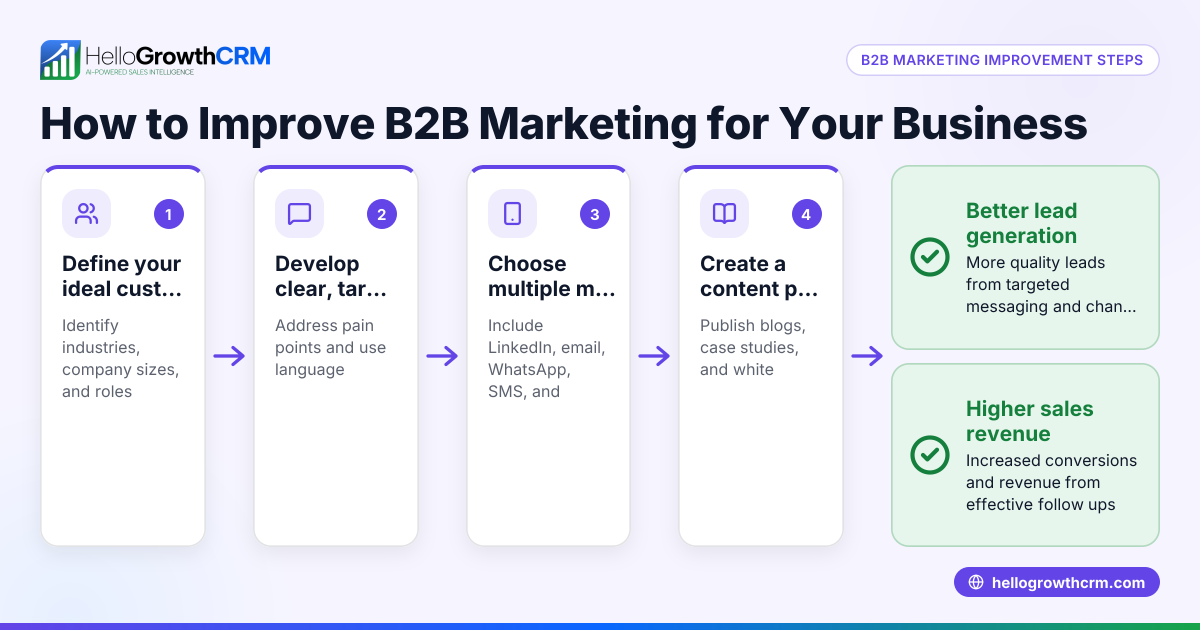
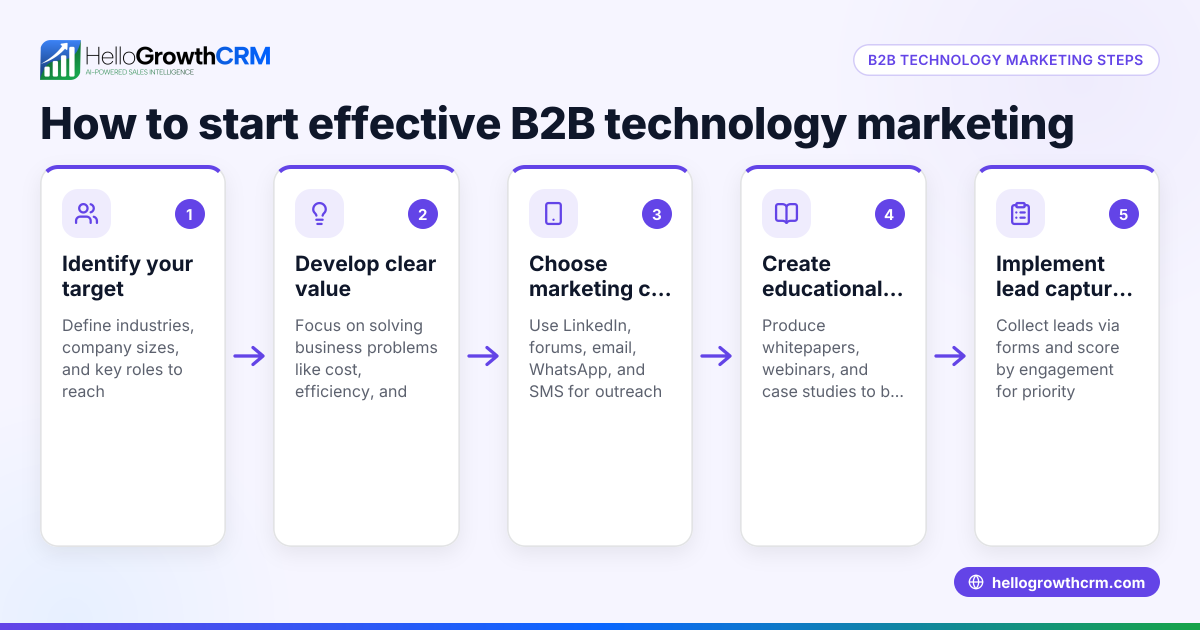
- Identify your target business customers and decision-makers. Check company size, industry, and roles like IT managers or procurement officers.
- Develop clear messaging that explains your technology’s benefits and solves specific business problems. Avoid jargon and focus on ROI.
- Choose marketing channels where your audience is active, such as LinkedIn, industry newsletters, or trade shows. Check engagement levels.
- Create content that educates and builds trust: whitepapers, case studies, webinars, and demos. Ensure content is relevant and easy to access.
- Capture leads using web forms integrated with your CRM to avoid losing contact information. Verify data accuracy.
- Follow up promptly and consistently via email, WhatsApp, SMS, or calls. Use a built-in CRM dialer to streamline calling efforts and track interactions.
- Score leads based on engagement and readiness to buy to prioritize sales efforts. Regularly review lead scores.
- Manage your sales pipeline visually with task boards to track progress and next steps. Keep the pipeline updated.
- Analyze sales forecasting and reporting to adjust your marketing tactics and improve ROI. Review reports monthly.
- Continuously refine your approach based on feedback and data to improve results. Conduct quarterly strategy reviews.
Example (fictional figures)
A Charlotte, North Carolina-based software company sells a cloud security solution to mid-sized businesses. They target IT directors in companies with 50-200 employees.
- They create a whitepaper explaining how their product reduces data breach risks.
- They promote it on LinkedIn and industry newsletters.
- Their web form captures 150 leads in Q1 2026.
- They follow up with emails and WhatsApp messages within 24 hours.
- Using lead scoring, they identify 40 high-potential leads.
- Their sales team uses a built-in CRM dialer to call these leads.
Calculations:
- Leads captured: 150
- High-potential leads: 40
- Conversion rate assumed: 25%
- Customers gained: 40 × 25% = 10
- Average contract value: $12,000
- Total revenue: 10 × $12,000 = $120,000
This example shows how targeted marketing and prompt follow-up can convert leads into customers and generate revenue.
Common mistakes
- Ignoring target audience specifics. Prevent by researching decision-makers and tailoring messages.
- Using generic or overly technical language. Prevent by focusing on clear benefits and ROI.
- Slow or inconsistent follow-up. Prevent by integrating lead capture with a CRM and using a built-in CRM dialer for timely calls.
- Not tracking leads or sales pipeline visually. Prevent by using task boards to organize and prioritize leads.
- Relying on too many disconnected tools like spreadsheets, email, and text. Prevent by centralizing communication in a WhatsApp and SMS CRM system.
Frequently asked questions
What is the difference between B2B and B2C tech marketing? B2B tech marketing targets other businesses and focuses on longer sales cycles, relationship-building, and ROI. B2C targets individual consumers and often emphasizes emotional appeal and quick purchases.
How do I generate quality leads in B2B tech marketing? Create educational content like whitepapers and webinars tailored to your target audience. Use targeted channels such as LinkedIn and industry newsletters to promote content and capture leads via web forms integrated with a CRM.
Why is follow-up important in B2B tech sales? Because decision-makers often evaluate multiple solutions over weeks or months, prompt and consistent follow-up keeps your product top of mind and builds trust.
How can I organize sales communications efficiently? Use a CRM that supports WhatsApp and SMS CRM messaging and a built-in CRM dialer to centralize and track all sales communications, improving team coordination.
What role does lead scoring play in B2B tech marketing? Lead scoring helps prioritize leads based on engagement and buying readiness, so sales teams focus efforts on the most promising prospects.
Key takeaways
- B2B tech marketing targets business buyers with tailored messaging and education.
- Identifying decision-makers and using targeted channels improves lead quality.
- Prompt follow-up via integrated CRM tools prevents lost leads.
- Visual pipeline management and lead scoring increase sales efficiency.
- Avoid scattered tools by centralizing communication in WhatsApp and SMS CRM with a built-in CRM dialer.
Start on the Free Forever plan (200 leads, no credit card) at HelloGrowthCRM for the United States to organize your B2B tech marketing efforts efficiently. Learn more about WhatsApp and SMS CRM and the built-in CRM dialer to streamline your sales process.
Visit Start on the Free Forever plan (200 leads, no credit card) to begin.
Ready to put this into practice?
Set up your pipeline, WhatsApp follow-ups, and AI lead scoring in minutes — free, no credit card.
Try HelloGrowthCRM freeGet CRM tips in your inbox
Join thousands of sales professionals who get weekly insights on CRM strategy, AI automation, and pipeline optimization.

The HelloGrowthCRM team publishes guides on CRM strategy, AI sales tools, and revenue operations for small business sales teams.