HelloGrowthCRM software
Built for real small-business sales teams
HelloGrowthCRM helps reps qualify faster, follow up on time, and close more deals—with practical automation in one place.
- AI lead scoring and pipeline visibility
- Built-in dialer, WhatsApp, and email automation
- Sales forecasting and RevOps-ready reporting
Bots for customer service are automated software tools designed to answer common customer questions and manage support tasks without needing a human agent for every interaction. They help small businesses respond faster, reduce repetitive work, and keep customer service organized.
Why this comes up / what goes wrong
Small-business owners often face slow or inconsistent customer support because their teams are small and handle multiple roles. Customers expect quick replies via chat, email, or messaging apps, but staff may be busy or unavailable. This delay can lead to lost sales, unhappy customers, and repeated questions that waste time. Managing service requests and follow-ups with spreadsheets or disconnected tools can become chaotic.
Bots for customer service come up as a solution to handle frequent questions automatically, provide 24/7 availability, and organize support tickets in one place. However, choosing and implementing bots requires care to avoid frustrating customers or creating extra work.
Step-by-step
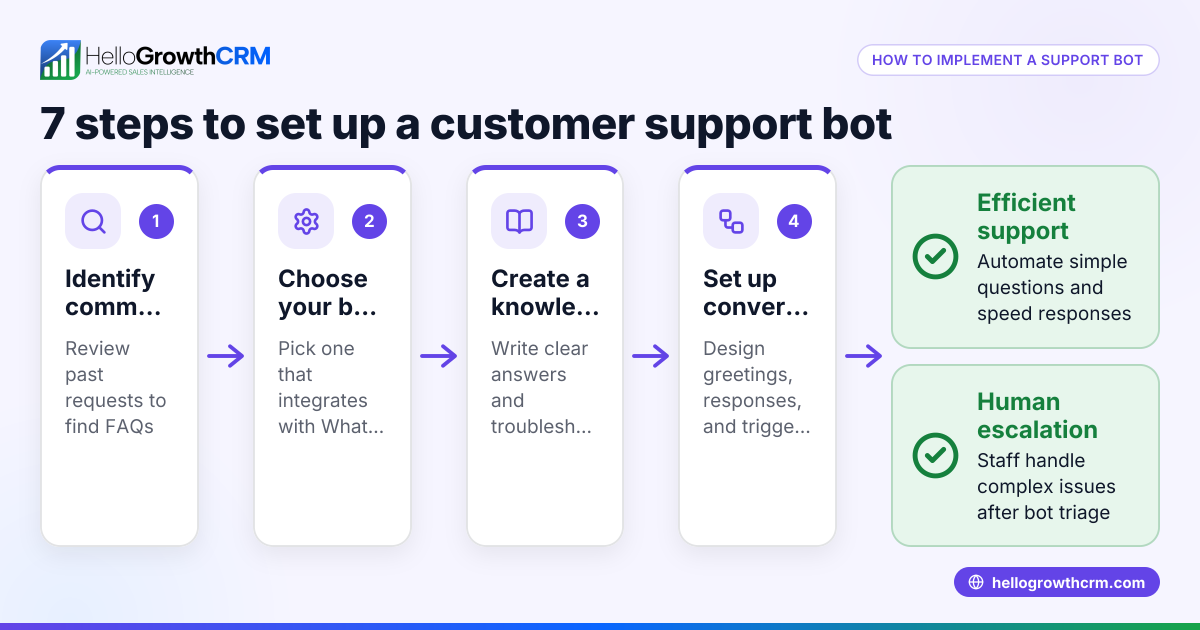
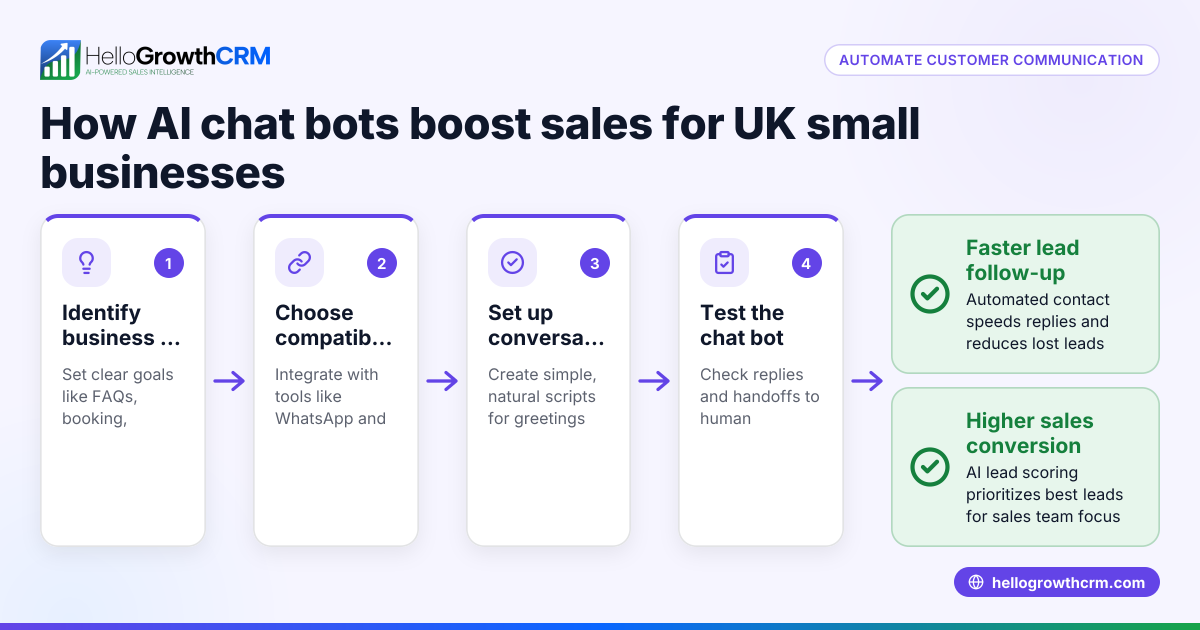
- Identify common customer questions and tasks to automate
- Review past support requests to find repetitive inquiries.
- Check if questions can be answered with fixed responses or simple workflows.
- Choose a bot platform that integrates with your existing tools
- Ensure the bot can connect with your CRM, email, or messaging apps.
- Verify it supports your preferred channels like WhatsApp or SMS.
- Design the bot conversation flow clearly
- Map out how customers will interact with the bot step-by-step.
- Include options to reach a human agent if the bot cannot resolve the issue.
- Test the bot internally and with a small group of customers
- Collect feedback on response accuracy and ease of use.
- Adjust the bot to fix misunderstandings or dead ends.
- Launch the bot and monitor its performance regularly
- Track how many requests the bot handles alone versus those escalated.
- Use customer feedback and analytics to improve the bot over time.
- Train your team on handling escalated tickets and maintaining the bot
- Make sure staff know when and how to intervene.
- Schedule regular reviews to update the bot’s knowledge base.
Check that your bot supports tracking service requests on the same customer record to avoid losing context. This helps maintain a complete history for each client, improving service quality. For example, HelloGrowthCRM’s customer portal and ticket system keep service requests linked to deals and customers, simplifying follow-up and issue resolution. Learn more about customer health score.
Example (fictional figures)
A residential real-estate team in Phoenix, Arizona, wants to reduce the time agents spend answering common questions about listings and appointments. They decide to implement a customer service bot integrated with their CRM.
- Monthly support requests: 500
- Estimated repetitive questions suitable for bot: 300
- Average agent time per question: 5 minutes
- Agent hourly cost: $30
Calculate time saved by bot handling 300 questions:
300 questions × 5 minutes = 1,500 minutes 1,500 minutes ÷ 60 = 25 hours saved
Calculate cost savings:
25 hours × $30 = $750 saved per month
By automating these questions, the team frees 25 hours monthly for agents to focus on complex sales tasks, improving overall productivity and customer satisfaction.
Common mistakes
- Deploying a bot without clear use cases
- Prevent by analyzing support data first to identify repetitive tasks.
- Making the bot too complex or rigid
- Prevent by keeping conversations simple and allowing easy transfer to humans.
- Ignoring customer feedback after launch
- Prevent by actively collecting and acting on user feedback to improve the bot.
- Failing to integrate the bot with CRM and ticket systems
- Prevent by choosing tools that keep service requests linked to customer records, like HelloGrowthCRM’s customer portal.
- Not training staff on bot management and escalation procedures
- Prevent by scheduling regular training and reviews.
- Assuming bots replace human agents completely
- Prevent by using bots to assist, not replace, your support team.
Doing this in HelloGrowthCRM
HelloGrowthCRM supports customer service automation with features like a branded customer portal, referral tracking, support tickets, and a knowledge base. After a sale, all service requests stay linked to the same customer record as the deal, helping your team keep context and follow up efficiently. If you don’t have a sales manager, HelloGrowthCRM’s Managed RevOps service assigns a revenue specialist who manages the follow-up queue weekly, ensuring no lead or service request falls through the cracks. For more details, see HelloGrowthCRM for the United States.
Frequently asked questions
What types of customer service tasks can bots handle? Bots handle repetitive tasks such as answering FAQs, providing order status, booking appointments, and collecting initial customer information. Complex issues usually require human agents.
How do bots improve customer satisfaction? Bots provide instant replies 24/7, reducing wait times and customer frustration. They ensure consistent answers and free human agents to focus on personalized service.
Can bots work with WhatsApp and SMS? Yes, many bots integrate with messaging platforms like WhatsApp and SMS, letting customers communicate through familiar channels. Managing these interactions alongside other sales and support tasks improves efficiency. Learn more about WhatsApp and SMS CRM.
How do I measure if a bot is effective? Track how many queries the bot handles without needing human help, customer satisfaction scores, and average resolution time. Regular reviews help optimize the bot.
Will bots replace my customer service team? Bots assist your team by handling routine inquiries and freeing up time. Human agents remain essential for complex, sensitive, or high-value interactions.
Key takeaways
- Bots automate repetitive customer service tasks, saving time and costs.
- Successful bots require clear goals, simple design, and integration with CRM systems.
- Testing, feedback, and staff training are essential to avoid common mistakes.
- HelloGrowthCRM links service requests to customer records and offers Managed RevOps for follow-up support.
- Bots work best as assistants, not replacements, for human agents.
Start using bots to improve your customer service efficiency and satisfaction. To try HelloGrowthCRM’s features including customer portals and Managed RevOps, start on the Free Forever plan (200 leads, no credit card).
Ready to put this into practice?
Set up your pipeline, WhatsApp follow-ups, and AI lead scoring in minutes — free, no credit card.
Try HelloGrowthCRM freeGet CRM tips in your inbox
Join thousands of sales professionals who get weekly insights on CRM strategy, AI automation, and pipeline optimization.

The HelloGrowthCRM team publishes guides on CRM strategy, AI sales tools, and revenue operations for small business sales teams.