HelloGrowthCRM software
Built for real small-business sales teams
HelloGrowthCRM helps reps qualify faster, follow up on time, and close more deals—with practical automation in one place.
- AI lead scoring and pipeline visibility
- Built-in dialer, WhatsApp, and email automation
- Sales forecasting and RevOps-ready reporting
Building a product CRM means creating or choosing a system that manages your leads, customer interactions, and sales pipeline effectively. For Indian small businesses, this involves capturing leads from multiple sources, tracking conversations, and automating follow-ups to prevent lost sales. This article covers why businesses consider building their own CRM, the steps to do it right, common pitfalls, and how HelloGrowthCRM supports your sales process.
Why this comes up / what goes wrong
Many small and mid-sized Indian businesses start sales on WhatsApp, Excel sheets, or manual lists. As leads grow, these methods become slow and error-prone. Leads get lost or followed up late, reducing sales. Business owners think about building a product CRM to centralize lead data, track sales stages, and automate reminders. However, they face challenges like unclear requirements, technical complexity, and ensuring the CRM is actually used by the sales team.
Step-by-step
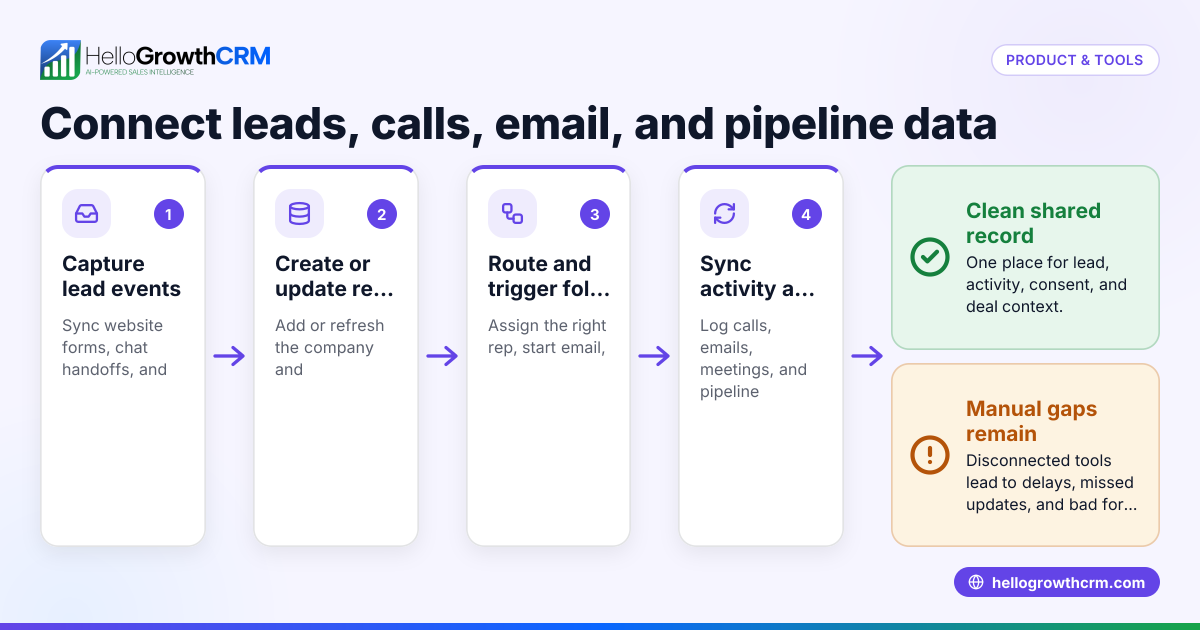
- Define your sales process clearly: Map out how leads come in, how they move through stages, and what follow-ups happen. Check if you have different lead sources like IndiaMART, JustDial, or web forms.
- List essential features: Decide on must-haves like lead capture, conversation logging (especially WhatsApp), task reminders, pipeline view, and reporting.
- Choose between building or buying: Building your own CRM requires software development skills and ongoing maintenance. Buying or customizing a CRM can be faster and more reliable.
- Plan for mobile and WhatsApp integration: Since many Indian sales teams use WhatsApp heavily, ensure the CRM supports WhatsApp conversations and follow-ups.
- Include automation for follow-ups: Automate reminders or message drafts after calls to reduce manual work and speed up response times.
- Test with your team: Run a pilot with a small group to get feedback on usability and features.
- Train your sales team and set usage rules: Make sure everyone knows how to update leads and use the CRM daily.
- Measure and improve: Use sales reports and forecasting to find bottlenecks and improve your CRM setup.
Example (fictional figures)
An Indian manufacturing business started building a CRM on 01/04/2024 to manage leads from IndiaMART and WhatsApp.
- They expected 500 leads monthly, each worth ₹1,20,000 on average.
- The cost to develop basic CRM features was ₹3,00,000 upfront.
- Monthly maintenance and hosting cost was ₹15,000.
Calculations:
Monthly lead value = 500 × ₹1,20,000 = ₹6,00,00,000
If the CRM improves conversion by 1%, additional revenue = ₹6,00,00,000 × 1% = ₹6,00,000
Payback period = ₹3,00,000 ÷ ₹6,00,000 = 0.5 months
This example shows how even small improvements in sales conversion can justify CRM investment quickly.
Common mistakes
- Ignoring user adoption: Building a CRM that sales reps find hard or time-consuming leads to poor usage. Prevent by involving users in design and training.
- Skipping mobile and WhatsApp integration: Without WhatsApp support, reps must switch apps, causing missed messages. Choose a CRM with WhatsApp and SMS features like HelloGrowthCRM (/product/whatsapp-sms-crm).
- Overcomplicating features: Adding too many custom features delays launch and confuses users. Start simple and add features based on feedback.
- No automation for follow-ups: Manual follow-ups cause delays and lost leads. Use AI agents or reminders to automate next steps (/product/ai-crm).
- Not testing before full rollout: Launching without pilot testing can hide usability issues. Test with a small team first.
Doing this in HelloGrowthCRM
HelloGrowthCRM offers a WhatsApp-native CRM that logs WhatsApp conversations on lead records and enables follow-ups as WhatsApp or SMS messages, helping sales teams stay on top of leads. After calls, AI agents draft follow-up messages for reps to review and send, speeding up communication. Small teams of two can start free on the Free Forever plan to run their pipeline without cost until they need calling or WhatsApp automation (/free-crm).
Frequently asked questions
What is the difference between building and buying a CRM? Building a CRM means developing custom software tailored to your needs, which requires technical resources and ongoing maintenance. Buying or subscribing to an existing CRM is faster and often includes support and updates but may have some limitations in customization.
Can I integrate WhatsApp with my CRM? Yes, WhatsApp integration is crucial for Indian SMBs since many sales conversations happen there. Look for CRM solutions that log WhatsApp chats and allow sending follow-ups directly, such as HelloGrowthCRM (/product/whatsapp-sms-crm).
How does automation help in a product CRM? Automation reduces manual work by sending reminders, drafting follow-up messages, or updating lead statuses. This speeds up response times and ensures no lead is forgotten. AI agents in HelloGrowthCRM can draft follow-ups after calls to save time (/product/ai-crm).
Is it expensive to build a CRM? Building a CRM requires upfront investment in development and ongoing maintenance. Costs vary widely depending on features and complexity. Sometimes starting with a free or low-cost CRM plan is more practical to test your process (/free-crm).
How do I ensure my sales team uses the CRM? Involve your sales team in choosing or building the CRM, provide training, and make the CRM easy to use with mobile and WhatsApp integration. Set clear usage expectations and monitor adoption regularly.
Key takeaways
- Building a product CRM requires clear sales process mapping and essential features like lead capture and follow-up automation.
- WhatsApp integration is critical for Indian SMBs to keep sales conversations in one place.
- Automating follow-ups with AI agents reduces manual work and speeds up sales cycles.
- Testing with a small team and focusing on user adoption prevents common CRM failures.
- HelloGrowthCRM supports WhatsApp and SMS messaging, AI-drafted follow-ups, and offers a Free Forever plan for small teams.
Start your CRM journey today with HelloGrowthCRM’s Free Forever plan, which supports up to 200 leads without a credit card at Start on the Free Forever plan (200 leads, no credit card).
Ready to put this into practice?
Set up your pipeline, WhatsApp follow-ups, and AI lead scoring in minutes — free, no credit card.
Try HelloGrowthCRM freeGet CRM tips in your inbox
Join thousands of sales professionals who get weekly insights on CRM strategy, AI automation, and pipeline optimization.

The HelloGrowthCRM team publishes guides on CRM strategy, AI sales tools, and revenue operations for small business sales teams.