HelloGrowthCRM software
Built for real small-business sales teams
HelloGrowthCRM helps reps qualify faster, follow up on time, and close more deals—with practical automation in one place.
- AI lead scoring and pipeline visibility
- Built-in dialer, WhatsApp, and email automation
- Sales forecasting and RevOps-ready reporting
A business email campaign is a planned series of emails sent to a targeted group of prospects or customers to promote products, services, or information. It aims to nurture leads, drive sales, or build customer relationships. This article explains why business owners use email campaigns, how to create one step-by-step, common pitfalls to avoid, and how HelloGrowthCRM can simplify managing your campaigns.
Why this comes up / what goes wrong
Small business owners often face challenges turning leads into customers because they lack a structured way to follow up. Many rely on manual email sends, spreadsheets, or text messages, which can lead to slow or inconsistent outreach. Without a clear plan, emails may be sent too infrequently or too often, missing the right timing to engage prospects. This results in lost sales opportunities and wasted effort.
Business email campaigns help by automating and organizing follow-up messages, ensuring prospects receive timely, relevant communication without extra manual work. Understanding what a business email campaign is and how to run one helps business owners improve lead conversion and customer retention.
Step-by-step
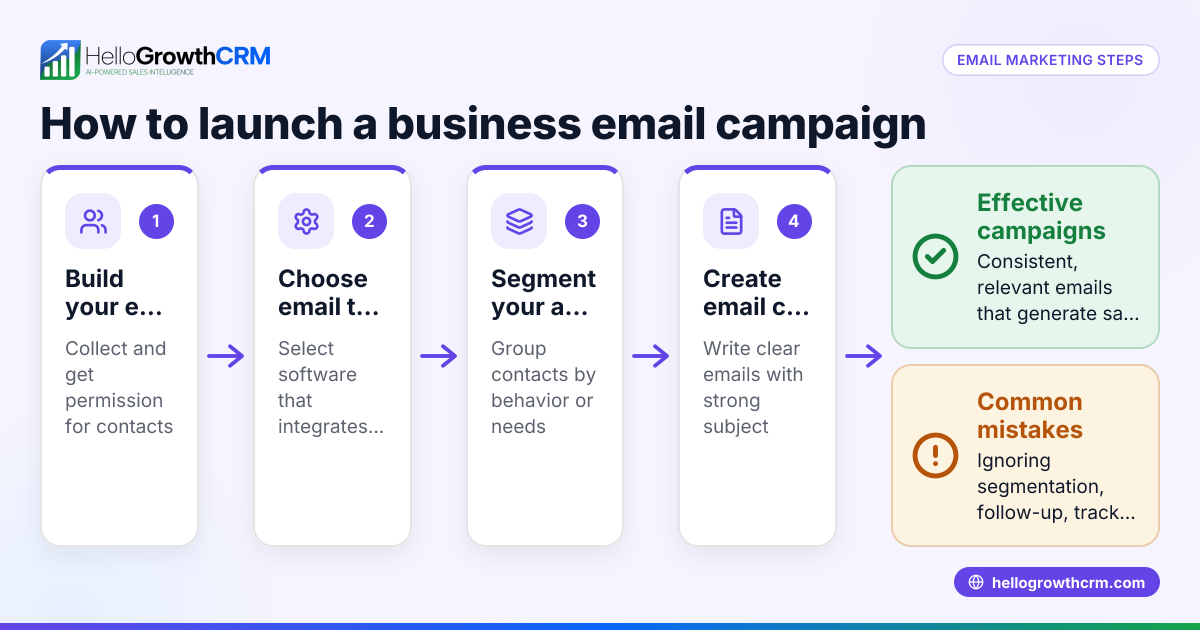
- Define your goal: Decide what you want to achieve—new sales, repeat business, event attendance, or brand awareness. This goal guides your messaging and call to action.
- Identify your audience: Segment your contacts based on criteria like past purchases, location, or engagement level. Targeting the right group improves response rates.
- Plan your email sequence: Outline the number of emails, timing, and content. A common approach is a multi-step follow-up over two weeks. Each email should build on the previous one and include a clear call to action.
- Write your emails: Craft concise, relevant, and personalized messages. Use subject lines that grab attention and body text that addresses the recipient’s needs.
- Set up automation: Use an email tool to schedule your sequence. Automation ensures emails are sent on time and stops the sequence if the prospect replies.
- Test and review: Before launching, test your emails for errors, check links, and preview on different devices.
- Launch and monitor: Send your campaign and track open rates, clicks, and replies. Use this data to refine future campaigns.
- Follow up promptly: Respond quickly to replies or inquiries generated by the campaign to maintain engagement.
For more on automating your outreach, see email automation and sequences. Also, consider integrating your outreach with WhatsApp and SMS CRM for multi-channel engagement.
Example (fictional figures)
A plumbing company in Austin, Texas, plans a business email campaign to promote a new water heater installation service.
- Goal: Generate 10 new water heater installation jobs in 30 days.
- Audience: 500 past customers who had plumbing work done in the last two years.
- Email sequence: 5 emails over 14 days.
Estimated conversion rate: 2% (10 jobs from 500 contacts).
Assumed average job revenue: $1,200.
Calculations:
500 contacts × 2% conversion = 10 jobs
10 jobs × $1,200 revenue = $12,000 total revenue
Cost to run campaign (email tool subscription, content creation): $300
Net revenue = $12,000 - $300 = $11,700
This campaign could bring $11,700 in net revenue if executed well.
Common mistakes
- Sending too many emails too quickly: This can annoy recipients and increase unsubscribes. Prevent by spacing emails over days or weeks.
- Lack of personalization: Generic emails feel like spam. Use the recipient’s name and tailor content to their interests.
- Ignoring replies: Not responding promptly to replies loses engagement. Set up alerts or shared inboxes to manage responses.
- No clear call to action: Without clear instructions, recipients don’t know what to do next. Always include a specific, easy-to-follow call to action.
- Not testing emails before sending: Broken links or formatting issues reduce credibility. Always test on multiple devices.
- Failing to segment your list: Sending the same email to everyone wastes opportunities. Segment your audience for better targeting.
Learn more about avoiding mistakes and improving follow-up in email automation and sequences.
Doing this in HelloGrowthCRM
HelloGrowthCRM offers Sequences and campaigns that automate your email outreach. You can set a five-step follow-up over two weeks that stops automatically when a prospect replies, saving you time and ensuring timely follow-up. Additionally, the HelloMail shared inbox lets your team see replies to quotation emails in one place, so no lead gets missed or duplicated. These features help small businesses run business email campaigns without juggling multiple tools. Learn more at email automation and sequences.
Frequently asked questions
What is the difference between a business email campaign and a newsletter? A business email campaign is a targeted, goal-driven series of emails designed to prompt action, like making a purchase. A newsletter is usually a regular update sent to a broad audience to share news or content without a direct sales focus.
How often should I send emails in a campaign? A typical campaign spreads several emails over a few weeks. Spacing helps avoid overwhelming recipients while keeping your message top of mind. Adjust frequency based on audience response.
Can I use the same email content for all prospects? It’s better to personalize emails based on segments or individual data. Personalized emails get higher engagement and conversion rates.
How do I know if my email campaign is successful? Track metrics like open rates, click-through rates, replies, and conversions. Success depends on meeting your specific campaign goal, whether that’s sales, leads, or event sign-ups.
What if a prospect replies during the campaign? Stop automated emails to that prospect and respond personally. HelloGrowthCRM’s sequences feature automates this stop-and-respond process to avoid over-emailing.
Is it better to combine email with other channels? Yes, combining email with SMS or WhatsApp outreach can increase engagement. HelloGrowthCRM supports multi-channel sequences for this purpose. See WhatsApp and SMS CRM.
Key takeaways
- A business email campaign is a planned series of targeted emails to nurture leads or customers.
- Define your goal, segment your audience, and plan a multi-step sequence with clear calls to action.
- Automate follow-up and stop sequences when prospects reply to avoid over-contacting.
- Avoid common mistakes like lack of personalization, ignoring replies, and poor timing.
- HelloGrowthCRM sequences and HelloMail shared inbox simplify managing email campaigns for small businesses.
Start your business email campaign today with HelloGrowthCRM. Start on the Free Forever plan (200 leads, no credit card).
Ready to put this into practice?
Set up your pipeline, WhatsApp follow-ups, and AI lead scoring in minutes — free, no credit card.
Try HelloGrowthCRM freeGet CRM tips in your inbox
Join thousands of sales professionals who get weekly insights on CRM strategy, AI automation, and pipeline optimization.

The HelloGrowthCRM team publishes guides on CRM strategy, AI sales tools, and revenue operations for small business sales teams.