HelloGrowthCRM software
Built for real small-business sales teams
HelloGrowthCRM helps reps qualify faster, follow up on time, and close more deals—with practical automation in one place.
- AI lead scoring and pipeline visibility
- Built-in dialer, WhatsApp, and email automation
- Sales forecasting and RevOps-ready reporting
A business process is a series of organised steps your business follows to complete a task or deliver a product or service reliably and efficiently. It ensures everyone on your team knows what to do, when, and how, helping avoid confusion and delays. For small businesses in New Zealand, having clear business processes can improve efficiency, customer satisfaction, and the ability to grow.
Why this comes up / what goes wrong
Many small business owners in New Zealand start without formal business processes. They rely on informal methods like texting, emails, or spreadsheets to manage sales and operations. This can lead to lost leads, inconsistent customer experiences, and wasted time. Without a clear process, your team might duplicate work or miss important steps, which slows growth and frustrates customers.
For example, a small retail business might receive enquiries via text message, email, and phone calls, but without a standard way to track and respond to each lead, some potential customers get missed or answered late. This inconsistency can damage your reputation and reduce sales.
Having a business process helps organise these activities into a clear system so your team can follow the same steps every time. This reduces errors, improves customer service, and makes it easier to train new staff.
Step-by-step
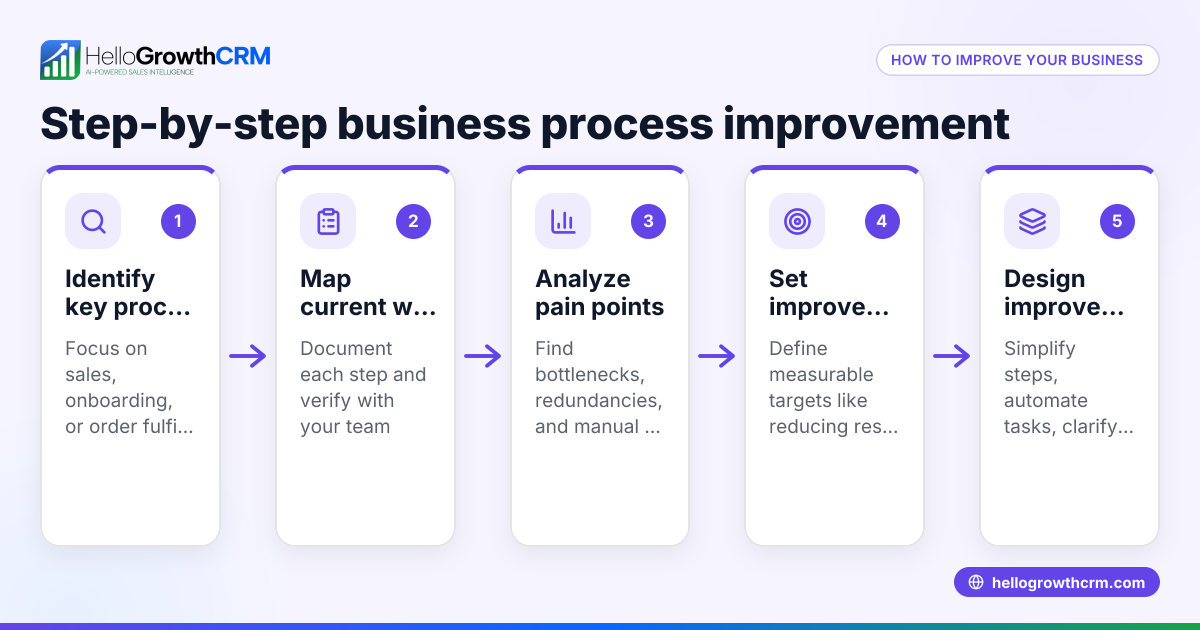
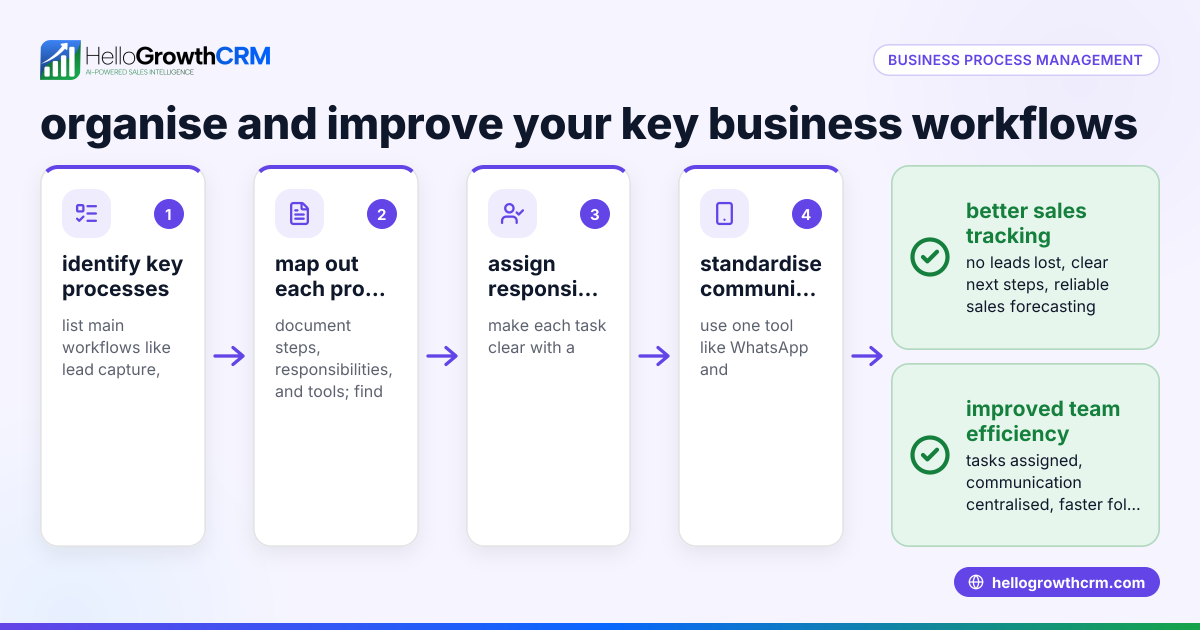
- Identify the key task or outcome Decide what specific business activity you want to standardise, such as handling new sales leads, processing orders, or delivering services.
- List all the steps involved Write down every action needed from start to finish. Include who does each step, what tools or information they need, and any deadlines.
- Check for gaps or bottlenecks Review the steps to find any missing information, delays, or unnecessary actions that slow down the process.
- Assign responsibilities clearly Make sure each step has a designated person or role responsible for completing it. Clarify who is accountable to avoid confusion.
- Document the process clearly Use simple language and visuals like flowcharts or checklists to make the process easy to understand and follow.
- Test the process with your team Run through the process in real situations, gather feedback, and adjust as needed to fix any issues.
- Train your team and update regularly Ensure everyone knows the process and review it periodically to improve efficiency and adapt to changes.
- Use tools to support the process Consider software that helps manage tasks and communication, such as a CRM that supports WhatsApp and SMS sequences, to keep your sales and customer follow-up organised. See WhatsApp and SMS CRM for options.
Example (fictional figures)
A dairy-equipment supplier in Hamilton wants a clear process for following up on web leads to improve sales.
- Step 1: Lead submits inquiry via website form.
- Step 2: Salesperson receives lead details immediately.
- Step 3: Salesperson calls lead within 24 hours.
- Step 4: If no answer, send WhatsApp message.
- Step 5: Schedule a follow-up task for 3 days later if no response.
Costs and timings:
- Lead capture software subscription: NZ$100/month
- Salesperson hourly wage: NZ$30/hour
- Average follow-up time per lead: 30 minutes = 0.5 hours
Monthly cost per 50 leads:
Lead follow-up time cost = 50 leads × 0.5 hours × NZ$30/hour = NZ$750
Adding software cost:
Total monthly cost = NZ$750 + NZ$100 = NZ$850
This clear process helps the supplier respond quickly and consistently, increasing chances of converting leads into sales and avoiding lost opportunities.
Common mistakes
- Skipping documentation: Without written steps, team members forget or do tasks differently. Prevent this by documenting the process clearly and making it easily accessible.
- Assigning unclear responsibilities: If no one owns a step, it gets missed. Assign each step to a person or role and confirm they understand their duties.
- Overcomplicating steps: Complex processes confuse staff and slow work. Keep steps simple, practical, and focused on outcomes.
- Ignoring feedback: Not updating the process after testing leads to repeated errors. Regularly gather team input and improve the process.
- Relying on informal communication: Using only texts or emails without a system can lose track of leads or tasks. Use a CRM with built-in tools like a dialer to manage communications efficiently, as explained in built-in CRM dialer.
- Not reviewing processes: Without periodic review, processes become outdated. Schedule reviews at least twice a year to keep them relevant and effective.
Frequently asked questions
What is the difference between a business process and a procedure? A business process is the overall flow of activities to complete a business goal. A procedure is a detailed way to perform an individual step within that process.
How do I know if my business needs formal processes? If you notice inconsistent results, lost leads, or confusion among your team, it's time to create clear processes.
Can small businesses benefit from CRM tools for processes? Yes. CRM tools that integrate WhatsApp, SMS, and calls can automate follow-ups and task management, helping your team stay organised. Learn more about HelloGrowthCRM for New Zealand.
How often should I update my business processes? Review your processes at least twice a year or whenever you spot inefficiencies or changes in your business.
What if my team resists following new processes? Involve them in creating the process, provide training, and explain how it makes their work easier and improves customer service.
How can technology improve my business processes? Using tools like CRMs with WhatsApp and SMS integration helps automate communication and task tracking. This reduces manual work and keeps your team aligned. Check out WhatsApp and SMS CRM for more.
Key takeaways
- A business process is a clear, step-by-step way to complete tasks consistently.
- Formalising processes helps small businesses avoid lost leads and slow follow-up.
- Document and assign responsibilities clearly to prevent confusion.
- Use tools like CRM systems with WhatsApp and SMS integration to support your process.
- Regularly test and update your processes based on team feedback.
- Review processes at least twice a year to keep them effective.
Start organising your business with clear processes today. To help manage leads and communications, consider starting on the Free Forever plan (200 leads, no credit card) at HelloGrowthCRM.
Ready to put this into practice?
Set up your pipeline, WhatsApp follow-ups, and AI lead scoring in minutes — free, no credit card.
Try HelloGrowthCRM freeGet CRM tips in your inbox
Join thousands of sales professionals who get weekly insights on CRM strategy, AI automation, and pipeline optimization.

The HelloGrowthCRM team publishes guides on CRM strategy, AI sales tools, and revenue operations for small business sales teams.