HelloGrowthCRM software
Built for real small-business sales teams
HelloGrowthCRM helps reps qualify faster, follow up on time, and close more deals—with practical automation in one place.
- AI lead scoring and pipeline visibility
- Built-in dialer, WhatsApp, and email automation
- Sales forecasting and RevOps-ready reporting
Contact management systems and spreadsheets are common tools for tracking customer and lead information. For US small businesses deciding between them, understanding their strengths and limitations is key. This article compares both options on important criteria and offers guidance on which fits your business needs.
Why this comes up / what goes wrong
Many small business owners start with spreadsheets because they are familiar and free. Spreadsheets are easy to set up for basic contact lists and simple sales tracking. However, as leads grow and sales processes become more complex, spreadsheets can cause slow follow-up, lost leads, and disorganized data. Without automation, manual entry errors and lack of collaboration slow down sales teams. This leads to missed opportunities, frustrated customers, and lost revenue. Owners often realize their spreadsheets are no longer enough when they struggle to keep track of who to contact next or when.
Step-by-step
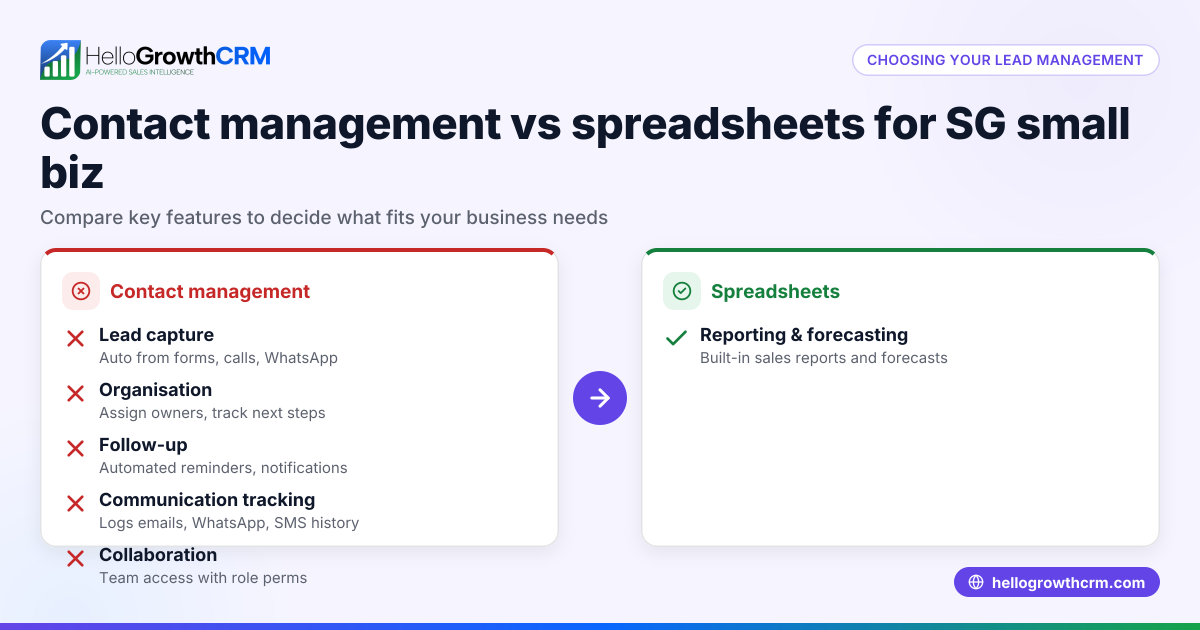
Here is a detailed comparison table of contact management systems versus spreadsheets on key criteria for US small businesses:
| Criteria | Contact Management System | Spreadsheets |
|---|---|---|
| Ease of Use | Designed for sales workflows; some learning curve | Familiar interface; simple for basic lists |
| Collaboration | Real-time updates, shared access, role-based permissions | Manual sharing; version conflicts common |
| Automation | Automated lead capture, task reminders, follow-up sequences | Manual data entry and reminders |
| Data Security | Centralized, access controls, backups | Risk of accidental deletion or exposure |
| Scalability | Handles growing leads and pipelines | Becomes unwieldy as data grows |
| Lead Qualification | AI lead scoring and prioritization | Manual sorting and filtering |
| Reporting & Forecasting | Built-in sales reports and forecasts | Requires manual report creation |
Who should pick which?
- Use spreadsheets if you have very few contacts, simple tracking needs, and a very small team.
- Choose a contact management system if you want to automate follow-ups, collaborate easily, improve lead qualification, and scale your sales process.
For more detailed CRM comparisons, see compare CRMs.
Example (fictional figures)
A B2B software reseller in Denver, Colorado, tracks 1,000 leads yearly.
With spreadsheets:
- Time spent entering and updating contacts: 5 minutes per lead × 1,000 leads = 5,000 minutes = 83.3 hours
- At $25/hour for sales staff, cost = 83.3 × $25 = $2,083
- Missed follow-ups estimated at 10% leads = 100 lost sales
- Average sale value = $1,000
- Lost revenue = 100 × $1,000 = $100,000
With contact management:
- Time spent per lead reduced to 2 minutes due to automation = 2 × 1,000 = 2,000 minutes = 33.3 hours
- Staff cost = 33.3 × $25 = $833
- Missed follow-ups reduced to 2% = 20 lost sales
- Lost revenue = 20 × $1,000 = $20,000
Savings in time cost = $2,083 - $833 = $1,250 Additional recovered revenue = $100,000 - $20,000 = $80,000
Total benefit = $1,250 + $80,000 = $81,250
This example shows how contact management systems can save time and recover revenue by improving follow-up and reducing manual work.
Common mistakes
- Continuing with spreadsheets as business grows: Leads to lost sales and inefficiency. Prevent by evaluating CRM options early to handle more leads and tasks.
- Not training staff on contact management tools: Causes underuse and frustration. Prevent by providing proper onboarding and ongoing support.
- Overcomplicating spreadsheets with too many formulas and tabs: Increases errors and confusion. Prevent by simplifying or switching to a CRM designed for sales.
- Ignoring data security in spreadsheets: Risk of data loss or leaks due to lack of access controls. Prevent by using secure CRM with centralized access and backups.
- Failing to automate follow-up tasks: Leads to slow responses and missed opportunities. Prevent by using CRM automation features for reminders and sequences.
For tips on CRM with WhatsApp and SMS integration, see WhatsApp and SMS CRM.
Doing this in HelloGrowthCRM
Every enquiry from a form, call, or WhatsApp lands as a lead with an owner and a next step, instead of in a notebook. This keeps new inquiries organized and moving toward conversion. HelloGrowthCRM is designed to capture leads and help small and mid-sized US businesses follow up faster and more reliably. Learn more about HelloGrowthCRM for the United States here.
Frequently asked questions
What is the main advantage of contact management over spreadsheets? Contact management automates lead capture, follow-up, and collaboration, reducing manual work and errors common in spreadsheets. It also provides better data security and sales reporting.
Can small businesses start with spreadsheets and switch later? Yes, but switching early prevents data chaos and lost leads. Planning a switch before growth accelerates sales and improves team efficiency.
Are contact management systems expensive? Many offer free tiers and scalable plans. Consider the time saved and revenue gained versus cost to find the best fit.
Do contact management systems integrate with communication tools? Yes, many integrate with email, WhatsApp, and SMS to streamline outreach and automate sequences.
Is data secure in contact management systems? Reputable systems have access controls and backups, reducing risk compared to spreadsheets that lack centralized security.
Key takeaways
- Spreadsheets suit very simple, low-volume contact lists with minimal collaboration.
- Contact management systems automate and scale lead tracking, follow-up, and reporting.
- Automation and collaboration reduce lost leads, sales delays, and manual errors.
- Data security and access controls are stronger in contact management systems.
- Early adoption of CRM helps small businesses grow sales efficiently and avoid data chaos.
Start organizing your leads better today. Start on the Free Forever plan (200 leads, no credit card) with HelloGrowthCRM and see how easy lead capture and follow-up can be.
Ready to put this into practice?
Set up your pipeline, WhatsApp follow-ups, and AI lead scoring in minutes — free, no credit card.
Try HelloGrowthCRM freeGet CRM tips in your inbox
Join thousands of sales professionals who get weekly insights on CRM strategy, AI automation, and pipeline optimization.

The HelloGrowthCRM team publishes guides on CRM strategy, AI sales tools, and revenue operations for small business sales teams.