HelloGrowthCRM software
Built for real small-business sales teams
HelloGrowthCRM helps reps qualify faster, follow up on time, and close more deals—with practical automation in one place.
- AI lead scoring and pipeline visibility
- Built-in dialer, WhatsApp, and email automation
- Sales forecasting and RevOps-ready reporting
CRM manufacture means choosing or creating a Customer Relationship Management system that fits your manufacturing business's sales and customer management processes. For small and mid-sized Canadian manufacturers, this involves software that can capture leads, manage sales pipelines, and automate follow-ups effectively to avoid losing potential customers.
Why this comes up / what goes wrong
Many small manufacturers in Canada rely on manual methods like spreadsheets, email, and text messages to track leads and sales. This often leads to slow follow-up, missed opportunities, and disorganised pipelines. As your business grows, these manual systems become inefficient and error-prone. You start searching for CRM manufacture options to find software that can centralize your customer data, automate repetitive tasks, and improve sales team coordination.
The challenge is that manufacturing businesses have specific needs: managing complex product lines, multiple sales stages, and sometimes technical customer interactions. Off-the-shelf CRMs may be too generic or too complex, while custom-built solutions can be costly and slow to deploy. Understanding your exact requirements and the trade-offs between features, usability, and cost is key.
Step-by-step
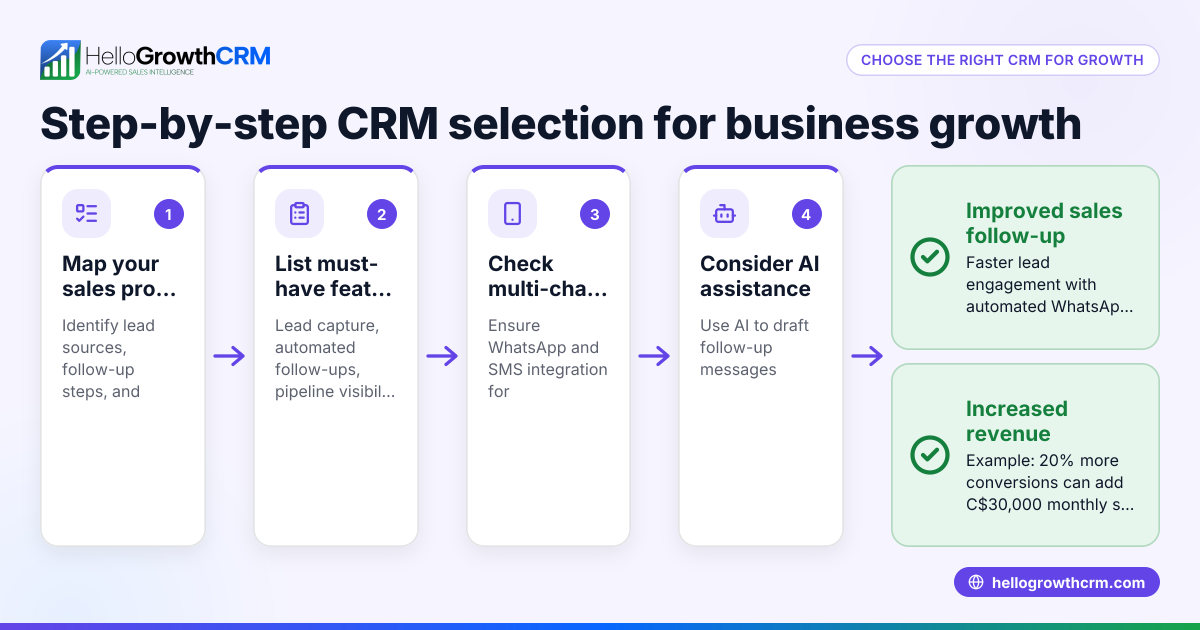
- Identify your sales process and pain points
- Map out how leads come in, how they are followed up, and how deals close.
- Note bottlenecks like slow responses or lost leads.
- List must-have CRM features for your manufacturing business
- Lead capture from website forms or integrations.
- Pipeline and task boards to track sales stages.
- Communication channels like email, SMS, or WhatsApp.
- Automation such as follow-up reminders or message sequences.
- Research CRM options focusing on manufacturing suitability
- Look for CRMs that support multi-channel communication and pipeline visibility.
- Check if the CRM can integrate with your existing tools.
- Evaluate ease of use and team adoption potential
- A CRM is only effective if your sales team uses it regularly.
- Request demos or trials to test user experience.
- Consider cost vs. benefits
- Account for setup, subscription fees, and support.
- Balance feature richness with budget constraints.
- Check for support and scalability
- Ensure the CRM can grow with your business.
- Look for available customer support and training resources.
- Make a shortlist and ask vendors detailed questions
- How does the CRM handle manufacturing-specific sales stages?
- Can it automate follow-ups on WhatsApp or SMS?
- What reporting and forecasting features are included?
Example (fictional figures)
A home-renovation contractor in Calgary, Alberta, wants a CRM to manage leads from web forms and follow up quickly via WhatsApp and SMS. They estimate 200 new leads per year and want to improve conversion from 10% to 15% by speeding follow-up.
- Current annual revenue from leads: C$500,000
- Average sale per customer: C$5,000
- Current conversion: 10% = 20 customers
- Target conversion: 15% = 30 customers
Additional customers: 30 - 20 = 10 Additional revenue: 10 × C$5,000 = C$50,000
If a CRM costing C$1,200/year helps achieve this, the return is:
C$50,000 - C$1,200 = C$48,800 net gain
This shows investing in CRM manufacture tailored to their sales process can pay off.
Common mistakes
- Choosing CRM based on features alone: Focus also on usability and team adoption to avoid underutilization.
- Overlooking automation capabilities: Manual follow-ups cause delays. Use AI agents that draft follow-ups for reps to review (/product/ai-crm).
- Underestimating setup and training time: Allocate resources for onboarding to ensure smooth adoption.
- Not planning for growth: Choose a CRM that can scale with your business size and sales complexity.
- Ignoring communication channels important for your sales: Pick a CRM that supports channels like WhatsApp and SMS to keep follow-ups efficient (/product/whatsapp-sms-crm).
Doing this in HelloGrowthCRM
HelloGrowthCRM offers a WhatsApp-native CRM that logs WhatsApp conversations on lead records and enables follow-ups via WhatsApp and SMS messages. Its AI agents can draft follow-up messages after calls, so sales reps only need to review and send, saving time. For small teams, the Free Forever plan supports up to two users managing pipelines at no cost, ideal for manufacturers starting to digitize their sales process. Learn more about HelloGrowthCRM for Canada (/canada).
Frequently asked questions
What does CRM manufacture mean? CRM manufacture refers to selecting or customizing CRM software specifically suited to your business's sales and customer management needs, rather than using generic software.
How do I know if a CRM fits my manufacturing business? Look for features that match your sales process, including lead capture, pipeline tracking, and communication channels like WhatsApp or SMS. Ease of use and automation are also important.
Can I try a CRM before buying? Many CRM providers offer free trials or free plans. For example, HelloGrowthCRM has a Free Forever plan for two users and 200 leads, allowing you to test core features without a credit card (/free-crm).
Why is automation important in CRM? Automation reduces manual tasks like follow-up messages, speeding up responses and improving lead conversion. AI agents can draft messages for review, increasing sales rep productivity (/product/ai-crm).
How does WhatsApp integration help manufacturers? WhatsApp is widely used for quick, direct communication. A CRM that logs WhatsApp chats and enables follow-ups on the same channel helps maintain clear records and faster engagement (/product/whatsapp-sms-crm).
Key takeaways
- CRM manufacture means choosing or customizing CRM software to fit your manufacturing sales process.
- Identify your sales workflow and communication needs before evaluating CRMs.
- Prioritize usability, automation, and support for channels like WhatsApp and SMS.
- Avoid common mistakes like ignoring team adoption or overpaying for unused features.
- HelloGrowthCRM offers WhatsApp-native messaging, AI follow-up drafting, and a Free Forever plan for small teams.
Start digitizing your manufacturing sales with confidence. Start on the Free Forever plan (200 leads, no credit card) to try HelloGrowthCRM and see how it fits your business.
Ready to put this into practice?
Set up your pipeline, WhatsApp follow-ups, and AI lead scoring in minutes — free, no credit card.
Try HelloGrowthCRM freeGet CRM tips in your inbox
Join thousands of sales professionals who get weekly insights on CRM strategy, AI automation, and pipeline optimization.

The HelloGrowthCRM team publishes guides on CRM strategy, AI sales tools, and revenue operations for small business sales teams.