HelloGrowthCRM software
Built for real small-business sales teams
HelloGrowthCRM helps reps qualify faster, follow up on time, and close more deals—with practical automation in one place.
- AI lead scoring and pipeline visibility
- Built-in dialer, WhatsApp, and email automation
- Sales forecasting and RevOps-ready reporting
CRM pricing models vary mainly by how vendors charge for users, features, and usage. The most common models are:
- Per-user pricing: You pay a monthly fee for each user who accesses the CRM.
- Tiered plans: Different packages bundle features at set prices.
- Usage-based pricing: Charges depend on how much you use specific features, like message volume or API calls.
Choosing the right pricing model depends on your team size, the features you need, and your budget. This article explains why understanding these models matters, shows you how to evaluate them step-by-step, provides a realistic example, highlights common mistakes to avoid, and describes relevant HelloGrowthCRM features.
Why this comes up / what goes wrong
Small-business owners searching for "CRM pricing models" are often replacing manual sales tracking methods like spreadsheets, texts, and emails. They want a CRM that fits their budget but also supports sales growth without hidden costs. Without understanding pricing models, they risk paying for unused features, overbuying licenses, or facing unexpected fees that strain cash flow.
Many CRMs have complex pricing with multiple tiers and add-ons. This can confuse buyers, leading to overspending or choosing a plan that lacks needed features. For growing teams, failing to plan for increased costs as users or usage rises creates budget surprises.
Step-by-step
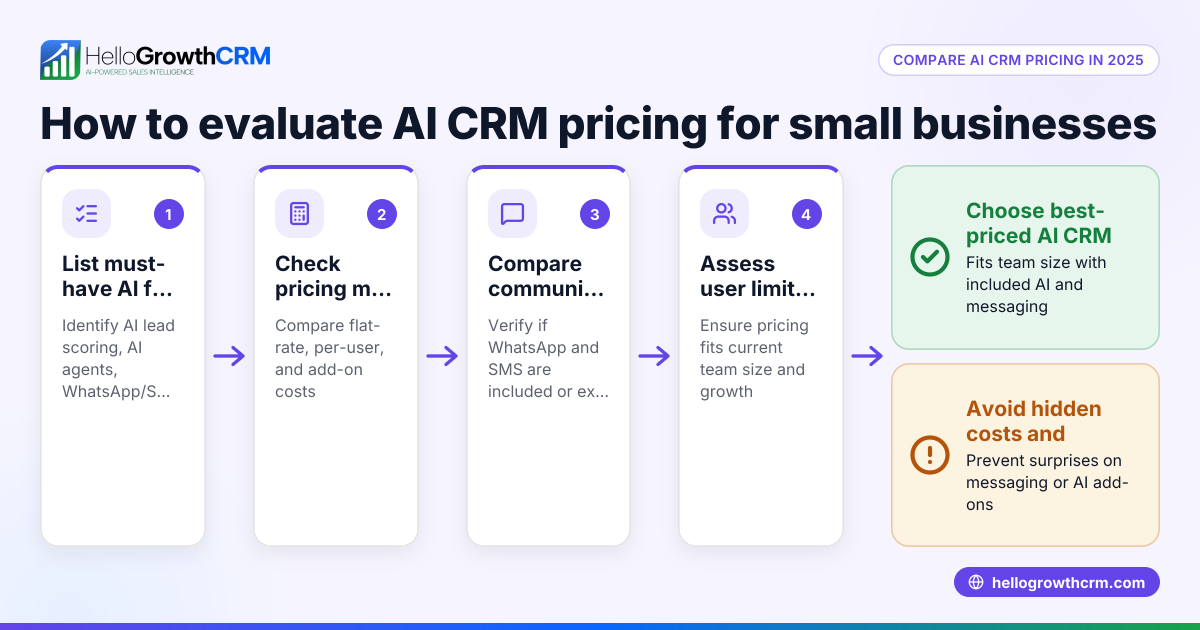
- Identify your team size and growth plans. Determine how many users need CRM access now and anticipate future hires. Pricing often depends on per-user fees.
- List must-have features. Decide which CRM features you need, such as lead capture, messaging, automation, or reporting. Some pricing tiers limit features.
- Compare pricing models. Look for per-user monthly fees, tiered plans with feature bundles, and any usage-based charges like message volumes or API calls.
- Check contract terms and hidden fees. Review billing cycles, cancellation policies, and extra costs for add-ons or overages.
- Evaluate free trials or free plans. Test the CRM with your team to see if it meets needs without upfront costs.
- Estimate your total cost of ownership. Multiply per-user fees by your team size, add any usage fees, and consider growth over 12 months.
- Ask about customer support and onboarding. Some plans include dedicated support which can save time and money.
For more detailed pricing options and plans designed for US businesses, see CRM pricing in the United States.
Example (fictional figures)
A B2B software reseller in Denver, Colorado, plans to use a CRM for their 5-person sales team starting 07/01/2024. They need lead capture, WhatsApp messaging, and AI-assisted follow-ups.
- Per-user monthly fee: $40
- Tiered plan includes WhatsApp and AI agents at Growth level
- No usage fees assumed for this example
Calculate monthly cost: $40 × 5 users = $200 per month
Estimate annual cost: $200 × 12 months = $2,400 per year
If they grow to 8 users by 01/01/2025: $40 × 8 users = $320 per month
Annual cost for 6 months at 5 users and 6 months at 8 users: ($200 × 6) + ($320 × 6) = $1,200 + $1,920 = $3,120
This estimate helps budget for growth and feature needs.
Common mistakes
- Choosing based on lowest price alone. Prevent by comparing feature sets and support included.
- Ignoring user limits or overage fees. Prevent by reading contract details carefully.
- Not accounting for future growth. Prevent by estimating team size changes and scaling costs.
- Skipping free trials or demos. Prevent by testing the CRM with your actual sales process.
- Overlooking integration costs or limitations. Prevent by checking CRM compatibility with your tools.
- Failing to ask about support and training. Prevent by clarifying what’s included with each plan.
For help understanding CRM features and pricing, visit our help center.
Doing this in HelloGrowthCRM
HelloGrowthCRM offers a Free Forever plan allowing a two-person team to manage its pipeline at no cost until calling or WhatsApp automation is needed. For growing teams, WhatsApp and SMS messaging features log conversations on lead records and enable follow-ups directly as messages. AI agents (currently in Beta on the Growth plan) draft follow-up messages after calls, so reps only review and send. These features help small and mid-sized businesses scale sales without complex pricing surprises. Learn more about HelloGrowthCRM for the United States.
Frequently asked questions
What are the common CRM pricing models? Common CRM pricing models are per-user monthly fees, tiered plans bundling features, and usage-based pricing that charges for message volume or API calls. Understanding these helps you predict costs.
How do I choose the right CRM pricing plan for my small business? Identify your team size, essential features, and growth plans. Compare plans for included features, per-user costs, and any extra fees. Testing with a free plan or trial helps ensure the CRM fits your workflow.
Are free CRM plans useful for small businesses? Yes, free plans like HelloGrowthCRM’s Free Forever plan let small teams manage pipelines at no cost. However, they often lack advanced features like calling or automation, which may be needed as you grow.
What should I watch out for in CRM contracts? Look for hidden fees, billing cycles, user limits, cancellation policies, and support availability. These affect your total cost and experience.
Can CRM pricing change as my business grows? Yes, many CRMs charge per user or for additional features, so costs typically increase as your team or usage grows. Planning ahead helps manage budgets.
For more details, visit our help center.
Key takeaways
- CRM pricing models vary mainly by per-user fees, feature tiers, and usage charges.
- Evaluate your team size, required features, and growth plans before choosing.
- Always check contract terms, hidden fees, and support included.
- Use free trials or free plans to test CRM fit before committing.
- Estimate total costs over time including growth to avoid surprises.
- HelloGrowthCRM offers a free plan for small teams and paid plans with WhatsApp, SMS, and AI features.
Choosing the right CRM pricing model ensures you pay for what you need without overspending. See US pricing and plan details at See US pricing.
Ready to put this into practice?
Set up your pipeline, WhatsApp follow-ups, and AI lead scoring in minutes — free, no credit card.
Try HelloGrowthCRM freeGet CRM tips in your inbox
Join thousands of sales professionals who get weekly insights on CRM strategy, AI automation, and pipeline optimization.

The HelloGrowthCRM team publishes guides on CRM strategy, AI sales tools, and revenue operations for small business sales teams.