HelloGrowthCRM software
Built for real small-business sales teams
HelloGrowthCRM helps reps qualify faster, follow up on time, and close more deals—with practical automation in one place.
- AI lead scoring and pipeline visibility
- Built-in dialer, WhatsApp, and email automation
- Sales forecasting and RevOps-ready reporting
Choosing the right CRM for your team means finding software your salespeople will actually use, that supports your communication style, and helps you close more leads without adding complexity. Many small and mid-sized businesses struggle with lead follow-up because they rely on scattered tools like texts, emails, and spreadsheets. This guide will help you identify what to look for in a CRM, walk you through practical steps to evaluate options, highlight common pitfalls, and show how HelloGrowthCRM’s features can assist your team.
Why this comes up / what goes wrong
Small business owners and sales leaders often search for the best CRM for teams because they face common challenges: leads slip through the cracks, follow-up is slow or inconsistent, and their sales process is spread across multiple apps. Teams that communicate with customers primarily via text or WhatsApp find many CRMs don’t integrate well with these channels. Without a centralized system that logs conversations and automates follow-up reminders, sales reps waste time and leads go cold.
Additionally, many small teams lack a dedicated sales manager or revenue operations specialist to keep the sales pipeline clean and ensure consistent follow-up. This can lead to missed revenue opportunities and frustration among team members.
Step-by-step
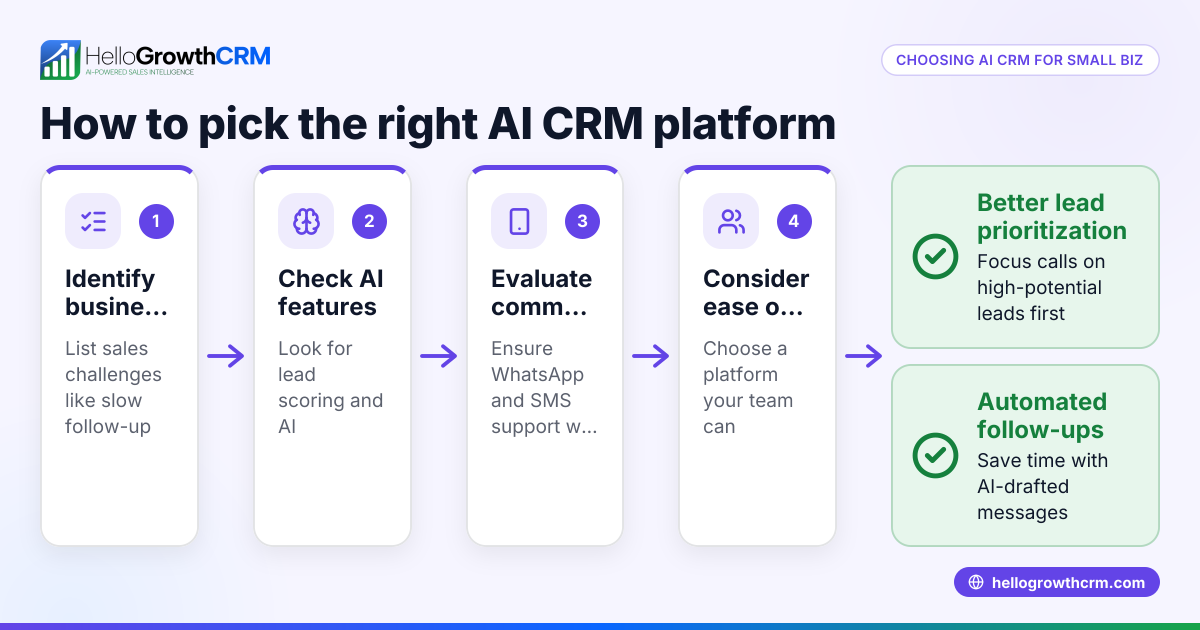
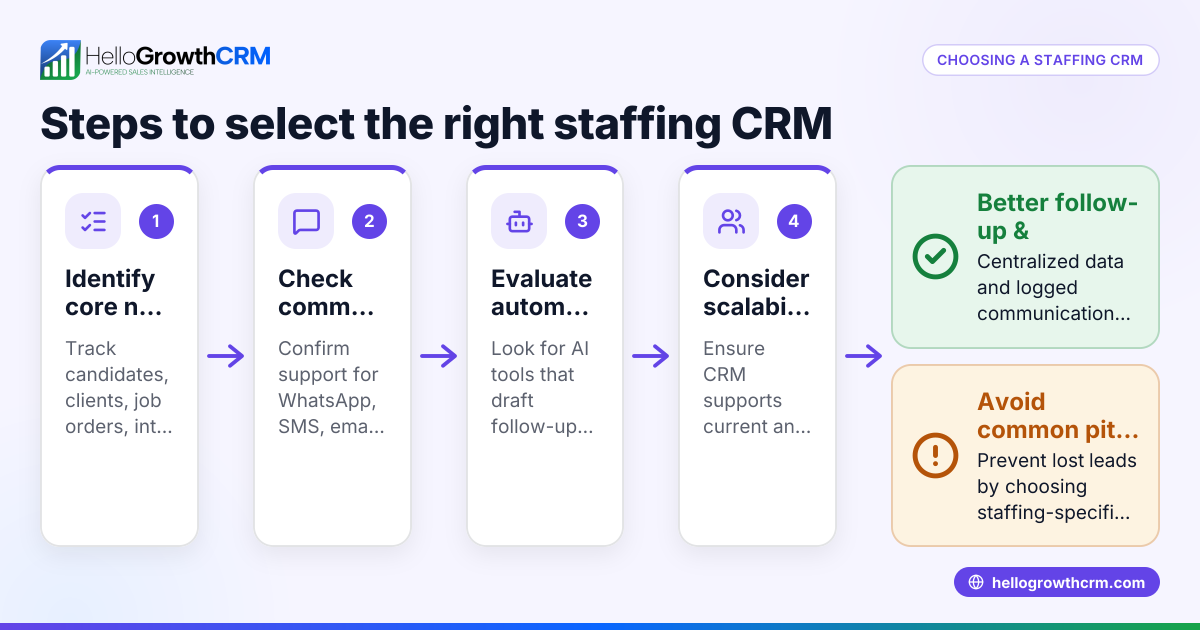
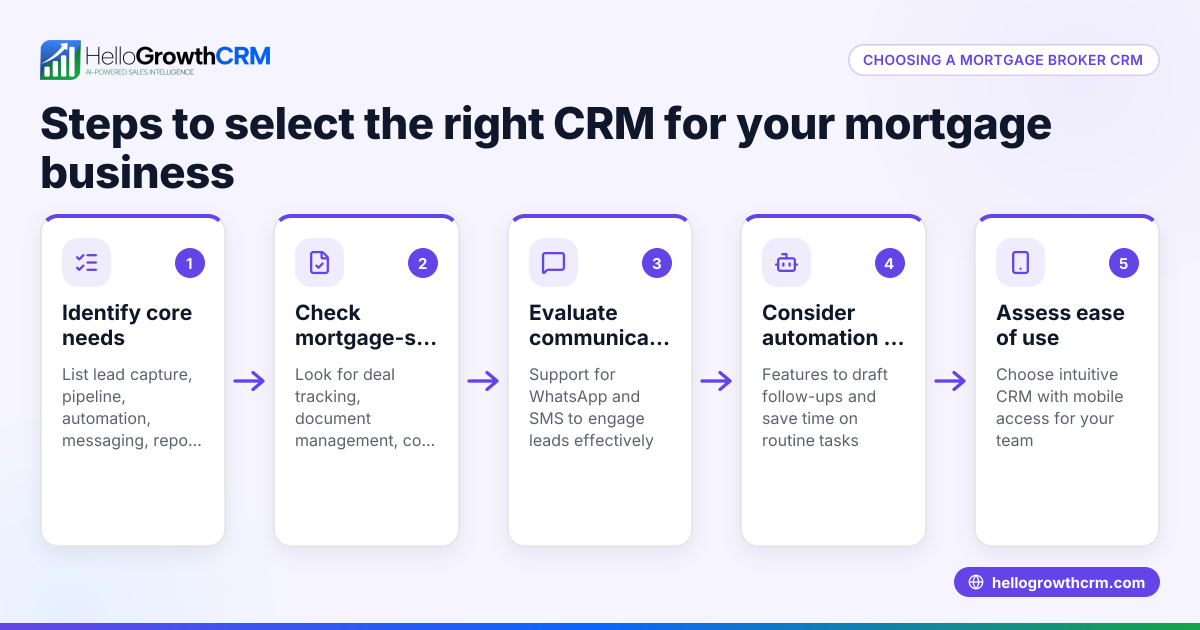
- Identify your team’s communication channels: Check if your team uses WhatsApp, SMS, email, or calls most frequently. Choose a CRM that supports these channels natively or via reliable integration.
- Evaluate ease of use and adoption: The best CRM is one your team will actually use daily. Look for a simple, mobile-friendly interface and features like automatic logging of conversations.
- Check for automation and AI features: See if the CRM offers AI agents or automation to draft follow-ups, update records, or manage tasks. This reduces manual work and speeds up response times.
- Consider revenue operations support: If you don’t have a sales manager, find a CRM provider that offers managed RevOps services to keep your pipeline clean and follow-ups on track.
- Review reporting and forecasting tools: Ensure the CRM provides sales forecasting and KPI reports to help you track team performance and revenue projections.
- Test integrations with your existing tools: Confirm the CRM can capture leads from your website forms and integrates with your email marketing or other sales tools.
- Compare pricing and plans: Look for transparent pricing that fits your budget, and consider whether features like AI agents or managed RevOps are included or add-ons.
For more details on AI features and sales forecasting, see AI CRM and sales forecasting.
Example (fictional figures)
Imagine a landscaping contractor in Charlotte, North Carolina, with a 10-person sales team. They want a CRM that supports WhatsApp messaging and automates follow-ups to reduce lost leads.
- The team receives 200 leads monthly.
- Average deal size is $5,000.
- Current conversion rate is 10%, but slow follow-up causes a 20% loss of potential deals.
If they improve follow-up speed with a CRM:
Leads lost due to slow follow-up = 200 × 20% = 40 leads
Potential deals recovered = 40 leads × 10% conversion = 4 deals
Additional revenue = 4 deals × $5,000 = $20,000 per month
By using a CRM with WhatsApp integration and AI follow-up agents, the team can reduce lost leads and increase revenue by $20,000 monthly, or $240,000 annually.
Common mistakes
- Choosing a CRM without mobile messaging support: Teams that rely on WhatsApp or SMS need a CRM that logs and manages those conversations. Prevent this by selecting a CRM with native WhatsApp and SMS workflows.
- Ignoring ease of use: Complex CRMs lead to poor adoption. Prevent this by demoing the CRM with your team and choosing one with an intuitive interface.
- Overlooking automation: Manual follow-ups waste time. Prevent this by selecting a CRM with AI agents that draft follow-up messages for reps to review.
- Not having revenue operations support: Without a sales manager, follow-ups can slip. Prevent this by choosing a CRM provider that offers managed RevOps services.
- Failing to check integrations: A CRM that doesn’t capture leads automatically adds manual work. Prevent this by confirming lead capture from your web forms and other tools.
- Ignoring reporting features: Without sales forecasting, planning is guesswork. Prevent this by selecting a CRM with built-in forecasting and KPI reports.
For more on managed RevOps, see HelloGrowthCRM for the United States.
Doing this in HelloGrowthCRM
HelloGrowthCRM supports teams with WhatsApp and SMS messaging workflows that log conversations on the lead record and allow follow-ups as messages. Its AI agents (in Beta on Growth plans) draft follow-up messages after calls, so reps only need to review and send them. For founders without a sales manager, managed RevOps services are available to help keep the follow-up queue active and the pipeline clean. These features help small and mid-sized teams improve lead response, reduce manual tasks, and stay organized.
Frequently asked questions
What is the best AI CRM for small teams? The best AI CRM for small teams offers automation that reduces manual work without overwhelming users. HelloGrowthCRM includes AI agents that draft follow-ups and update records, helping reps focus on selling. You want a CRM that balances AI features with ease of use.
Which CRM works best for revenue operations teams? Revenue operations teams need CRMs with pipeline hygiene tools, lead scoring, and detailed reporting. Managed RevOps services provide a dedicated specialist to maintain your pipeline and tune lead scoring, plus monthly strategy calls.
What is the best value CRM for small teams? Best value means getting useful features at a reasonable price. Plans with WhatsApp-native messaging, AI agents, and managed RevOps help save time and increase revenue without unnecessary complexity.
How do I choose the best CRM for small teams? Focus on your team’s communication channels, ease of use, automation capabilities, and support services. Test CRMs with your team and check integrations. This ensures the CRM fits your workflow and is adopted quickly.
Can a CRM improve sales forecasting? Yes, good CRMs provide sales forecasting and KPI reports that help you predict revenue and manage your pipeline. Features like these keep your team aligned on goals.
For more on AI and managed RevOps, see AI CRM and HelloGrowthCRM for the United States.
Key takeaways
- The best CRM for teams fits your communication style and sales process.
- Prioritize CRMs that support WhatsApp and SMS messaging natively.
- Automation and AI agents reduce manual follow-up work.
- Managed RevOps services help small teams without sales managers.
- Test ease of use and integration before committing.
- Sales forecasting and reporting improve revenue planning.
Choosing a CRM that your team actually uses and that supports the channels your customers prefer will increase sales and reduce lost leads. Features like WhatsApp-native messaging, AI agents, and managed RevOps help small and mid-sized teams grow efficiently.
See US pricing at See US pricing.
Ready to put this into practice?
Set up your pipeline, WhatsApp follow-ups, and AI lead scoring in minutes — free, no credit card.
Try HelloGrowthCRM freeGet CRM tips in your inbox
Join thousands of sales professionals who get weekly insights on CRM strategy, AI automation, and pipeline optimization.

The HelloGrowthCRM team publishes guides on CRM strategy, AI sales tools, and revenue operations for small business sales teams.