HelloGrowthCRM software
Built for real small-business sales teams
HelloGrowthCRM helps reps qualify faster, follow up on time, and close more deals—with practical automation in one place.
- AI lead scoring and pipeline visibility
- Built-in dialer, WhatsApp, and email automation
- Sales forecasting and RevOps-ready reporting
In the UAE, a useful CRM sales pipeline visual should show the deal facts that change action and paperwork locally: lead source, emirate or free-zone context, consent path, payment method, deposit status and the next customer commitment.
That matters because a pipeline board is not just a sales dashboard here. It often becomes the handoff point between sales, operations, finance and compliance. If the card only shows a contact name, a value and a vague probability, your team still has to hunt through chat threads, PDFs and bank messages to work out what happens next. A UAE business usually needs the board to answer practical questions fast: did this lead come from WhatsApp or an exhibition, is the customer in DIFC or on the mainland, has a deposit already landed, does Arabic need to be the customer-facing language, and which office or field team owns the work.
The right visual therefore looks less like a generic funnel and more like an operating map for how your business actually sells in Dubai, Abu Dhabi, Sharjah and beyond.
Lead source should mirror how UAE buyers actually make first contact
A board becomes more useful the moment every card shows where the inquiry started. In the UAE, that is rarely just web form or email. Depending on the business, leads often begin on WhatsApp, Instagram, Google Business Profile, Dubizzle, Property Finder, Noon, Talabat, referrals, or exhibitions and trade shows. A dental clinic in Jumeirah may get appointment intent from Google Business Profile and WhatsApp. A facilities-management contractor in Al Quoz may get site visit requests after a referral or a trade-show conversation. A car-service workshop in Sharjah may see repeat customers message on WhatsApp instead of filling in any form at all.
If those sources are hidden, your pipeline visual cannot explain why some deals move faster. WhatsApp leads often expect a quick back-and-forth before they will take a call. Exhibition leads may need qualification because the badge scan alone says little about buying authority. Marketplace inquiries can be price-led and need tighter quote follow-up. Source is not a marketing vanity field in the UAE; it predicts the response style the buyer expects.
This is where lead capture and qualification tools matter: the immediate goal is not fancy analytics but getting each new inquiry into the pipeline with source and first action attached, instead of leaving it in one rep's phone.
Make location visible because the same deal can sit under different rule sets
Many countries let you treat location as a reporting detail. In the UAE, location often changes the commercial and compliance context of the deal, so it belongs on the card. You may be dealing with a mainland customer, a free-zone entity, or a regulated financial business in DIFC. The trade licence and free-zone status can change which rules apply to the same activity in the same tower. Multi-emirate operations add another layer, because licensing authorities differ by emirate and sector.
For a corporate services firm in DIFC, the pipeline card should make it obvious whether the prospect is a DIFC entity, an ADGM entity, another free-zone company or a mainland LLC. For a tutoring centre in Abu Dhabi, the card may need the branch or emirate because scheduling, staffing and local approvals can differ. For healthcare, the operational handoff may need to reflect the Dubai Health Authority or another competent authority depending on where the service sits.
This is also a tax issue. VAT and corporate tax are administered by the Federal Tax Authority, but the treatment of a transaction can depend on the legal structure and facts of the supply. Free-zone and mainland entities can face different treatment, which is why a generic pipeline template copied from another market is risky. Do not hard-code tax assumptions into your stages. Instead, show the legal context so finance or your adviser can review the deal against the current FTA guidance and the applicable law.
Deposits and payment method change when a deal is operationally real
In many UAE businesses, a deal is not truly ready for delivery when the quote is accepted. It becomes real when a deposit is paid, a post-dated cheque is received, a bank transfer reference arrives, or the customer chooses a payment route that your team can actually collect against. That is why payment method deserves a visible field before the deal reaches any final stage.
Common rails in the UAE include bank transfer, credit card, cheque, Apple Pay, Google Pay, cash and Careem Pay. They do not create the same operational path. A workshop may start work against cash or card. A contractor may schedule around staged bank transfers or post-dated cheques. A clinic may treat a booking as soft until a deposit is received. If your board marks all of these simply as “won,” collections and operations inherit avoidable confusion.
There is also a VAT angle. The Federal Tax Authority publishes guidance on VAT registration and the treatment of advances. In practice, receipt of payment can trigger the obligation, so a deposit counts when it arrives rather than on the service date. The current legal position should always be checked against the FTA's official guidance and your adviser, because the correct treatment depends on the facts. Your pipeline visual cannot replace tax advice, but it can show whether money has been received, what form it took, and whether invoicing has started.
The arithmetic below is illustrative; the figures are made up to show the shape of the decision. A facilities-management contractor has a proposal for AED 48,000 for planned maintenance across several units. The customer agrees in principle but wants service to begin after a purchase order, with AED 12,000 by bank transfer upfront and the balance against later milestones. If the board shows the deal as fully won on verbal approval, operations may reserve staff and procurement may order materials too early. If the board instead moves to a stage that means “commercially accepted, waiting for funds or PO,” the team knows not to commit fully yet. Once the AED 12,000 arrives, finance can check the VAT treatment under current FTA guidance and operations can release the first work package. This simple distinction leaves out credit risk, retentions, supplier lead times and the exact tax treatment, but it shows why a UAE pipeline visual should separate commercial intent from collectible revenue.
Consent and identity fields belong on the deal card, not buried in policy files
The UAE pipeline visual should help your team contact people lawfully and proportionately. The Personal Data Protection Law sits under the UAE Data Office, while DIFC and ADGM have their own data protection regulators and frameworks. On top of that, marketing traffic to UAE numbers sits under the regulatory framework overseen by the TDRA, which distinguishes promotional from service messages. That distinction matters in day-to-day sales work, because many contacts will reply happily on WhatsApp but may not have consented to the same kinds of outreach across every channel.
So the board should not just store a phone number. It should show how the person entered your funnel, what channel they used, whether the message you plan to send is promotional or service-related, and whether there is a clear business purpose for the personal data you hold. If your staff collect Emirates ID details, that needs a stated purpose tied to the service, not a default habit copied into every lead form.
Language belongs here too. In the UAE, customer-facing communication may need to work in Arabic, English, Hindi, Urdu, Tagalog or Malayalam depending on the audience. Arabic is not only a translation issue; it must render right-to-left on the public page and in messages, and Arabic-script names need to survive export and re-import without corruption. If a customer's preferred language is invisible until after sale, the board is hiding a real execution risk.
Working week, Ramadan and Hijri holidays should shape your stage aging
A generic aging view can make a healthy UAE pipeline look stalled. The working week is not simply Monday to Friday in every customer context, and public-sector and private-sector patterns are not identical. During Ramadan, reduced working hours apply and many clients become more reachable in the evening. Several holidays follow the Hijri calendar, so dates are announced close to the time rather than fixed far in advance.
That means stage aging should be read against customer availability, not against a rigid global clock. A tutoring centre in Abu Dhabi may find that parent response patterns shift sharply around Ramadan evenings. A B2B services firm selling to government-linked entities may need to account for public-sector timing that differs from private companies. A trade-show lead collected just before a holiday period should not be judged by the same follow-up clock as a warm referral received in a normal week.
A useful visual board therefore highlights the next customer commitment date and the context around it, rather than punishing reps for “lateness” that is really a calendar mismatch. If you use task and note tracking, the value is in keeping the reason for the pause on the record so the next rep or manager can see it without guessing. Task boards and activity history are useful here because a delayed deal is not automatically a neglected deal.
Use one board for customer commitments and a separate layer for internal work
The strongest UAE pipeline visuals avoid turning every internal chore into a stage. The board should describe customer commitments that alter revenue confidence: qualified, site visit booked, quote sent, commercial acceptance, waiting for deposit or PO, scheduled, closed. Internal tasks such as legal review, licence check, staff allocation or parts ordering belong in activities, workflows or task boards, not as extra columns.
This matters especially where handoffs are heavy. A facilities contractor may need site survey, scope confirmation, pricing review and team allocation. A clinic may need patient document checks and booking confirmation. A corporate services firm may need KYC review and document collection. If all of that becomes stage clutter, the visual stops telling management what the customer has actually done.
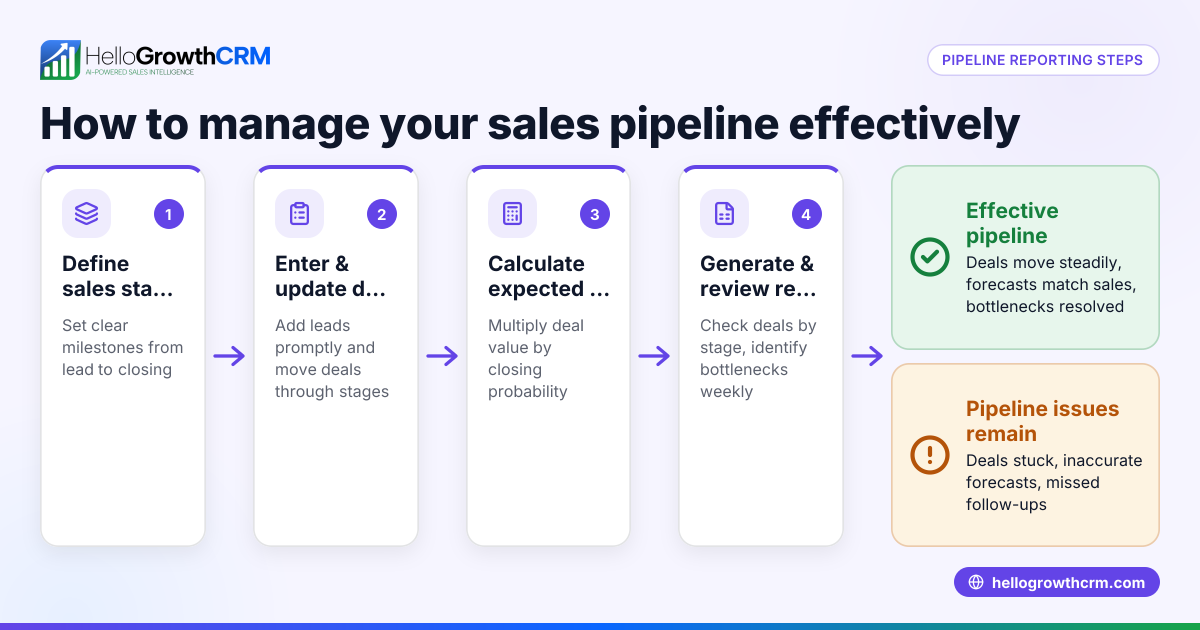
The better pattern is one pipeline card with a few decisive visible fields and supporting tasks underneath. Pipeline management can track stage movement, probability and expected value, while workflows and record updates handle the internal machinery behind the scenes. That way the board remains readable even when volume rises across several emirates or business lines.
A UAE-ready visual needs owners, territories and field context on the same record
Many UAE sales motions involve movement across neighborhoods, emirates or branches, so ownership should be explicit on the card. This is not only for enterprise field sales. A workshop may dispatch collection and delivery by area. A facilities-management company may assign estimators by zone. A tutoring business may split leads by branch and language. If ownership is inferred from memory instead of shown on the board, duplicates and slow follow-up appear quickly.
Where site visits matter, the visual should answer three practical questions before a manager opens the deal: who owns the next action, where does the activity happen, and has a booking been confirmed. For dispersed teams, territory and field operation tools help when ownership follows geography rather than a simple round-robin rule. For businesses that sell by appointment, scheduling and booking can shorten the path from inquiry to a committed conversation, which is often the real conversion point in the UAE.
One short note on software: choose the view that reduces switching, not the one with the most columns
For a UAE business, the practical test of a CRM pipeline visual is whether staff can move from inquiry to follow-up without leaving the record. That usually means one place to capture leads, move deals through stages, log calls and notes, message on the channels customers actually answer on, and produce quotes when the deal is ready. HelloGrowthCRM covers those core jobs through its deals pipeline, lead capture, activity logging, messaging and quoting tools. If your team relies heavily on mobile replies, the important point is that WhatsApp and SMS workflows are available inside the CRM rather than treated as an afterthought.
If you are redesigning your board, start with the UAE facts that actually change a decision: source, location and legal context, channel and consent, payment method, deposit received, preferred language, owner and next customer commitment. Everything else should support those fields, not bury them. That is what makes a pipeline visual useful in the UAE instead of merely neat.
Ready to put this into practice?
Set up your pipeline, WhatsApp follow-ups, and AI lead scoring in minutes — free, no credit card.
Try HelloGrowthCRM freeGet CRM tips in your inbox
Join thousands of sales professionals who get weekly insights on CRM strategy, AI automation, and pipeline optimization.

The HelloGrowthCRM team publishes guides on CRM strategy, AI sales tools, and revenue operations for small business sales teams.