HelloGrowthCRM software
Built for real small-business sales teams
HelloGrowthCRM helps reps qualify faster, follow up on time, and close more deals—with practical automation in one place.
- AI lead scoring and pipeline visibility
- Built-in dialer, WhatsApp, and email automation
- Sales forecasting and RevOps-ready reporting
The customer complaint resolution process is a structured approach for small and mid-sized businesses to handle customer issues effectively. It ensures complaints are addressed promptly and fairly, preserving customer trust and loyalty. This article explains why complaints arise, provides detailed steps to resolve them, highlights common mistakes, presents a realistic example, and describes tools to manage complaints efficiently.
Why this comes up / what goes wrong
Small-business owners often encounter customer complaints due to product defects, service delays, misunderstandings, or communication gaps. Without a clear process, complaints may escalate, causing lost trust and revenue. Many businesses still rely on scattered notes, emails, or spreadsheets, leading to slow or inconsistent follow-up. When sales and service teams use different tools, information can get lost. A consistent complaint resolution process helps ensure every issue is tracked, addressed, and resolved, making customers feel heard and valued.
Step-by-step
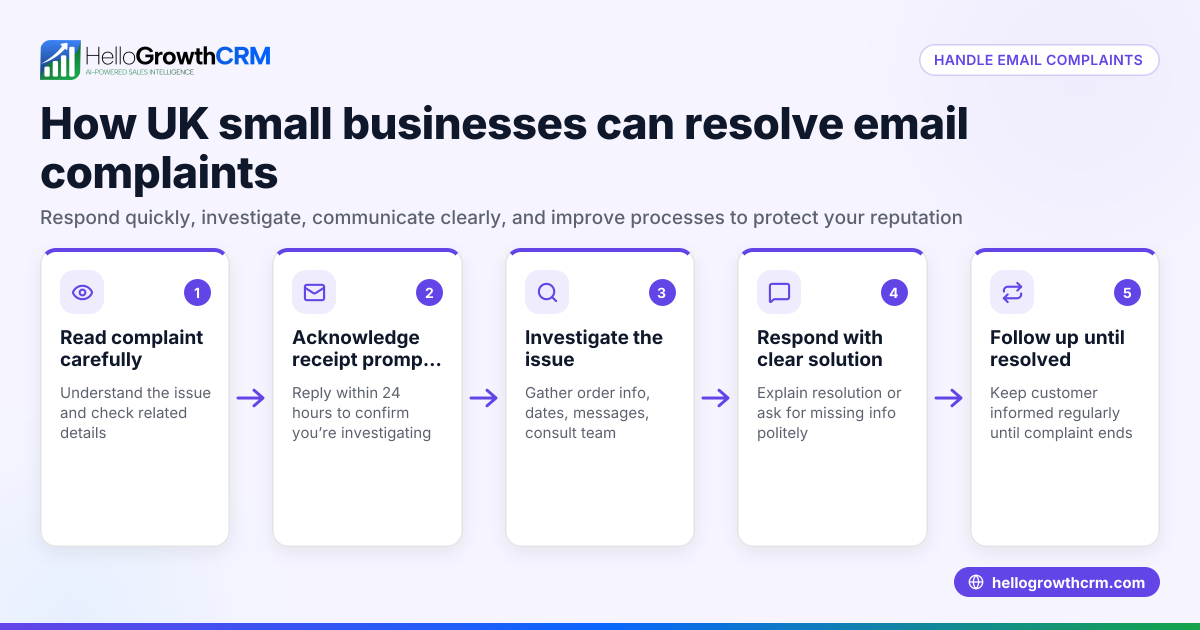
- Receive and acknowledge the complaint promptly
- Listen carefully or read the complaint fully.
- Respond quickly to confirm receipt, ideally within 24 hours.
- Check that the customer feels heard and understood.
- Record the complaint details clearly
- Document the customer’s contact information, complaint date, and specifics of the issue.
- Use a centralized system or CRM to keep all complaint data in one place.
- Assess and investigate the complaint
- Review relevant facts, the product or service involved, and prior interactions.
- Consult team members or departments as needed.
- Check for similar past complaints to identify patterns.
- Communicate a resolution plan to the customer
- Explain the steps you will take to resolve the issue.
- Set realistic expectations for timing and outcomes.
- Resolve the complaint
- Take corrective action such as repair, replacement, refund, or service adjustment.
- Ensure the solution meets the customer’s needs.
- Follow up and confirm satisfaction
- Contact the customer after resolution to confirm the issue is fully addressed.
- Thank them for their feedback and patience.
- Record the outcome and close the complaint
- Update the complaint record with resolution details.
- Analyze the data to improve products or processes.
- Use insights to improve customer health score and retention
- Track complaint trends to prevent future issues, linking to customer health score.
Example (fictional figures)
A plumbing company in Austin, Texas, receives a complaint on 03/10/2026 about a leaking pipe repair that failed after one week.
- Complaint received: 03/10/2026
- Acknowledged within 24 hours: Responded 03/11/2026
- Investigated: Technician reviewed repair records and found a faulty part
- Offered to replace part and waive service fee: Estimated cost $150
- Customer agreed; repair scheduled 03/15/2026
- Follow-up call on 03/20/2026 confirmed repair success
Calculations:
Service fee waived = $150 Repair cost covered by company = $150 Total cost to company = $150 + $150 = $300
The company documented the resolution in their CRM system and improved part sourcing to prevent future complaints.
Common mistakes
- Ignoring or delaying response: Prevent by setting a 24-hour acknowledgment rule.
- Poor documentation: Prevent by using a CRM or ticket system to record complaints and actions.
- Lack of follow-up: Prevent by scheduling follow-up calls or messages to confirm resolution.
- Not training staff on complaint handling: Prevent by regular team training and clear guidelines.
- Failing to analyze complaint trends: Prevent by reviewing complaint data regularly to improve products and services, linking to customer health score.
- Using multiple disconnected tools: Prevent by consolidating communication channels, for example, using a WhatsApp and SMS CRM system to keep all messages and tickets in one place, see WhatsApp and SMS CRM.
Doing this in HelloGrowthCRM
HelloGrowthCRM helps manage the complaint resolution process by keeping service requests on the same customer record as the deal. It offers a branded self-service customer portal where customers can submit support tickets directly. The system tracks referrals, support tickets, and includes a knowledge base for quick answers. This centralized approach helps teams respond faster and maintain organized complaint records. Learn more at HelloGrowthCRM for the United States.
Frequently asked questions
What is the best way to acknowledge customer complaints? Acknowledge complaints quickly, ideally within 24 hours, by confirming receipt and showing empathy. This reassures customers that their concerns are taken seriously and sets a positive tone for resolution.
How can small businesses track multiple complaints efficiently? Using a CRM or ticketing system that centralizes customer communication and complaint records is key. It prevents lost information and enables consistent follow-up. HelloGrowthCRM offers integrated ticketing and customer portals that help manage complaints efficiently.
Why is follow-up important after resolving a complaint? Follow-up confirms the customer is satisfied and the issue is fully resolved. It helps rebuild trust and can turn a negative experience into a positive one, encouraging repeat business.
How do complaint trends help improve business? Analyzing complaint trends identifies recurring issues, allowing you to fix root causes and improve products or services. Tracking this data can also improve your customer health score, signaling stronger customer relationships.
Can complaints be handled through WhatsApp or SMS? Yes, many customers prefer quick, informal channels like WhatsApp or SMS. Integrating these channels into a single system makes it easier for teams to respond promptly and keep all communication organized, as described in WhatsApp and SMS CRM.
Key takeaways
- Acknowledge complaints quickly and document details clearly.
- Investigate thoroughly and communicate next steps to the customer.
- Resolve complaints with appropriate action and confirm customer satisfaction.
- Avoid common mistakes like delayed responses and poor record-keeping.
- Use a CRM to centralize complaint tracking and communication.
- Analyze complaint data to improve customer health and prevent future issues.
Start managing your customer complaints efficiently and keep your customers loyal. Start on the Free Forever plan (200 leads, no credit card).
Ready to put this into practice?
Set up your pipeline, WhatsApp follow-ups, and AI lead scoring in minutes — free, no credit card.
Try HelloGrowthCRM freeGet CRM tips in your inbox
Join thousands of sales professionals who get weekly insights on CRM strategy, AI automation, and pipeline optimization.

The HelloGrowthCRM team publishes guides on CRM strategy, AI sales tools, and revenue operations for small business sales teams.