HelloGrowthCRM software
Built for real small-business sales teams
HelloGrowthCRM helps reps qualify faster, follow up on time, and close more deals—with practical automation in one place.
- AI lead scoring and pipeline visibility
- Built-in dialer, WhatsApp, and email automation
- Sales forecasting and RevOps-ready reporting
Customer prioritization is the process of identifying which customers or leads are most important to your business goals. It allows you to allocate your sales and service efforts efficiently, focusing on customers with the highest potential value or urgency. This article covers why small businesses need customer prioritization, how to do it step-by-step, a detailed example with numbers, common pitfalls to avoid, and how HelloGrowthCRM can help manage customers after the sale.
Why this comes up / what goes wrong
Many small business owners and sales teams struggle to keep up with all their customers and leads. Without a clear way to prioritize, they might spend too much time on low-value or unready customers and miss opportunities with those who could bring bigger sales or faster payments. This leads to lost revenue, slower growth, and overwhelmed teams. Customer prioritization helps solve this by giving a clear framework to rank customers based on criteria like purchase potential, urgency, or strategic fit.
Step-by-step
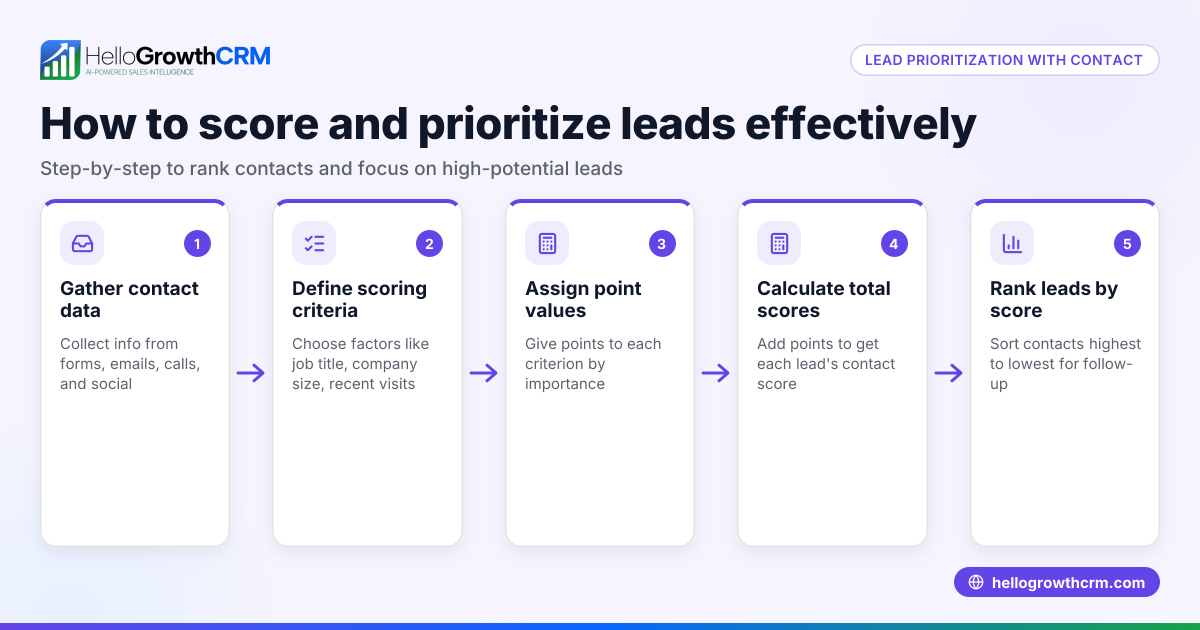
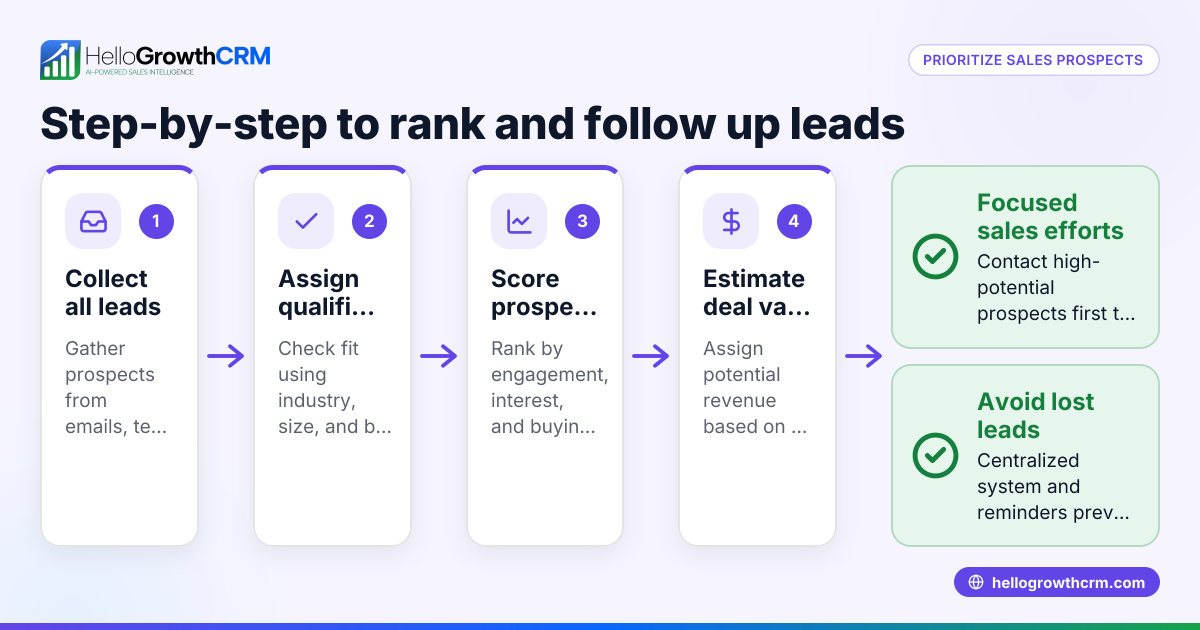
- Gather customer data: Collect relevant information such as purchase history, lead source, engagement level, and payment timeliness. Check that your data is up to date and accurate.
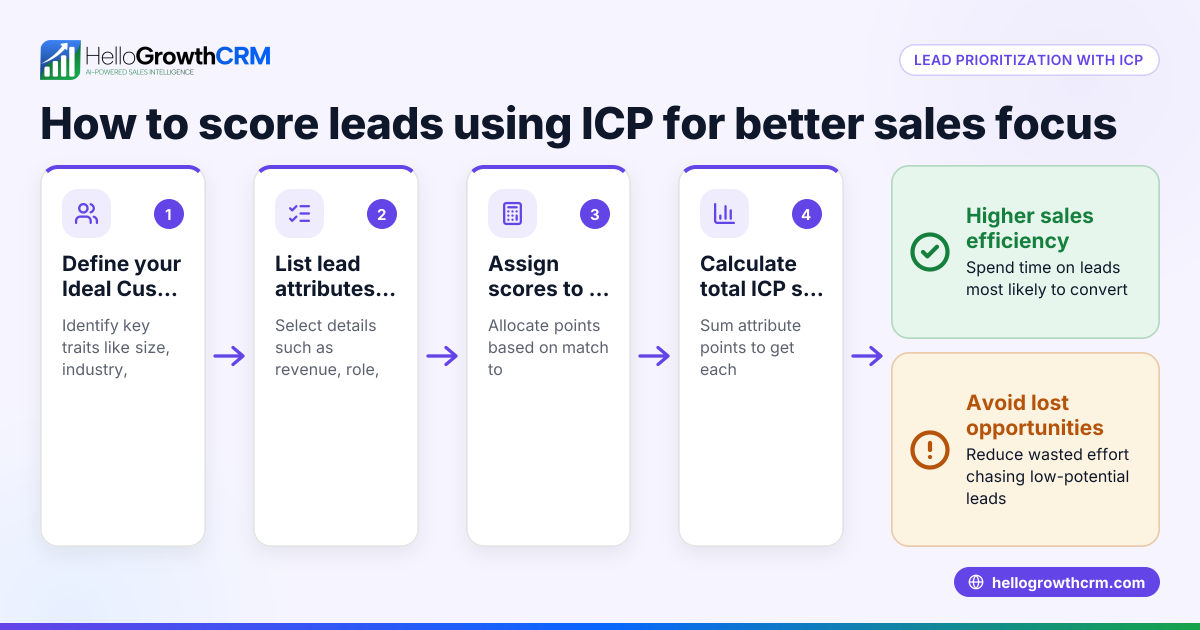
- Define prioritization criteria: Decide what matters most for your business. Common criteria include potential revenue, likelihood to buy soon, customer lifetime value, or strategic importance.
- Assign scores or ranks: For each customer, assign a score or rank based on your criteria. For example, rate potential revenue on a scale from 1 to 10, and urgency on a scale from 1 to 5.
- Combine scores for a final priority: Use a weighted formula if needed to combine different criteria into one priority score. Check that the formula reflects your business goals.
- Segment customers by priority: Group customers into high, medium, and low priority buckets. Verify that the groups make sense and align with your resources.
- Plan actions for each segment: Decide how to engage each group. High-priority customers get immediate follow-up, medium priority get nurturing, low priority get less frequent contact.
- Review and update regularly: Customer priorities can change, so review scores monthly or quarterly to adjust your focus.
For more on tracking customer engagement and health, see customer health score.
Example (fictional figures)
A Denver-based B2B software reseller wants to prioritize 3 leads as of 04/15/2026.
- Lead A expects a $120,000 deal closing in 1 month.
- Lead B expects a $60,000 deal closing in 6 months.
- Lead C expects a $90,000 deal closing in 3 months.
They assign scores:
Potential revenue score (scale 1-10): Lead A: 10 (highest deal) Lead B: 5 Lead C: 7.5
Urgency score (scale 1-5): Lead A: 5 (closing soon) Lead B: 2 Lead C: 3
Weighted formula: (Potential revenue score × 0.7) + (Urgency score × 0.3)
Lead A: (10 × 0.7) + (5 × 0.3) = 7 + 1.5 = 8.5 Lead B: (5 × 0.7) + (2 × 0.3) = 3.5 + 0.6 = 4.1 Lead C: (7.5 × 0.7) + (3 × 0.3) = 5.25 + 0.9 = 6.15
Priority ranking:
- Lead A (8.5)
- Lead C (6.15)
- Lead B (4.1)
The team focuses first on Lead A, then Lead C, and nurtures Lead B over time.
Common mistakes
- Ignoring data quality: Using outdated or incomplete data leads to wrong priorities. Prevent by regularly updating and verifying customer info.
- Using too many criteria: Overcomplicating scoring makes it hard to apply. Prevent by focusing on 2-3 most impactful criteria.
- Not weighting criteria: Treating all factors equally may misrepresent importance. Prevent by assigning weights that reflect your business goals.
- Failing to review priorities: Customers change over time. Prevent by scheduling regular reviews to update scores.
- Neglecting post-sale service: Prioritization often focuses on leads but ignoring existing customers can hurt retention. Prevent by integrating service requests and support tickets with customer records.
Learn more about managing ongoing customer service and referrals in WhatsApp and SMS CRM.
Doing this in HelloGrowthCRM
HelloGrowthCRM helps you manage customers after the sale by keeping service requests, support tickets, referrals, and knowledge base entries linked on the same customer record as the deal. This lets your team see the full history and prioritize follow-up effectively without losing context. The branded self-service customer portal also empowers customers to raise tickets or request service, streamlining your support process. For details, visit HelloGrowthCRM for the United States.
Frequently asked questions
What is the best way to prioritize customers? The best way is to use clear criteria like potential revenue and urgency, assign scores, and combine them into an overall priority. Keep it simple and review regularly.
How often should I update customer priorities? Update priorities monthly or quarterly to reflect changes in customer behavior, deal progress, or market conditions.
Can I prioritize existing customers as well as leads? Yes, prioritization applies to both. Existing customers with high lifetime value or urgent service needs should get priority attention.
How does customer prioritization help sales teams? It helps sales teams focus efforts on the most promising leads and customers, improving conversion rates and customer satisfaction.
Does HelloGrowthCRM support customer prioritization? HelloGrowthCRM supports managing customer service and referrals on the same record as deals, helping you track ongoing needs and prioritize follow-up effectively.
Key takeaways
- Customer prioritization ranks customers by potential value and urgency to focus your efforts.
- Use clear criteria, assign scores, and combine them with weights for a final priority.
- Regularly update priorities to keep pace with changing customer situations.
- Avoid data quality issues and overcomplicating your scoring system.
- HelloGrowthCRM keeps service requests and referrals linked to customer records for better post-sale prioritization.
Start prioritizing your customers today to improve sales and service efficiency. Start on the Free Forever plan (200 leads, no credit card).
Ready to put this into practice?
Set up your pipeline, WhatsApp follow-ups, and AI lead scoring in minutes — free, no credit card.
Try HelloGrowthCRM freeGet CRM tips in your inbox
Join thousands of sales professionals who get weekly insights on CRM strategy, AI automation, and pipeline optimization.

The HelloGrowthCRM team publishes guides on CRM strategy, AI sales tools, and revenue operations for small business sales teams.