HelloGrowthCRM software
Built for real small-business sales teams
HelloGrowthCRM helps reps qualify faster, follow up on time, and close more deals—with practical automation in one place.
- AI lead scoring and pipeline visibility
- Built-in dialer, WhatsApp, and email automation
- Sales forecasting and RevOps-ready reporting
Customer relationship marketing is a strategy that focuses on building and maintaining long-term relationships with customers through personalized communication and ongoing value delivery. Instead of only aiming for one-time sales, it prioritizes understanding customer needs, encouraging loyalty, and fostering repeat business. This article explains why small businesses need customer relationship marketing, provides step-by-step guidance to implement it, highlights common mistakes to avoid, offers a practical example, and describes how HelloGrowthCRM supports managing customer relationships effectively.
Why this comes up / what goes wrong
Small business owners often struggle with keeping customers engaged after the first sale. Communication is frequently slow or scattered across text messages, emails, and spreadsheets, which leads to missed follow-ups and lost revenue. Managing service requests and referrals manually can overwhelm small teams, causing frustration and inefficiency. These challenges drive owners to seek a structured approach that keeps customers informed, handles support efficiently, and encourages repeat business.
Step-by-step
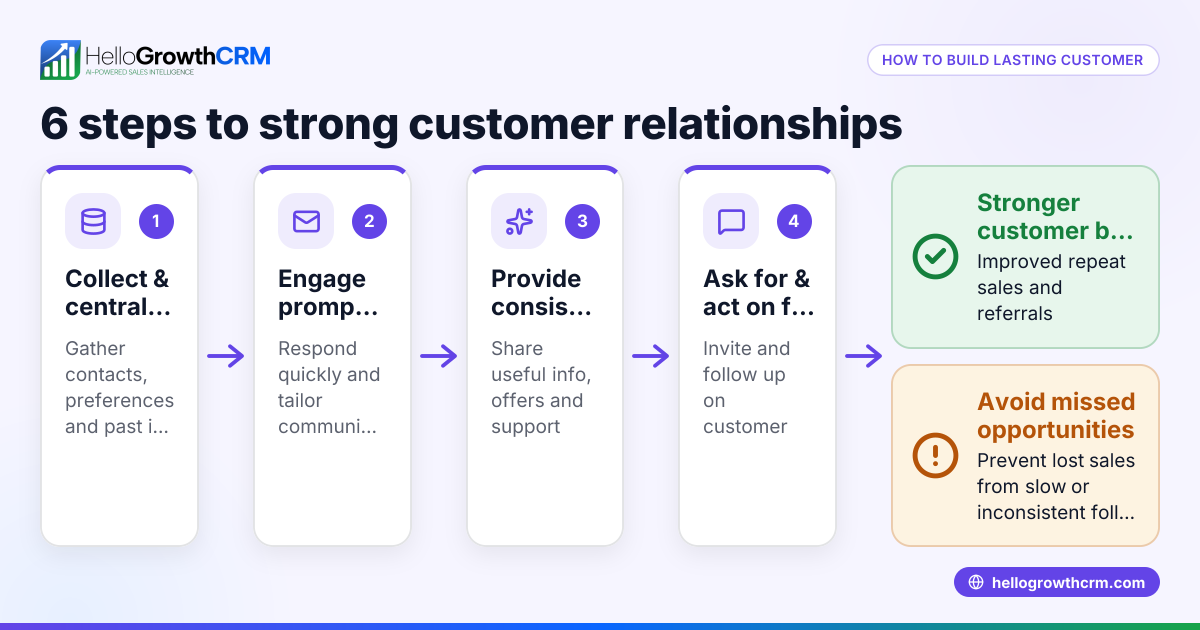
- Identify customer segments: Group customers by purchasing behavior, preferences, or demographics. Check that these groups represent meaningful differences so you can tailor your messages effectively.
- Collect and centralize customer data: Gather contact details, communication history, and service requests in one place. Regularly verify that the data is accurate and up to date.
- Personalize communication: Use the customer data to send targeted messages via email, WhatsApp, or SMS that speak directly to each group’s interests or needs.
- Set up a referral program: Encourage customers to refer others by tracking referrals and offering rewards. Monitor referral activity and adjust incentives as needed.
- Manage service requests and tickets: Keep all support requests linked to customer records for quick resolution. Ensure tickets are resolved promptly and none remain open too long.
- Provide a customer portal: Offer a branded self-service portal where customers can access knowledge bases, submit tickets, and track their requests independently.
- Analyze customer health and feedback: Regularly review customer satisfaction and engagement scores to identify risks or opportunities. Adjust your strategies accordingly. See customer health score for more.
- Maintain consistent follow-up: Schedule regular check-ins or updates to keep customers informed and engaged.
Example (fictional figures)
A residential real-estate team in Phoenix, Arizona wants to increase repeat sales and referrals through better customer relationship marketing.
- They start with 100 active clients.
- Segment clients into first-time buyers (60) and repeat buyers (40).
- Launch personalized WhatsApp sequences for each segment.
- Set referral rewards at $200 per successful referral.
- Over 3 months, 10 referrals convert to sales, each averaging $350,000.
Calculations:
Referral rewards paid = 10 × $200 = $2,000
Revenue from referrals = 10 × $350,000 = $3,500,000
If the team closes 5 more sales from repeat buyers due to improved follow-up, averaging $300,000 each:
Additional revenue = 5 × $300,000 = $1,500,000
Total increased revenue = $3,500,000 + $1,500,000 = $5,000,000
The referral cost ($2,000) is minimal compared to the revenue impact.
Common mistakes
- Ignoring data organization: Prevent lost or duplicated data by centralizing all customer information in one system.
- Sending generic messages: Use segmentation and personalization to ensure communications are relevant and engaging.
- Failing to track service requests: Link tickets to customer records and monitor resolution times to avoid unresolved issues.
- Not tracking or rewarding referrals: Implement clear referral incentives and monitor results to motivate customers.
- Skipping customer self-service options: Provide a portal for customers to find answers and submit tickets, reducing support workload.
- Inconsistent follow-up: Use task boards or reminders to ensure timely customer contact. For managing WhatsApp and SMS communication efficiently, see WhatsApp and SMS CRM.
Doing this in HelloGrowthCRM
HelloGrowthCRM includes a branded self-service customer portal, referral program tracking, and support tickets with a knowledge base. After the sale, service requests stay linked to the same customer record as the deal, keeping all customer information together. This helps small businesses manage ongoing customer communication and service efficiently.
Learn more about HelloGrowthCRM for US businesses at HelloGrowthCRM for the United States.
Frequently asked questions
What is the difference between customer relationship marketing and traditional marketing? Customer relationship marketing focuses on building long-term relationships and personalized communication, while traditional marketing often emphasizes one-time sales and broad messaging. CRM aims to increase customer loyalty and lifetime value.
How can small businesses start implementing customer relationship marketing? Begin by organizing customer data, segmenting your audience, and personalizing communication channels like email or WhatsApp. Setting up a referral program and a customer portal for support also helps build stronger connections.
Why is tracking service requests important in customer relationship marketing? Tracking service requests ensures timely resolution of issues, improving customer satisfaction and trust. It also helps identify recurring problems and opportunities for improvement.
How do referrals fit into customer relationship marketing? Referrals are a key part of CRM because satisfied customers can bring in new business. Tracking and rewarding referrals encourages customers to promote your brand.
Can I manage all communication channels in one place? Yes, using a CRM that supports multiple channels like WhatsApp, SMS, and email helps keep communications organized and consistent, improving follow-up speed and personalization.
Key takeaways
- Customer relationship marketing builds long-term customer loyalty through personalized communication and service.
- Organize and segment customer data to tailor messages and offers effectively.
- Track service requests and referrals linked to customer records for better management.
- Use a branded customer portal to empower customers with self-service options.
- Consistent follow-up and referral incentives increase repeat business and new leads.
- HelloGrowthCRM provides tools to manage these activities efficiently in one platform.
Start building better customer relationships today. Start on the Free Forever plan (200 leads, no credit card).
Ready to put this into practice?
Set up your pipeline, WhatsApp follow-ups, and AI lead scoring in minutes — free, no credit card.
Try HelloGrowthCRM freeGet CRM tips in your inbox
Join thousands of sales professionals who get weekly insights on CRM strategy, AI automation, and pipeline optimization.

The HelloGrowthCRM team publishes guides on CRM strategy, AI sales tools, and revenue operations for small business sales teams.