HelloGrowthCRM software
Built for real small-business sales teams
HelloGrowthCRM helps reps qualify faster, follow up on time, and close more deals—with practical automation in one place.
- AI lead scoring and pipeline visibility
- Built-in dialer, WhatsApp, and email automation
- Sales forecasting and RevOps-ready reporting
Customer sentiment analysis is a method to understand how customers feel about your business by examining their comments, reviews, messages, and other feedback. This helps you identify positive or negative trends and improve your products, services, and customer experience. In this article, you will learn why small businesses need sentiment analysis, how to do it step-by-step, see a real-world example with detailed calculations, avoid common errors, and discover how HelloGrowthCRM can help you manage customer service efficiently.
Why this comes up / what goes wrong
Small-business owners often hear from customers through various channels like emails, social media, WhatsApp, SMS, or phone calls. Without a clear way to analyze this feedback, it’s hard to know whether customers are happy or frustrated. Slow or manual review leads to missed opportunities to fix problems or build on positive experiences. For example, a plumbing company might get multiple messages about a delayed appointment but not realize the growing dissatisfaction until customers stop calling. This lack of insight can cause lost sales and damage your reputation.
Step-by-step
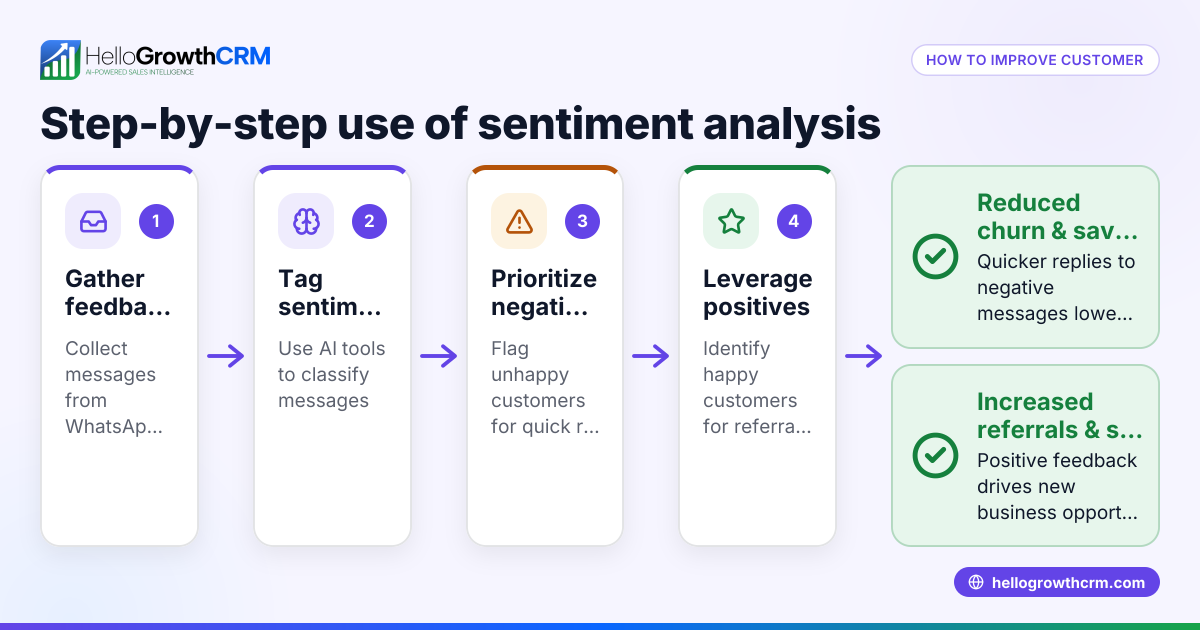
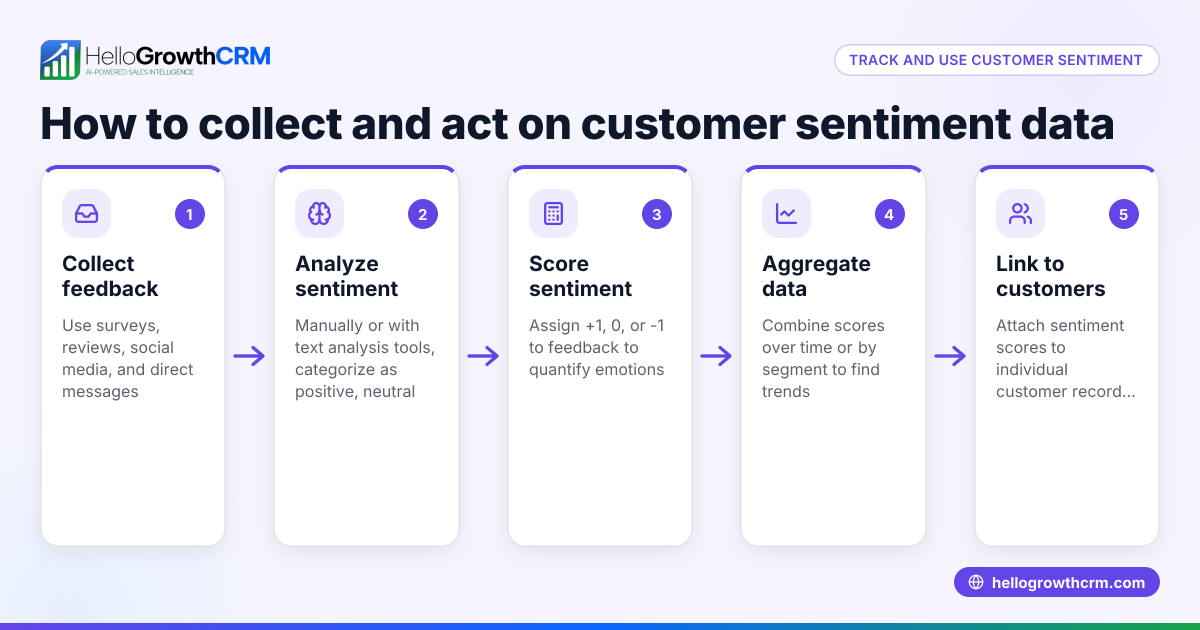
- Collect customer feedback: Gather reviews, messages, emails, and survey responses from all channels where customers communicate with you. Check that you have enough recent data to analyze.
- Organize the data: Use spreadsheets or software to compile the feedback in one place. Categorize comments by product, service, or interaction type.
- Analyze sentiment: Read through the feedback and label each comment as positive, negative, or neutral. Look for common words or phrases that indicate satisfaction or issues.
- Identify patterns: Group similar comments to find trends, such as frequent complaints about scheduling or praise for quick responses.
- Prioritize actions: Decide which issues to address first based on how often they appear and their impact on customer satisfaction.
- Respond and improve: Reach out to unhappy customers to resolve problems and use positive feedback to reinforce what works well.
- Monitor ongoing sentiment: Regularly repeat this process to track changes over time and measure the effect of your improvements.
Use tools like a customer health score to help monitor sentiment trends and customer satisfaction over time.
Example (fictional figures)
A plumbing company in Austin, Texas, wants to analyze customer sentiment from the past quarter (01/01/2026 to 03/31/2026). They collected 200 customer feedback messages across WhatsApp, email, and SMS.
- Positive comments: 120
- Neutral comments: 50
- Negative comments: 30
Calculate the percentage of each sentiment:
Positive percentage = (120 ÷ 200) × 100 = 60% Neutral percentage = (50 ÷ 200) × 100 = 25% Negative percentage = (30 ÷ 200) × 100 = 15%
The company notices that a significant portion of feedback is negative, mostly about late arrivals. They decide to improve scheduling and notify customers of delays more promptly. After implementing changes, they track customer sentiment monthly to see if the negative percentage decreases.
Common mistakes
- Ignoring neutral feedback: Neutral comments can contain useful information. Prevent this by reviewing all feedback carefully.
- Analyzing too little data: Small samples may not represent overall sentiment. Collect feedback consistently over time.
- Failing to act on insights: Analysis is wasted if you don’t address issues. Set clear action plans after each review.
- Mixing channels without context: Different channels may have different tones. Separate data by source to understand context better.
- Not tracking changes over time: Sentiment can shift. Regular monitoring helps you respond to trends.
Using a WhatsApp and SMS CRM can help organize and track customer messages efficiently.
Doing this in HelloGrowthCRM
HelloGrowthCRM includes a customer portal, referrals, tickets, and a knowledge base that keep all service requests connected to the same customer record as the deal. This helps you track customer issues and feedback after the sale without losing context. Managing support tickets and maintaining a reference library lets you resolve common problems faster, improving your customer sentiment over time. Learn more about these features at HelloGrowthCRM for the United States.
Frequently asked questions
What is the difference between customer sentiment analysis and customer feedback? Customer feedback is the raw information customers provide, such as reviews or messages. Sentiment analysis interprets this feedback to determine if the feelings expressed are positive, negative, or neutral.
Can I do sentiment analysis manually or do I need software? You can start manually by reading and categorizing comments, especially if your volume is low. As your business grows, software tools can speed up analysis and help track trends more reliably.
How often should I perform customer sentiment analysis? Regularly is best—monthly or quarterly—depending on your feedback volume. Frequent checks help you catch problems early and adjust your strategies.
How does sentiment analysis improve sales? By understanding customer feelings, you can address complaints before they escalate, highlight strengths in marketing, and improve customer loyalty, all of which support better sales outcomes.
Is sentiment analysis only for online feedback? No, it applies to any customer communication, including phone calls, in-person comments, and surveys. The key is to collect and analyze the feedback systematically.
Key takeaways
- Customer sentiment analysis reveals how customers feel about your business by examining their feedback.
- Collect and organize feedback from all communication channels before analyzing.
- Label feedback as positive, negative, or neutral to identify trends and prioritize improvements.
- Regularly monitor sentiment to track changes and measure the impact of your actions.
- Avoid common mistakes like ignoring neutral feedback or failing to act on insights.
- HelloGrowthCRM helps keep customer service requests tied to deals for better follow-up and sentiment management.
Start improving your customer relationships today. Start on the Free Forever plan (200 leads, no credit card).
Ready to put this into practice?
Set up your pipeline, WhatsApp follow-ups, and AI lead scoring in minutes — free, no credit card.
Try HelloGrowthCRM freeGet CRM tips in your inbox
Join thousands of sales professionals who get weekly insights on CRM strategy, AI automation, and pipeline optimization.

The HelloGrowthCRM team publishes guides on CRM strategy, AI sales tools, and revenue operations for small business sales teams.