HelloGrowthCRM software
Built for real small-business sales teams
HelloGrowthCRM helps reps qualify faster, follow up on time, and close more deals—with practical automation in one place.
- AI lead scoring and pipeline visibility
- Built-in dialer, WhatsApp, and email automation
- Sales forecasting and RevOps-ready reporting
Customer solutions refer to how a business addresses its customers’ needs through tailored products, services, and support. For UK small businesses, customer solutions extend beyond the initial sale to ongoing assistance that builds loyalty and encourages repeat business. This article explains why customer solutions matter, practical steps to develop them, a worked example with clear calculations, common mistakes to avoid, and how a CRM with customer portal and ticket features can help manage service requests efficiently.
Why this comes up / what goes wrong
Small business owners often juggle many roles and lack dedicated systems for customer service. Without clear processes, service requests can be missed or delayed, leading to unhappy customers and lost sales. Many rely on fragmented tools such as WhatsApp, email, and spreadsheets, which complicate tracking customer interactions and follow-ups. This can cause slow response times and missed opportunities for referrals or repeat business.
Step-by-step
- Identify Customer Needs: Gather feedback through surveys, direct conversations, or social media to understand customer wants and pain points.
- Develop Tailored Solutions: Use feedback to design products or services that address common issues. Check that these solutions fit your resources.
- Set Up Clear Communication Channels: Make sure customers can contact you easily via phone, WhatsApp, email, or a customer portal. Confirm these channels are monitored regularly.
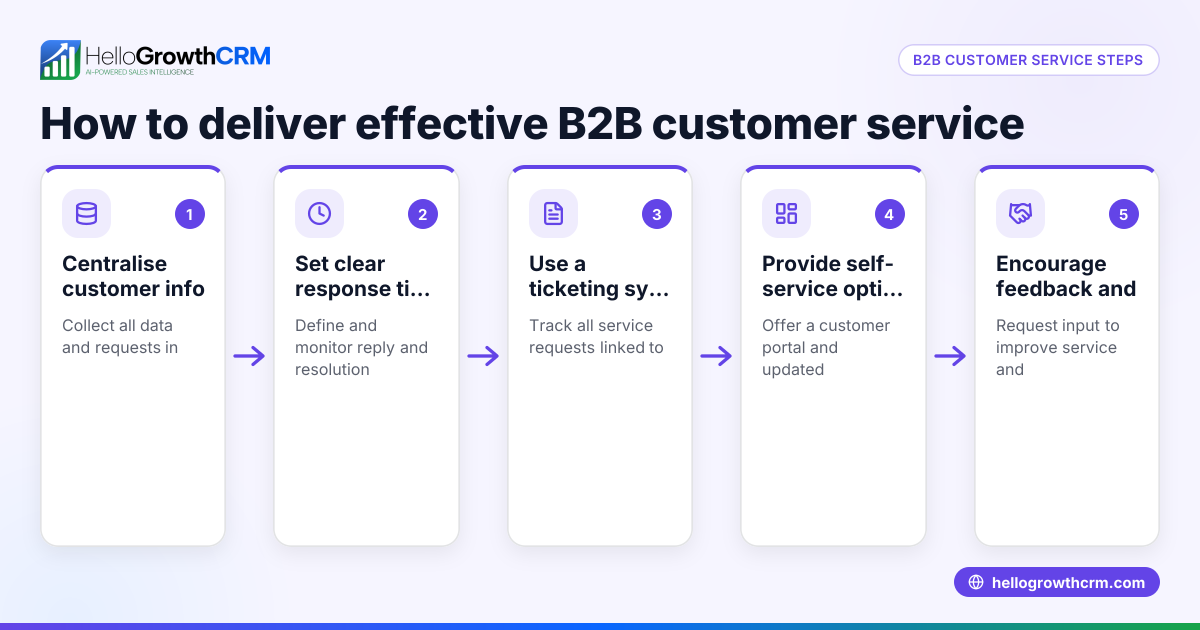
- Implement a Tracking System: Use a CRM or similar tool to log all customer interactions and service requests in one place. Check that every request is assigned and tracked until resolved.
- Train Your Team: Ensure your sales and support teams understand the solutions offered and how to use your tracking system.
- Follow Up Consistently: After resolving issues or completing sales, follow up to confirm satisfaction and invite referrals.
- Review and Improve: Regularly analyse customer feedback and service data to refine your solutions and processes.
These steps help meet current customer needs and build a foundation for ongoing engagement and growth. For example, a CRM with a customer portal supports clear communication and service tracking, helping manage requests efficiently. Learn more about customer health score for monitoring customer engagement.
Example (fictional figures)
A letting agency in Manchester wants to improve its customer solutions. It currently handles service requests by WhatsApp and email but often misses follow-ups.
- The agency receives 100 service requests monthly.
- It aims to resolve 90% within 48 hours.
- Each unresolved request risks losing a £1,000 monthly rental fee.
If 10 requests go unresolved:
10 requests × £1,000 = £10,000 potential monthly loss
Improving resolution to 95% reduces unresolved requests to 5:
5 requests × £1,000 = £5,000 potential monthly loss
The improvement in potential losses is:
£10,000 - £5,000 = £5,000 saved monthly
This example shows how structured customer solutions can reduce financial risk.
Common mistakes
- Ignoring customer feedback: Prevent by regularly collecting and acting on feedback.
- Using multiple disjointed tools: Prevent by consolidating communication and tracking in one system like a CRM.
- Not training staff: Prevent by providing clear guidance and training on customer solutions and tools.
- Failing to follow up: Prevent by scheduling follow-ups as part of your workflow.
- Overcomplicating processes: Prevent by keeping solutions simple and customer-focused.
- Neglecting referral tracking: Prevent by implementing a referral programme to reward satisfied customers.
For managing communications effectively, consider a WhatsApp and SMS CRM that integrates messaging with customer records.
Doing this in HelloGrowthCRM
A CRM with a branded self-service customer portal, referral tracking, support tickets, and knowledge base helps small businesses keep all service requests on the same customer record as the deal. This centralised approach means your team has full context for each customer, improving response times and satisfaction. See how it works for UK businesses at HelloGrowthCRM for the United Kingdom.
Frequently asked questions
What are customer solutions in business? Customer solutions are the products, services, and support a business provides to solve its customers’ problems and meet their needs. They include everything from the initial sale to after-sales service and ongoing engagement.
Why are customer solutions important for small businesses? They help build customer satisfaction, loyalty, and referrals. Effective customer solutions reduce lost sales caused by slow follow-up or poor communication, which is common in small businesses using fragmented tools.
How can I improve customer solutions with limited resources? Focus on clear communication channels, simple tracking systems, and regular follow-ups. Using a CRM that integrates messaging and service requests can save time and reduce errors.
What role does technology play in customer solutions? Technology like CRM systems centralises customer data, tracks interactions, and automates workflows. This helps small teams deliver consistent and timely service.
How do referrals fit into customer solutions? Referrals are a key part of customer solutions because happy customers can bring new business. Tracking referrals systematically encourages and rewards this behaviour.
Key takeaways
- Customer solutions combine products, services, and support to meet customer needs.
- Small businesses often struggle due to fragmented tools and lack of processes.
- Follow these steps: identify needs, develop solutions, set communication channels, track requests, train staff, follow up, and improve.
- Avoid common mistakes like ignoring feedback, poor follow-up, and disjointed tools.
- A CRM with customer portal, tickets, referrals, and knowledge base helps manage service requests on one customer record.
Start improving your customer solutions today by organising your service requests and communications. Start on the Free Forever plan (200 leads, no credit card).
Ready to put this into practice?
Set up your pipeline, WhatsApp follow-ups, and AI lead scoring in minutes — free, no credit card.
Try HelloGrowthCRM freeGet CRM tips in your inbox
Join thousands of sales professionals who get weekly insights on CRM strategy, AI automation, and pipeline optimization.

The HelloGrowthCRM team publishes guides on CRM strategy, AI sales tools, and revenue operations for small business sales teams.