HelloGrowthCRM software
Built for real small-business sales teams
HelloGrowthCRM helps reps qualify faster, follow up on time, and close more deals—with practical automation in one place.
- AI lead scoring and pipeline visibility
- Built-in dialer, WhatsApp, and email automation
- Sales forecasting and RevOps-ready reporting
Customer surveys are essential for small businesses to understand customer needs, satisfaction, and loyalty. Different types of customer surveys serve different purposes, so knowing these types helps you choose the right one to get actionable insights.
Why this comes up / what goes wrong
Many small-business owners want to improve customer experience but struggle with choosing the right survey type. Without understanding customer survey types, they may send generic surveys that do not address specific questions or miss critical feedback opportunities. This leads to slow follow-up, lost leads, or missed chances to improve service and retain customers.
Step-by-step
- Identify your goal: Decide what you want to learn from your customers—overall satisfaction, specific product feedback, loyalty measurement, or market preferences. This goal guides your survey type choice.
- Choose the survey type:
- Feedback surveys: Open-ended or rating questions about recent experiences to gather detailed opinions.
- Satisfaction surveys: Measure overall happiness with your product or service using rating scales.
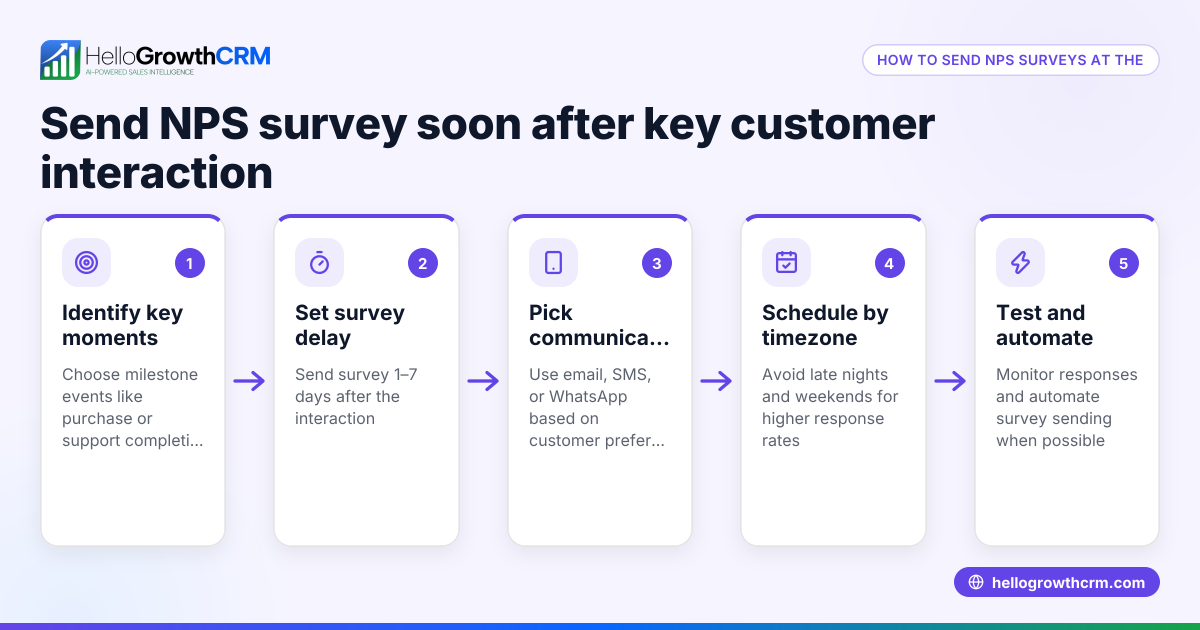
- Net Promoter Score (NPS) surveys: Ask customers how likely they are to recommend your business, scoring loyalty.
- Product/service-specific surveys: Focus on features, support, or particular interactions.
- Market research surveys: Explore broader customer needs, preferences, or trends.
- Design your survey: Keep it concise—ideally 5 to 10 questions. Use a mix of rating scales (e.g., 1-5), multiple-choice, and open-ended questions for richer insights.
- Select the delivery method: Choose how to send your survey—email, SMS, WhatsApp, or embed it on your website. Pick the channels your customers use most.
- Send and collect responses: Schedule survey sends and reminders thoughtfully to avoid spamming customers.
- Analyze results and act: Look for patterns in responses, prioritize issues, and plan improvements based on the feedback.
- Follow up: Reach out to customers who gave low scores or detailed negative feedback to resolve issues and show you care.
Example (fictional figures)
A residential real-estate team in Phoenix, Arizona, wants to measure client satisfaction after closing deals. They send a satisfaction survey with 5 questions rated 1 to 5.
- They email 100 clients on 05/15/2026.
- 60 clients respond.
- Average scores per question are 4.2, 4.5, 4.0, 3.8, and 4.3.
Calculate overall satisfaction:
4.2 + 4.5 = 8.7 8.7 + 4.0 = 12.7 12.7 + 3.8 = 16.5 16.5 + 4.3 = 20.8 20.8 ÷ 5 = 4.16
Overall satisfaction score = 4.16 out of 5
They identify the 3.8 score as the lowest, indicating an area for improvement (such as communication during closing). They plan follow-up calls to clients who rated that question 3 or below.
Common mistakes
- Sending too long surveys: Customers lose interest quickly. Prevent this by limiting surveys to 5-10 questions.
- Using only open-ended questions: These are hard to analyze and quantify. Combine with rating scales for easier interpretation.
- Ignoring the results: Sending surveys without acting frustrates customers. Always plan follow-up steps.
- Surveying too often: Frequent surveys cause fatigue and reduce response rates. Space surveys quarterly or after key interactions.
- Not choosing the right delivery channel: If customers prefer WhatsApp or SMS, avoid relying only on email. Use multi-channel options like those in a WhatsApp and SMS CRM (/product/whatsapp-sms-crm).
- Not linking survey feedback to customer records: This makes follow-up difficult. Use a CRM that keeps service requests and tickets on the same customer record as the deal (/product/customer-health-score).
Doing this in HelloGrowthCRM
HelloGrowthCRM helps track customer service after the sale by keeping service requests, tickets, and referrals on the same customer record as the deal. Its branded customer portal allows clients to self-serve and submit support tickets, while the knowledge base provides quick answers. This centralized system helps you follow up on survey feedback efficiently and improve your customer health score (/product/customer-health-score).
Frequently asked questions
What is the best customer survey type for small businesses? It depends on your goal. Satisfaction surveys and NPS surveys are popular for measuring loyalty and overall happiness. Feedback surveys work well for gathering specific service improvement ideas.
How often should I send customer surveys? Avoid sending surveys too frequently to prevent customer fatigue. For most small businesses, quarterly surveys or surveys after key events like a sale are effective.
Can I use WhatsApp to send surveys? Yes, WhatsApp is a great channel for customer surveys, especially if your customers use it often. HelloGrowthCRM supports WhatsApp and SMS CRM to manage these communications (/product/whatsapp-sms-crm).
How do I act on survey results? Analyze scores to find patterns and prioritize issues. Follow up with customers who gave low ratings to resolve problems and improve your products or services.
Can surveys improve customer retention? Yes, by identifying problems early and showing customers you care through follow-up, surveys can increase retention.
Why is linking survey data to customer records important? Linking survey feedback to customer records helps you track issues and service requests in one place, making follow-up and service improvements easier (/product/customer-health-score).
Key takeaways
- Choose survey types based on your specific business goals.
- Keep surveys short, clear, and use mixed question types.
- Use the right delivery method for your customers, including WhatsApp and SMS.
- Analyze results and act on feedback promptly.
- Avoid common mistakes like over-surveying or ignoring responses.
- Use HelloGrowthCRM’s customer portal and tickets to track service requests and improve customer health (/product/customer-health-score).
Start collecting valuable customer feedback today. Start on the Free Forever plan (200 leads, no credit card).
Ready to put this into practice?
Set up your pipeline, WhatsApp follow-ups, and AI lead scoring in minutes — free, no credit card.
Try HelloGrowthCRM freeGet CRM tips in your inbox
Join thousands of sales professionals who get weekly insights on CRM strategy, AI automation, and pipeline optimization.

The HelloGrowthCRM team publishes guides on CRM strategy, AI sales tools, and revenue operations for small business sales teams.