HelloGrowthCRM software
Built for real small-business sales teams
HelloGrowthCRM helps reps qualify faster, follow up on time, and close more deals—with practical automation in one place.
- AI lead scoring and pipeline visibility
- Built-in dialer, WhatsApp, and email automation
- Sales forecasting and RevOps-ready reporting
An ecommerce call center is a specialized team or service that manages customer interactions for online stores. It handles order questions, returns, technical support, and sales follow-up to improve customer satisfaction and boost revenue. Ecommerce businesses often need call centers to manage high call volumes and provide consistent service.
Why this comes up / what goes wrong
US ecommerce business owners and accountants often face challenges with customer communication. Without a dedicated call center, they may lose sales due to slow responses, mishandled returns, or inconsistent follow-up. Managing calls through personal phones or unorganized spreadsheets leads to lost leads and frustrated customers. Ecommerce businesses also need to handle multiple channels, including calls, texts, and emails, requiring a streamlined system.
Step-by-step
- Define Your Call Center Needs: Decide if you want an in-house team or an outsourced call center. Check if they specialize in ecommerce support, including returns, order tracking, and payment questions.
- Evaluate Technology Compatibility: Ensure the call center uses technology compatible with your sales and customer management systems. Ask if they support CRM integration and multichannel communication.
- Check Staffing and Training: Confirm the call center trains agents specifically for ecommerce products and policies. Ask about their average call handling time and ability to upsell or cross-sell.
- Assess Scalability and Flexibility: Make sure the call center can handle seasonal spikes, like holidays or sales events, and adjust staffing accordingly.
- Review Reporting and Analytics: Request access to call metrics, customer satisfaction scores, and lead tracking reports to monitor performance.
- Confirm Compliance and Security: Verify that the call center follows data privacy laws applicable in the US and secures customer information.
- Ask About Communication Channels: Confirm if they handle calls, SMS, WhatsApp, and email to cover all customer touchpoints.
- Request a Trial or Pilot Program: Test the call center service with a small volume of calls to evaluate quality and responsiveness.
- Review Pricing and Contracts: Compare pricing models (per call, per agent hour, or flat fee) and contract terms to avoid surprises.
- Plan for Integration with Your CRM: Ensure the call center’s system can integrate with your CRM to log calls and outcomes automatically.
Example (fictional figures)
A US-based ecommerce business, "GreenLeaf Home," sells eco-friendly home goods online with two warehouses in Austin, Texas, and Denver, Colorado. They receive about 1,200 customer calls monthly, mostly about order tracking and returns.
GreenLeaf decides to outsource to a call center specializing in ecommerce support.
- Monthly call volume: 1,200
- Average call length: 5 minutes
- Agent hourly cost: $20
- Average calls handled per hour: 12
Calculate agent hours needed:
1,200 calls ÷ 12 calls per hour = 100 agent hours
Calculate monthly cost:
100 agent hours × $20 per hour = $2,000
GreenLeaf also requires a CRM with a built-in dialer to track calls and outcomes. They use HelloGrowthCRM, which lets reps work leads directly inside the CRM and logs call results automatically.
This setup helps GreenLeaf reduce lost leads from slow follow-up and improves customer satisfaction.
Common mistakes
- Not defining specific ecommerce needs: Prevent by listing key call types (returns, order status) before choosing.
- Ignoring technology compatibility: Prevent by verifying CRM and communication channel integration.
- Overlooking agent training: Prevent by confirming ecommerce-specific training and scripts.
- Failing to plan for seasonal spikes: Prevent by choosing a scalable call center.
- Not monitoring performance metrics: Prevent by requiring regular reporting access.
- Neglecting data security compliance: Prevent by asking about US data privacy standards.
Doing this in HelloGrowthCRM
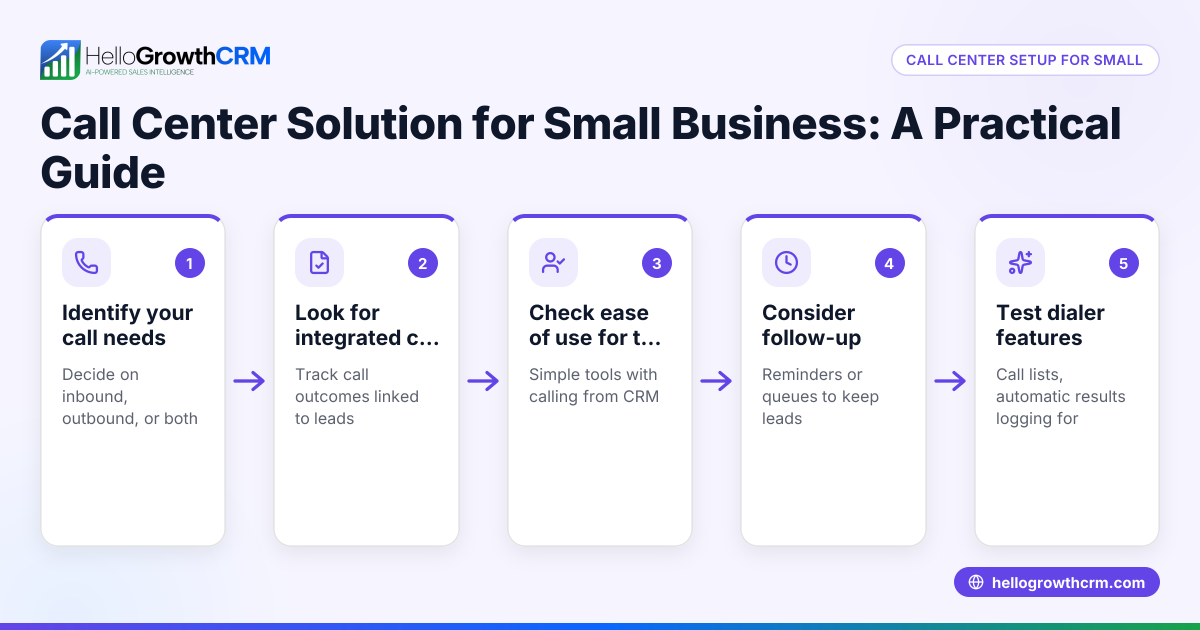
HelloGrowthCRM includes a built-in dialer that lets reps work a list from inside the CRM. Each call's outcome is logged on the lead automatically, keeping full call history tied to contact and deal records. This feature helps ecommerce teams manage follow-ups efficiently and avoid losing leads due to slow or disorganized call handling. Learn more about the built-in CRM dialer.
Frequently asked questions
What is the difference between an in-house and outsourced ecommerce call center? An in-house call center is staffed by your employees, giving you direct control but higher overhead. Outsourced centers are third-party providers, often more flexible and cost-effective but may require more coordination.
How can a call center improve ecommerce sales? By providing timely responses to customer inquiries, handling returns smoothly, and following up on leads, a call center reduces lost sales and increases customer satisfaction.
What communication channels should an ecommerce call center support? Calls, SMS, WhatsApp, and email are common. Supporting multiple channels ensures customers can reach you in their preferred way.
How important is CRM integration for ecommerce call centers? CRM integration is crucial. It helps log calls, track leads, and automate follow-ups, improving team efficiency and customer experience. HelloGrowthCRM supports this with its built-in dialer.
Can a call center handle seasonal ecommerce spikes? Yes, a good call center will scale staffing during high-demand periods like holidays or sales events to maintain service quality.
What should I ask before signing a contract with a call center? Ask about pricing models, service level agreements, data security policies, reporting access, and trial options.
Key takeaways
- Define ecommerce-specific call center needs before selecting a provider.
- Ensure technology compatibility and CRM integration for smooth operations.
- Confirm agent training in ecommerce products and customer handling.
- Choose scalable call centers to manage seasonal call volume.
- Monitor performance with regular reporting and analytics.
- Use tools like HelloGrowthCRM’s built-in dialer to log calls and outcomes efficiently.
Choosing the right ecommerce call center improves customer satisfaction and sales by handling calls professionally and promptly. To get started managing your leads and calls better, start on the Free Forever plan (200 leads, no credit card).
For more on supporting ecommerce sales teams, see E-commerce and online sellers and learn about HelloGrowthCRM for the United States.
Ready to put this into practice?
Set up your pipeline, WhatsApp follow-ups, and AI lead scoring in minutes — free, no credit card.
Try HelloGrowthCRM freeGet CRM tips in your inbox
Join thousands of sales professionals who get weekly insights on CRM strategy, AI automation, and pipeline optimization.

The HelloGrowthCRM team publishes guides on CRM strategy, AI sales tools, and revenue operations for small business sales teams.