HelloGrowthCRM software
Built for real small-business sales teams
HelloGrowthCRM helps reps qualify faster, follow up on time, and close more deals—with practical automation in one place.
- AI lead scoring and pipeline visibility
- Built-in dialer, WhatsApp, and email automation
- Sales forecasting and RevOps-ready reporting
In Singapore, electrician lead management works best when you treat each enquiry as a job with local compliance, payment and scheduling consequences from the first message, not just a name in a spreadsheet.
For a small electrical contractor, the hard part is rarely getting an enquiry. Leads can come from Google Business Profile, Carousell, WhatsApp, Facebook, Instagram and referrals from condo managers or existing customers. The hard part is deciding which requests are worth a fast site visit, which can be quoted from photos, which need a licensed specialist, and which are shopping around with no real intent. Good handling means faster response, cleaner records and fewer disputes when it is time to invoice.
Singapore makes that discipline more important because customers expect quick replies, commonly message on mobile first, and often want evening or lunch-hour appointments. Add deposits through PayNow, GST timing, and PDPA messaging rules, and poor recordkeeping turns into real admin risk.
Different lead sources need different first questions
An electrical fault report from WhatsApp is not the same as a commercial fit-out enquiry from LinkedIn or a public-sector tender trail that started on GeBIZ. If your team throws all of them into one bucket marked “new lead”, the pipeline becomes noisy and your best jobs get buried.
For Singapore electricians, source tells you what information is likely to be missing. A Google Business Profile lead often arrives with urgency but little detail: “power trip”, “lights not working”, “need today”. A Carousell lead may be price-led and comparing several contractors. A referral from a management office may already carry trust but require stricter attendance timing and paperwork. GeBIZ opportunities are a separate lane entirely, because they involve formal procurement rather than ordinary retail follow-up.
Your intake should capture source, property type, urgency, exact location and whether the customer wants troubleshooting, replacement, installation or certification-related work. “Condo in Orchard, repeated breaker trip, evenings only” is useful. “Electrical issue” is not. In Singapore, location matters operationally: CBD jobs, industrial estates in Jurong, and heartland HDB flats produce different travel, parking and access patterns.
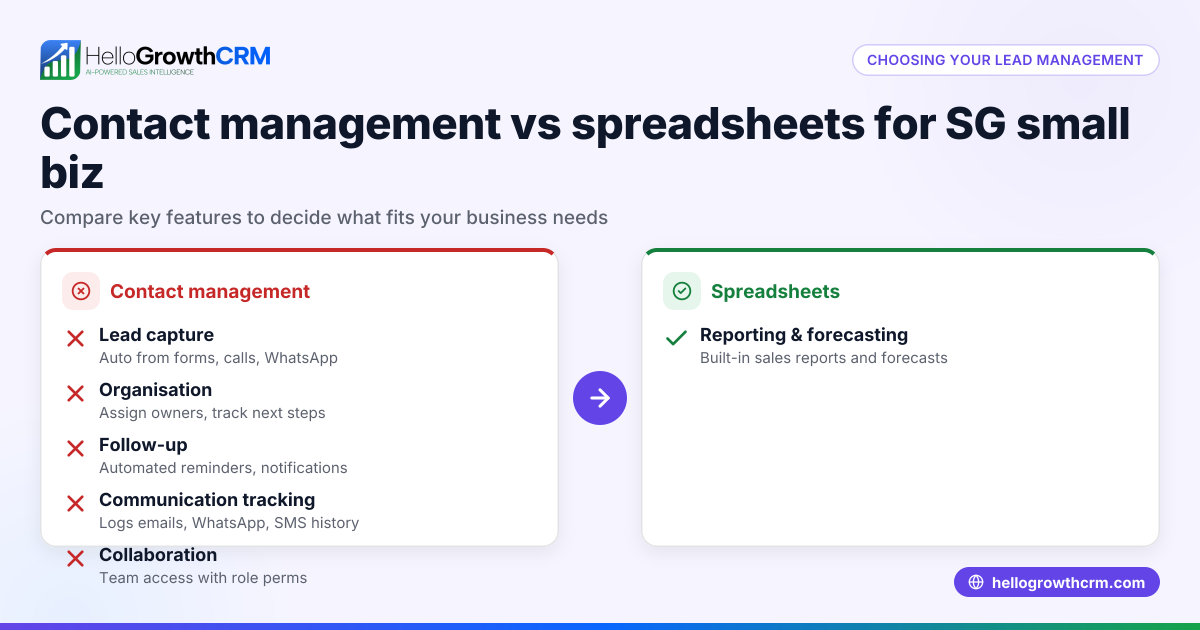
It also helps to separate household work from B2B work on day one. A facilities manager asking for multiple retail units is not buying the same way as a homeowner replacing ceiling lights. If you want a structured place to capture and qualify these details, lead capture and qualification tools are more useful than a general contact list because they keep source and pipeline entry tied together.
PDPA changes how you chase quotes on WhatsApp and SMS
Singapore electricians live on the phone, but outreach still sits under the Personal Data Protection Act and the Do Not Call provisions administered by the Personal Data Protection Commission. If you send specified marketing messages to Singapore numbers, the sender has the duty to check the relevant Do Not Call Registry unless an exception applies. That duty does not shift to your software vendor.
This matters because many electrical businesses blur the line between service updates and marketing. A message saying a technician is on the way is different from sending a promotion for rewiring packages to old numbers in your phone. Purely transactional messages sit differently from marketing, and clear, unambiguous consent changes the position again. Your records need to show why a message was sent and what consent you relied on, if any.
Lead forms deserve the same care. A booking form asking for NRIC by default creates needless risk. PDPC guidance is restrictive on collecting NRIC numbers, and an electrician almost never needs one to inspect a socket, replace a distribution board or quote for additional power points. Ask for name, mobile, address, problem description and access instructions; do not collect identity data that adds no value.
For teams using mobile-first follow-up, this is where channel history matters. If you use WhatsApp and SMS workflows, the benefit is not only speed. It is having a cleaner record of what was sent, when the customer replied, and whether the next message should be a quote reminder, an appointment note or nothing at all.
Booking windows in Singapore are not evenly valuable
Many templated sales articles assume the workday is flat. It is not. In Singapore, lunch-hour and post-work slots often carry stronger demand for home access than mid-morning, especially for occupied flats and condos. If your lead system treats all requested times as equal, you will overpromise the hours customers actually care about.
Public holidays complicate this further because they span several communities and some move year to year with lunar and Islamic calendars. That affects staffing, building access and customer availability. A quote follow-up sent at the wrong moment may be ignored for reasons that have nothing to do with interest.
Geography adds another layer. A job in the CBD may be easy to reach at one hour and awkward at another. Heartland appointments may cluster after work. Industrial customers may want early attendance before operations start. Singapore has one time zone, which helps, but some commercial clients coordinate with regional teams elsewhere in ASEAN, so the decision-maker may not reply on your local rhythm.
The practical fix is to store preferred visit windows as part of qualification, not as a note buried in chat history. Then route the lead according to realistic coverage. If you need structure around follow-up and handoff, task boards and activity logging are useful because dispatch, sales and technicians can see the same promise made to the customer.
Deposits, PayNow and GST timing belong in the lead record
In Singapore, the money trail for an electrical job often starts before the final invoice. A customer may send a deposit by PayNow to secure a slot or to cover materials for an urgent replacement. That sounds like an operations detail, but it affects both follow-up and tax treatment.
Under Singapore GST rules, administered by IRAS, a payment received for a taxable supply can trigger the obligation at the earlier of invoice or payment. In plain terms, a deposit can matter on the day it arrives. Whether your business must register for GST depends on taxable turnover, and the current registration position is published by IRAS under the GST regime. The exact figure and timing should be checked on the official IRAS guidance and, where needed, with an accountant.
There is also a practical reconciliation issue. PayNow and ordinary bank transfer receipts do not show up inside a card processor dashboard. If the office team does not manually record them against the correct customer and job, the sales pipeline may still show “quote pending” when the customer has already paid a booking amount. That creates embarrassing follow-up messages and avoidable mistrust.
A useful lead record in Singapore therefore needs fields for quoted amount, deposit requested, deposit received, payment rail used and tax status. SGQR, FAST, GIRO, NETS, cards and bank transfer all appear in local trading, but they produce different evidence trails. Sales and admin should be working from one job history, not from separate WhatsApp chats and bank screenshots.
Quoting for HDB, condo and commercial sites should not use one script
Electrical leads look similar at first and become expensive when assumptions are wrong. A homeowner in an HDB flat asking for extra power points may have straightforward access and a clear decision-maker. A condo job can involve visitor registration, parking friction, management rules and narrower work windows. A commercial office may need after-hours attendance, purchase order references or landlord coordination.
That means your qualification should quickly answer the operational questions that decide whether the lead is profitable:
- What type of premises is it, and who controls access?
- Is this fault-finding, installation, replacement or a broader upgrade?
- Can the problem be assessed from photos or does it need a site visit?
- Is there urgency because power is down, or is this planned work?
- Who approves the quote and how will payment be made?
In Singapore, that final question matters early. A homeowner may confirm on WhatsApp and pay by PayNow. A business customer may need a formal quote, then a purchase order, then bank transfer after completion. If you discover that only after sending a casual one-line estimate, your response will look less credible than a contractor who asked properly at the start.
Language can also affect conversion. English is the working language, but customer-facing copy in Mandarin or Malay can matter by segment, especially for household jobs. You do not need four full sales scripts. You do need clear, simple explanations of what is included, what is excluded and when attendance is available.
A simple local arithmetic check stops low-value jobs clogging the calendar
The arithmetic below is illustrative; the figures are made up to show the shape of the decision.
Assume a Jurong-based electrician gets an enquiry to replace light fittings in a condo near Orchard. The customer came through Instagram, wants an evening slot and has already asked for “best price”. Your team estimates S$180 labour, S$95 materials, S$24 parking and miscellaneous access costs, and S$38 of travel and admin time. Expected total direct job cost: S$337.
You are considering whether to offer a site visit first for S$0 or ask for a S$120 deposit credited against the final bill. If no deposit is taken, there is a fair chance the customer keeps shopping, holds your preferred evening slot and then goes quiet. If a S$120 deposit is paid by PayNow, the lead is more serious, the slot is protected, and admin can tag the payment to the job immediately. Even if the final quoted amount lands at S$460, the office already knows this is not just an enquiry; it is a live job with money attached.
What this arithmetic leaves out: GST treatment, warranty callbacks, technician overtime, and the fact that some electrical faults expand once the team opens up the fitting or board. It also leaves out the legal question of how your quotation and terms handle cancellation. But it shows why lead management for electricians in Singapore is not only about conversion. It is about protecting scarce evening capacity for work that is likely to proceed.
Government and corporate buyers belong in a separate pipeline
Many electricians hope to “do more commercial work” but then manage every enquiry the same way. In Singapore, public-sector and larger corporate buyers usually require a different process from domestic jobs. GeBIZ opportunities, vendor onboarding, entity checks through ACRA records, and formal quotation formats are not just bigger versions of consumer sales.
That is why your CRM should split these leads early. A facilities contractor asking for maintenance across several sites may require account-level tracking, not just a one-off job card. Someone in admin may submit the enquiry, but the real approver may sit in finance or procurement. Corppass and SingPass shape how businesses and individuals authenticate with government services, and that wider operating culture means buyers often expect cleaner documentation and named company details than a household customer would.
A separate B2B pipeline lets you store company records, quote versions and follow-up tasks without cluttering your domestic board. If you are evaluating systems, pipeline management for deals is useful here because the stages for “site survey booked”, “quote submitted”, “PO pending” and “awarded” are different from “home visit tomorrow” or “deposit received”.
One shared record matters more than another marketing channel
Most electrician sales problems in Singapore are not caused by a lack of leads. They come from split records: one person answers WhatsApp, another takes a phone call, a technician receives a bank transfer screenshot, and nobody updates the same file. The result is duplicated chasing, forgotten deposits and weak handovers.
A better setup is simple. Every new enquiry enters one record. Calls, messages, notes, site-visit promises and quote changes sit under that record. If the customer rings back from the MRT and asks whether your technician can arrive after work, the person answering should not have to search three devices to find context.
HelloGrowthCRM is relevant here because it combines lead capture, pipeline tracking, task logging, messaging and scheduling in one place. For a small contractor, that means one system for qualification, follow-up and booked work rather than a patchwork of chat apps and spreadsheets. You can start with the free CRM if you want a low-risk way to test whether the team will actually use a shared pipeline.
In Singapore, the electrician who responds fast and keeps a clean record usually wins more of the right jobs, not just more enquiries.
Ready to put this into practice?
Set up your pipeline, WhatsApp follow-ups, and AI lead scoring in minutes — free, no credit card.
Try HelloGrowthCRM freeGet CRM tips in your inbox
Join thousands of sales professionals who get weekly insights on CRM strategy, AI automation, and pipeline optimization.

The HelloGrowthCRM team publishes guides on CRM strategy, AI sales tools, and revenue operations for small business sales teams.