HelloGrowthCRM software
Built for real small-business sales teams
HelloGrowthCRM helps reps qualify faster, follow up on time, and close more deals—with practical automation in one place.
- AI lead scoring and pipeline visibility
- Built-in dialer, WhatsApp, and email automation
- Sales forecasting and RevOps-ready reporting
A food CRM is a customer relationship management system designed to help food businesses streamline their sales and customer engagement processes. It centralises customer data, tracks orders, and automates follow-ups to reduce lost leads and improve customer service. This article explains why food businesses seek a CRM, guides you through selecting one, shows an example with realistic Singapore figures, highlights common mistakes, and describes how HelloGrowthCRM can help.
Why this comes up / what goes wrong
Small food business owners in Singapore often start by managing sales via WhatsApp, email, or spreadsheets. This informal approach leads to slow follow-up, missed orders, and lost customers. As the business grows, juggling multiple communication channels and tracking leads manually becomes overwhelming. A food CRM can organise these interactions, automate reminders, and provide a clear sales pipeline so the team can respond faster and close more deals.
Step-by-step
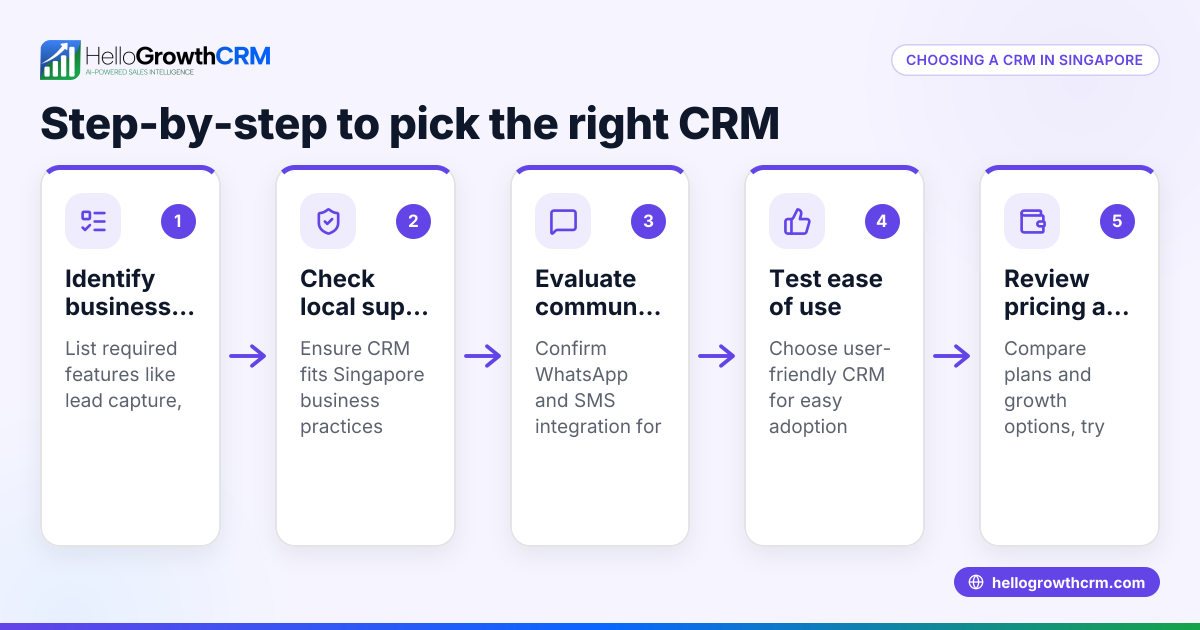
- Identify your food business needs: Determine the key workflows—order tracking, customer communication, delivery scheduling, or loyalty programmes. Check if you need mobile messaging integration (e.g., WhatsApp) because many Singapore customers prefer it.
- Check CRM features for food businesses: Look for lead capture from web forms or integrations, pipeline management, and messaging sequences via WhatsApp, SMS, or email. Confirm if the CRM supports logging conversations and automating follow-ups.
- Consider ease of use for your team: The CRM should be simple enough for your sales and delivery teams to adopt without extensive training. Check if it has AI assistance to draft follow-ups, reducing manual work.
- Evaluate pricing and scalability: Start with a free or low-cost plan that fits your current team size and lead volume. Make sure the CRM can grow with your business needs.
- Test integrations and mobile support: Verify that the CRM works well with your existing tools and supports mobile usage, especially WhatsApp, which is common in Singapore food sales.
- Request demos or trials: Use trial periods to see if the CRM meets your workflow and team adoption requirements.
- Review reporting and forecasting capabilities: A good CRM should give insights into sales performance and help forecast demand.
Example (fictional figures)
A food delivery startup in Tampines, "TasteBites", handles about 150 leads monthly from its website and social media. They want to automate follow-ups and track orders.
- Leads per month = 150
- Average conversion rate without CRM = 20% (30 orders)
- Average order value = S$45
- Monthly revenue without CRM = 30 × S$45 = S$1,350
By adopting a CRM with automated WhatsApp follow-ups, TasteBites improves conversion to 30% (45 orders).
- New orders = 150 × 30% = 45
- Monthly revenue with CRM = 45 × S$45 = S$2,025
Revenue increase = S$2,025 - S$1,350 = S$675
This demonstrates how a food CRM can directly impact sales by improving lead follow-up and order management.
Common mistakes
- Choosing a CRM without WhatsApp or SMS integration: Since many Singapore food customers prefer WhatsApp, missing this feature leads to poor engagement. Prevent this by prioritising CRMs with mobile messaging workflows like HelloGrowthCRM's WhatsApp and SMS CRM (/product/whatsapp-sms-crm).
- Ignoring team adoption challenges: Complex CRMs can frustrate staff and reduce usage. Select a CRM with simple interfaces and AI agents that draft follow-ups for reps to review, reducing manual effort (/product/ai-crm).
- Overlooking lead capture automation: Manually entering leads wastes time and causes errors. Use a CRM that captures leads automatically from web forms and integrations.
- Not testing scalability: Starting with a CRM that cannot grow with your business leads to costly migrations. Begin with a plan that fits small teams and can scale, like HelloGrowthCRM's Free Forever plan for two-person teams (/free-crm).
- Neglecting reporting and pipeline visibility: Without clear sales forecasting and pipeline boards, it's hard to prioritise tasks and predict revenue. Choose a CRM with these features.
Doing this in HelloGrowthCRM
HelloGrowthCRM supports food businesses with WhatsApp and SMS messaging workflows that log conversations on lead records and automate follow-ups. Its AI agents draft follow-up messages after calls for reps to review and send, reducing manual work. Small teams can start on the Free Forever plan, managing up to 200 leads and running a full pipeline at no cost until they need calling or WhatsApp automation. Learn more about HelloGrowthCRM for Singapore (/singapore).
Frequently asked questions
What is a food CRM and why do I need one? A food CRM is a system to manage customer relationships specifically for food businesses, helping track leads, orders, and communications. It improves follow-up speed and organisation, reducing lost sales.
Can a food CRM integrate with WhatsApp? Yes, many food CRMs, including HelloGrowthCRM, offer WhatsApp integration to log conversations and automate messaging, which is crucial since WhatsApp is widely used by Singapore customers.
Is there a free CRM suitable for small food businesses? Yes, HelloGrowthCRM offers a Free Forever plan that supports two-person teams with up to 200 leads, allowing small food businesses to manage pipelines without upfront costs.
How does AI help in a food CRM? AI agents can draft follow-up messages and update records automatically, saving time and ensuring timely customer engagement.
What should I ask when evaluating a food CRM? Ask about messaging channel support (WhatsApp, SMS), ease of use, automation features, lead capture methods, reporting tools, and pricing scalability.
Can a food CRM help with sales forecasting? Yes, a good CRM provides sales forecasting and pipeline visibility to help plan inventory and staffing.
Key takeaways
- A food CRM helps food businesses manage leads, orders, and customer communication efficiently.
- Prioritise CRMs with WhatsApp and SMS integration to match customer preferences in Singapore.
- Ensure the CRM is easy for your team to use and offers AI assistance to reduce manual tasks.
- Start with scalable, affordable plans like HelloGrowthCRM's Free Forever plan.
- Avoid common mistakes like ignoring team adoption and missing automated lead capture.
- Use CRM reporting and forecasting to improve sales planning and customer engagement.
Start streamlining your food business sales today by trying HelloGrowthCRM’s Free Forever plan with no credit card required at /free-crm.
Ready to put this into practice?
Set up your pipeline, WhatsApp follow-ups, and AI lead scoring in minutes — free, no credit card.
Try HelloGrowthCRM freeGet CRM tips in your inbox
Join thousands of sales professionals who get weekly insights on CRM strategy, AI automation, and pipeline optimization.

The HelloGrowthCRM team publishes guides on CRM strategy, AI sales tools, and revenue operations for small business sales teams.