HelloGrowthCRM software
Built for real small-business sales teams
HelloGrowthCRM helps reps qualify faster, follow up on time, and close more deals—with practical automation in one place.
- AI lead scoring and pipeline visibility
- Built-in dialer, WhatsApp, and email automation
- Sales forecasting and RevOps-ready reporting
In Canada, free lead management software is useful only if it can capture where leads came from, preserve consent records, and fit the way Canadian businesses actually book, bill and follow up.
That matters because a clinic in Mississauga, a contractor in Calgary and an agency in Montreal do not all handle inquiries the same way. Canada has federal privacy rules under PIPEDA, Quebec has Law 25, marketing messages are shaped by CASL, and customer payments often arrive by Interac e-Transfer rather than through a card processor. If your free system ignores those details, you do not merely lose convenience; you lose evidence, misread your pipeline, and make later migration harder.
This guide focuses on what a Canadian owner or manager should test before committing even to a free plan.
Lead source tracking should reflect how Canadians actually find local businesses
A generic lead inbox is not enough. In Canada, many small firms draw inquiries from Google Business Profile, referrals, Facebook, LinkedIn, Kijiji, HomeStars and, in some trades and local services, Yellow Pages. Those channels produce different kinds of intent. A HomeStars inquiry for emergency HVAC service in Calgary is not the same as a LinkedIn message to a Montreal staffing agency or a Google Business Profile call to a Vancouver dental office.
Your software should let you record the original source at intake, not as an afterthought added by staff later. If the source field is optional or hidden, people skip it when they are busy. Once that habit forms, you cannot tell whether a cheap channel is creating qualified work or just noise.
A second Canada-specific issue is bilingual intake. In Quebec, customer-facing communication has language implications, and in practice a French form, confirmation and reminder are often part of doing business properly. If the lead record does not preserve the language of the inquiry, follow-up can quickly become inconsistent.
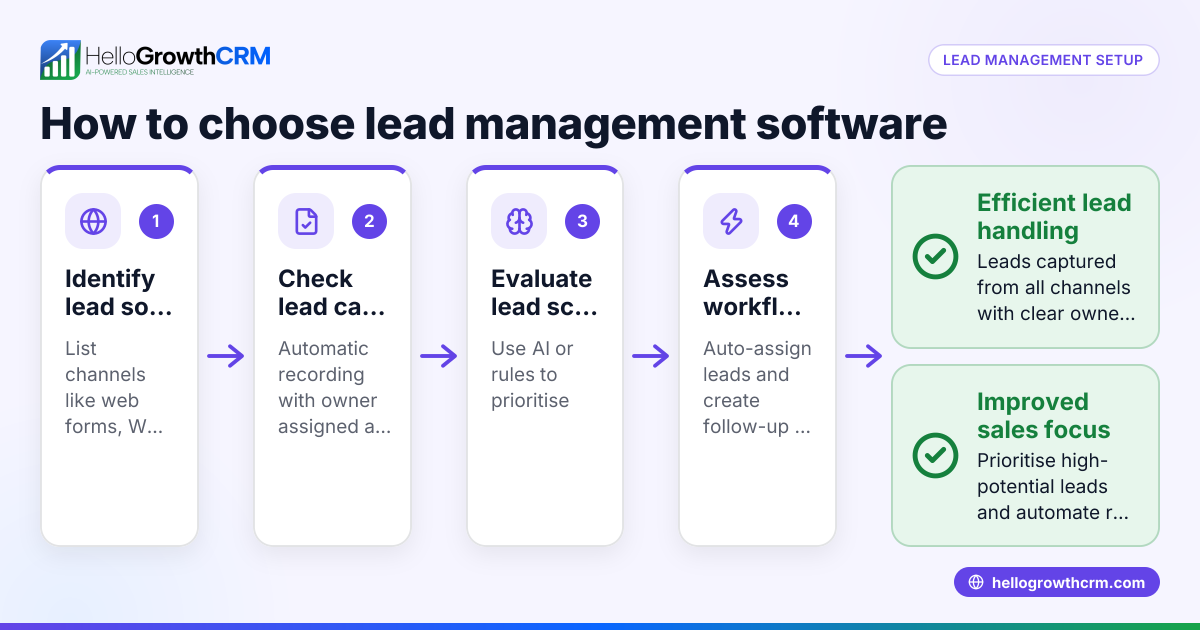
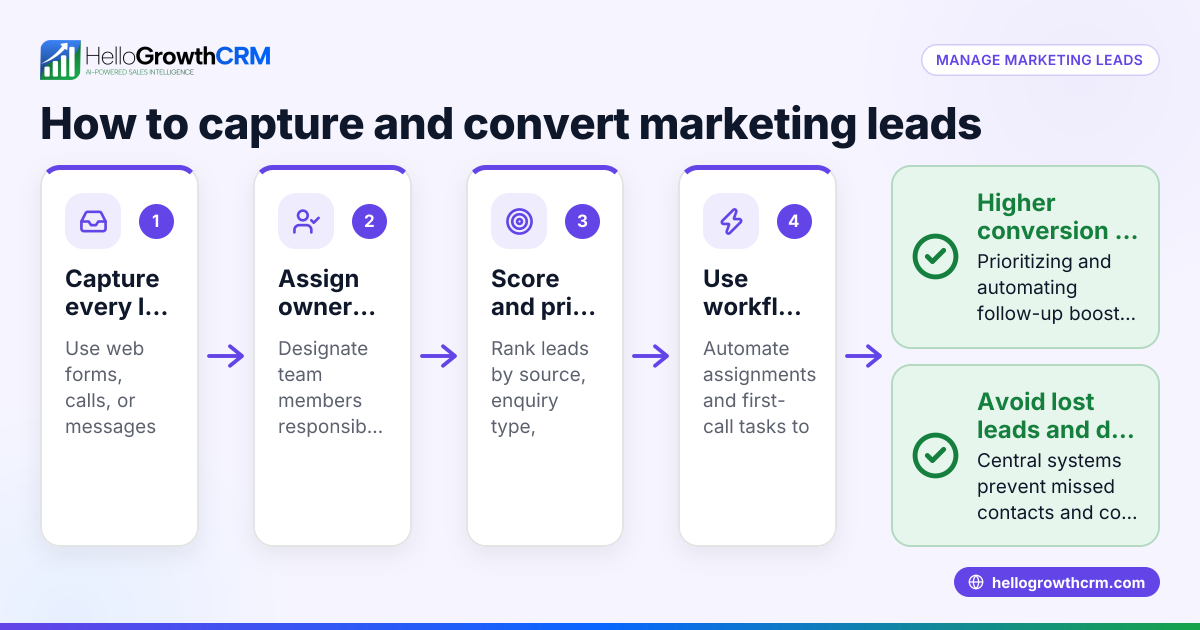
For a free setup, look first for basic lead capture and pipeline entry rather than a long feature list. HelloGrowthCRM’s lead capture and qualification tools are available on its free tier, which makes it possible to organize incoming inquiries before deciding whether a paid stack is necessary.
CASL turns consent tracking from a marketing nicety into a recordkeeping job
Canada’s anti-spam law is not just an email marketing issue. CASL, enforced by the CRTC, governs commercial electronic messages and requires consent, sender identification and a working unsubscribe mechanism. For lead management, the practical consequence is simple: the CRM must store when consent was obtained, what kind it was, and where it came from.
That matters because implied consent does not last indefinitely. The current rules and timing are published by the CRTC, and you should verify them there rather than relying on a blog post or an old playbook. A system that records only “subscribed: yes” is weak evidence if you ever need to explain why a campaign went out.
Another Canadian trap is mixing service and marketing messages. A booking confirmation or appointment reminder may be operational, but add a promotional line and you can move the message into CASL’s scope. Good lead management therefore keeps transactional templates separate from promotional outreach. That is a workflow question, not just a legal one.
If you plan to follow up across more than email, review how the software handles message history and opt-outs on each channel. For teams that need outbound sequences later, it is safer to start in a system that can mature with you than to export consent data into spreadsheets. HelloGrowthCRM offers sequences and campaign tools on paid tiers, but even on a free plan the key question is whether the contact record can hold the evidence you need.
Privacy obligations differ between the rest of Canada and Quebec
Lead data is personal information. For most private-sector organizations across Canada, the baseline federal law is PIPEDA, overseen by the Office of the Privacy Commissioner of Canada. In Quebec, Law 25 adds its own obligations around consent, transparency and reporting of confidentiality incidents, with oversight from the Commission d’accès à l’information.
For software selection, do not turn this into a vague “security matters” slogan. Ask whether the system lets you control who can see notes, whether staff activity is tied back to the contact record, and whether deletion or correction requests can be handled without hunting across disconnected tools. If a receptionist, sales rep and owner all work from different inboxes and phones, your privacy position is already weaker than your policy may suggest.
Storage location is not the only issue Canadian businesses should think about. The bigger operational issue is governance: can you show what was collected, why it was collected, and who used it? A free tool that scatters contact history across email, SMS and paper notes can create more risk than a modest paid system with cleaner records.
If security review is part of your buying process, keep it practical. HelloGrowthCRM provides a security overview, which is a sensible place to start before you involve legal or IT.
Time zones and booking rules matter more in Canada than many buyers expect
Canada spans six time zones, including Newfoundland’s half-hour offset. Daylight saving time is not observed uniformly, and Saskatchewan catches many teams because assumptions built around Toronto or Vancouver do not always hold. A booking created in October for work due in March should remain anchored to the intended local time, not drift by an hour because of a bad calendar setup.
This is not only a scheduling issue. Lead response SLAs, reminder messages and rep assignment windows all depend on time handling. If your inside sales team sits in Ontario and books appointments for Alberta and British Columbia, the wrong default time zone can create missed calls and duplicate outreach.
Statutory holidays add another wrinkle. They vary by province, and some are observed only in certain places. If your automation sends reminders or escalation tasks without location context, staff may be expected to respond on a local holiday or customers may receive poorly timed messages.
For Canadian service businesses, free lead management software should at minimum preserve local time on activities and bookings. If appointments are central to conversion, test booking pages with contacts in different provinces before you roll them out. HelloGrowthCRM includes scheduling and booking on its free tier, which makes this easy to test with a small volume before standardizing the process.
Payment habits in Canada can distort your pipeline if you only watch card receipts
Canadian customers often pay in ways that do not pass through a card processor. Interac e-Transfer is common for deposits and final balances, especially in home services and smaller professional practices. Pre-authorised debit, cheque and wire transfer also remain normal in some sectors. If your lead process assumes a closed deal equals a card payment, you will under-record cash received and misjudge which lead sources actually convert into money.
The tax side adds another reason to keep records clean. Canada does not have a single national sales tax in practice. Depending on where the supply takes place, the relevant mix may involve GST, HST, PST and, in Quebec, QST. The Canada Revenue Agency publishes rules on GST and HST, and Revenu Québec publishes current QST guidance. For multi-province operators, recording the province of supply on each transaction matters more than simply storing the total amount.
Deposits are a specific paperwork problem. CRA guidance distinguishes between the timing of the tax obligation and the treatment of deposits and forfeited amounts; those are not identical questions. So if your business takes a booking deposit today and applies or keeps it later, your CRM and payment record should preserve what happened and when. Do not rely on memory after month-end.
The arithmetic below is illustrative; the figures are made up to show the shape of the decision. An HVAC contractor in Calgary spends C$0 on a free CRM plan, takes in 30 new inquiries in a month, books C$4,800 of quoted work, and receives C$1,500 by Interac e-Transfer plus C$900 by card as deposits. If the owner reviews only the card processor, it looks as if less than half the deposits were collected. If the lead record and deal record both reflect payment received, the owner sees that a referral source produced two e-Transfer-paying jobs and a Facebook source produced one card-paying job. That does not tell you gross margin, tax liability, chargebacks, refunds, labour cost or whether the work should be recognized as revenue yet; it simply shows why a card-only view misreads demand in Canada.
Free plans are worth it only when the upgrade path matches your workload
A free tool is not automatically cheap. It is cheap only if the fields, records and workflow structure you create now can survive when your volume increases. In lead management, the real cost appears when staff create side spreadsheets because the free plan cannot support the next step.
For Canadian firms, that next step is often not advanced analytics. It is basic operational maturity: a visible pipeline, task ownership, meeting history and a single place to review every interaction. If the product walls off core pipeline management until you pay, your team will never build disciplined habits on the free tier.
HelloGrowthCRM’s Free Forever plan includes lead management, a Kanban pipeline, tasks and scheduling, with no credit card required. That makes it suitable for trialing real intake and follow-up rather than a toy demo. The useful question is not whether free exists; it is whether you can run one location, one rep or one service line in a consistent way before spending more.
When you compare options, keep the checklist short:
- Can each lead record store source, province, language and consent evidence?
- Can tasks, calls, meetings and notes stay attached to the same contact and deal?
- Can booking times remain correct across Canadian time zones and daylight saving changes?
- Can staff record payments that arrive by Interac e-Transfer, cheque or PAD as well as by card?
- Can the setup expand into automation or integrations without rebuilding your data model?
Canadian regulated businesses should test the edge cases first
Many Canadian buyers are not generic small businesses. They are clinics, law practices, dental offices and staffing firms. Those organizations face sector rules on top of general privacy and messaging law, often from provincial colleges or law societies. A free lead management tool might be acceptable for initial inquiry capture yet unsuitable for storing sensitive intake detail.
That does not mean regulated firms cannot use a free CRM. It means they should define what belongs in the lead record. A physiotherapy clinic in Mississauga may log a new inquiry, preferred location and booking status while keeping clinical detail elsewhere. A Halifax law practice may capture referral source, matter type and conflicts-check status without dumping confidential facts into the first-contact note. The design choice is operational, but the consequences are legal and reputational.
Accessibility also belongs in this review. In Ontario, the Accessibility for Ontarians with Disabilities Act affects customer-facing digital content, and other provinces have their own accessibility legislation. If booking pages or forms are part of your lead process, they are not merely marketing assets; they are part of service access.
Use one system to create a usable contact history, not a pile of disconnected channels
The best argument for lead management software in Canada is not automation. It is having one usable record when a prospect phones, emails, fills a form, replies by SMS and then pays by e-Transfer. Without that history in one place, every handoff becomes guesswork.
That is where even a small team benefits from a CRM instead of inbox folders. HelloGrowthCRM combines pipeline tracking in its CRM and deals layer with activity logging through tasks and task boards, so new inquiries and follow-up work can stay connected to the same record. If your team later adds calling, messaging or integrations, you are extending one workflow rather than reconciling separate systems.
For a Canadian business, that unified record should answer practical questions fast: who contacted you, in what language, from which source, in which province, with what consent, and what happened next. If a free plan can do that cleanly, it is worth trying. If it cannot, “free” is only postponing the mess.
Ready to put this into practice?
Set up your pipeline, WhatsApp follow-ups, and AI lead scoring in minutes — free, no credit card.
Try HelloGrowthCRM freeGet CRM tips in your inbox
Join thousands of sales professionals who get weekly insights on CRM strategy, AI automation, and pipeline optimization.

The HelloGrowthCRM team publishes guides on CRM strategy, AI sales tools, and revenue operations for small business sales teams.