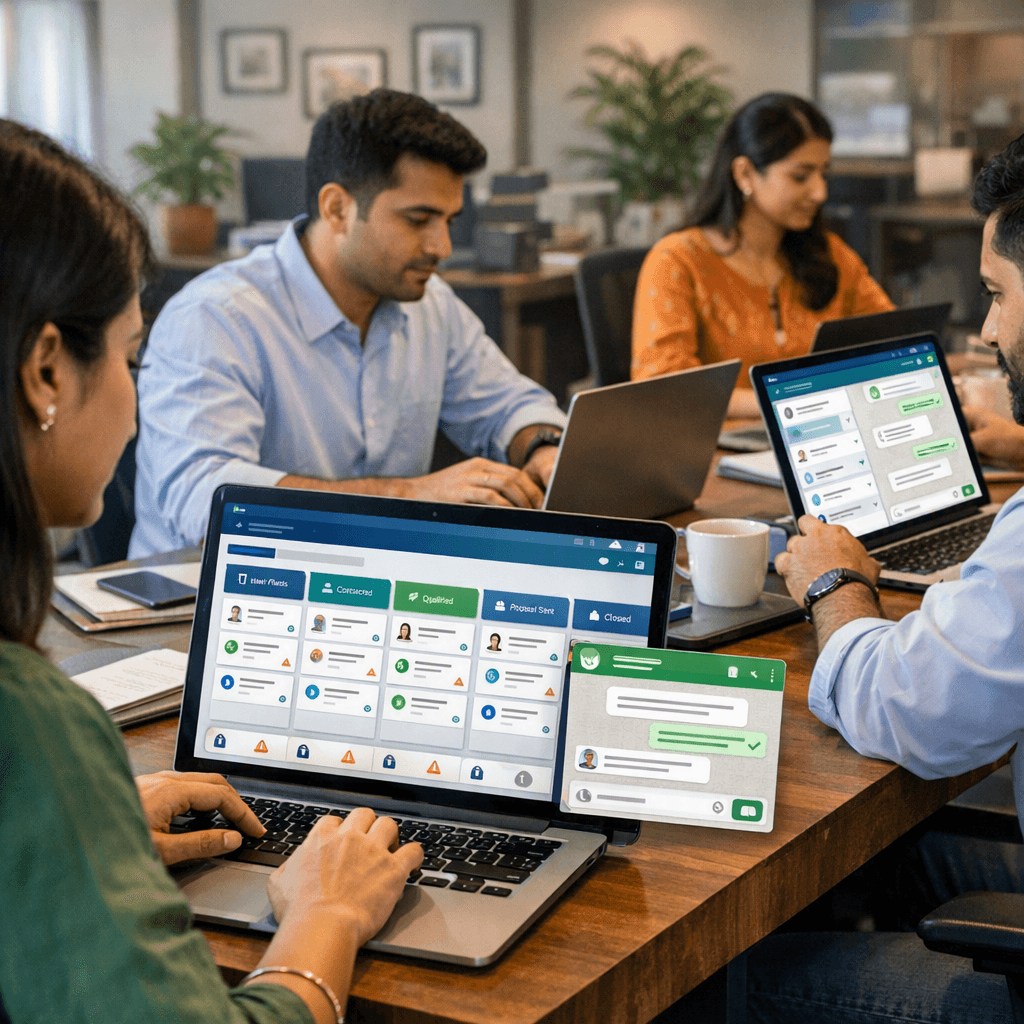
HelloGrowthCRM software
Built for real small-business sales teams
HelloGrowthCRM helps reps qualify faster, follow up on time, and close more deals—with practical automation in one place.
- AI lead scoring and pipeline visibility
- Built-in dialer, WhatsApp, and email automation
- Sales forecasting and RevOps-ready reporting
HelloGrowthCRM for IndiaMART, JustDial, and WhatsApp lead management is a CRM workflow for Indian SMEs that centralises inbound leads, routes them by source and territory, tracks consent and follow-ups, and gives sales teams one DPDPA-aware pipeline for faster response, cleaner forecasting, and better conversion.
Key Takeaways
- Indian B2B SMEs can capture IndiaMART, JustDial, website, and WhatsApp leads in one place inside HelloGrowthCRM’s AI CRM.
- Fast speed-to-lead matters more than adding more channels. Routing, ownership, and follow-up SLAs need to be defined first.
- DPDPA-safe workflows should cover consent capture, purpose limitation, access control, and retention policies for lead records.
- Razorpay payment visibility and Tally sync planning help sales, finance, and ops work from the same customer timeline.
- For Mumbai, Pune, and tier-2 or tier-3 markets, territory rules and WhatsApp-first outreach often outperform generic email-only cadences.
- HelloGrowthCRM works best when SMEs standardise qualification, pipeline stages, and handoffs before turning on automation.
Why Indian SMEs need one CRM for IndiaMART, JustDial, WhatsApp, and website leads
Indian SMEs need one CRM for IndiaMART, JustDial, WhatsApp, and website leads because fragmented inboxes slow first response, create duplicate records, and hide real pipeline health. A unified workflow in HelloGrowthCRM helps teams assign leads faster, qualify consistently, and measure source-wise conversion without losing local selling context.
Most Indian B2B teams do not have a lead generation problem. They have a lead handling problem.
A typical Mumbai or Pune SME gets inquiries from:
- IndiaMART
- JustDial
- Website forms
- WhatsApp chats
- Referral calls
- Field sales handovers
If these land in separate tools, three things happen fast:
- Reps cherry-pick easy leads.
- Managers lose visibility into follow-up discipline.
- Forecasts become guesswork.
This is where Features inside HelloGrowthCRM matter. Instead of asking reps to check five systems, you centralise lead capture, automate routing, and track every call, note, message, and payment signal in one record.
In one rollout we did with a 12-person sales team selling industrial equipment in Pune, the biggest issue was not lead volume. It was response delay. IndiaMART leads sat in one sales manager’s inbox for two hours at a time. Once we moved source capture and round-robin assignment into the CRM, missed follow-ups dropped within the first week.
What “centralise” should mean in practice
Centralising leads does not just mean importing contacts. It should mean:
- One lead record per company or buyer
- Source tagging at capture
- Auto-assignment by territory, product line, or language
- WhatsApp and call history on the same timeline
- Qualification status visible to managers
- Payment and finance signals linked back to the opportunity
That is the practical difference between a database and an operating CRM.
What a DPDPA-safe lead workflow looks like in HelloGrowthCRM
A DPDPA-safe lead workflow in HelloGrowthCRM means collecting only the lead data needed for a stated sales purpose, controlling who can access it, documenting consent or lawful use context, and enforcing retention, audit, and follow-up rules across every source and user action.
India’s Digital Personal Data Protection Act, 2023 sets the direction for lawful, purpose-bound handling of personal data in business systems, and MeitY provides the official framework context at meity.gov.in/data-protection-framework.
For Indian SMEs, this should shape CRM design from day one. It should not be a legal note added later.
Core DPDPA-safe controls for SME sales teams
Use these controls inside your CRM process:
- Capture source and consent context at lead creation
- Limit visible fields by role
- Define why each field is collected
- Avoid storing unnecessary personal details
- Set retention rules for stale or unqualified leads
- Keep an activity log for edits, ownership changes, and outreach
If your team uses WhatsApp & SMS CRM, this matters even more. WhatsApp feels informal, but the data is still business data. Teams should know what they can store, who can message a lead, and when old chats should be archived.
When I have audited pipelines like this, the most common risk is over-collection. Teams store alternate numbers, personal family details, and unrelated notes because “it may help later.” That creates compliance exposure and clutters qualification.
Keep access tied to role and workflow
For small teams under 50 reps, simple controls usually work:
| Workflow area | Recommended control in HelloGrowthCRM | Why it matters |
|---|---|---|
| Lead intake | Mandatory source field and consent context field | Preserves origin and usage basis |
| Assignment | Role-based access by region or team | Reduces unnecessary data visibility |
| Follow-up | Template-based outreach with audit trail | Keeps communication consistent |
| Qualification | Required BANT or MEDDPICC fields before stage movement | Improves data quality |
| Closed-lost/stale | Auto-retention review task | Supports data minimisation |
| Finance visibility | Payment status visible, banking details restricted | Balances context with privacy |
This setup is usually enough for SME sales motions. For larger teams or regulated sectors, you may need more granular controls and internal policy review.
How HelloGrowthCRM routes and qualifies inbound Indian leads without slowing speed-to-lead
HelloGrowthCRM routes and qualifies inbound Indian leads by capturing source data at entry, applying assignment logic for geography or product, triggering immediate tasks or WhatsApp outreach, and standardising qualification fields so reps can respond quickly without skipping the information managers need for coaching and forecasting.
Speed-to-lead is a process problem first. Technology just enforces it.
The right approach is to connect lead capture with Sales Task Boards, Meeting Scheduler, and AI Lead Scoring so the rep knows exactly what to do next.
Best routing rules for Indian SME sales teams
For IndiaMART and JustDial leads, use simple routing first:
- By city cluster: Mumbai, Pune, Bangalore, Ahmedabad
- By state or zone
- By product category
- By language preference
- By new lead vs re-inquiry
- By account owner if the company already exists
For tier-2 and tier-3 markets, city-based ownership often works better than generic round-robin. Local reps know travel routes, buying cycles, and channel partner relationships.
Qualification fields that actually help conversion
Avoid 25-field forms. Start with the minimum set that improves decisions:
- Lead source
- Product interest
- City and state
- Business type
- Monthly order potential
- Required timeline
- Existing vendor
- Contactability status
- Qualification score
- Next follow-up date
Use one framework consistently. For small B2B sales cycles, BANT is fine. For larger deal sizes, use MEDDPICC elements gradually. If your team wants automation, AI Pipeline Management and AI Deal Insights are more useful when qualification fields are clean.
Which pipeline design works best for Mumbai, Pune, and tier-2 or tier-3 B2B markets
The best pipeline design for Mumbai, Pune, and tier-2 or tier-3 B2B markets is a short, operational pipeline with clear entry criteria, contactability checks, qualification gates, quote visibility, and payment-linked deal progress, because Indian SME deals often move through calls, WhatsApp, local meetings, and finance approvals in parallel.
Most SME pipelines should have 6 to 8 stages, not 12.
A practical design for HelloGrowthCRM looks like this:
- New lead
- First contact attempted
- Connected
- Qualified
- Quote or proposal sent
- Negotiation
- Payment pending
- Won or lost
This structure works well with Proposal Builder, CRM Dialer, and Smart Inbox.
Stage definitions matter more than stage names
If reps move deals based on mood, your forecast will fail.
Define each stage using objective triggers:
- Connected: buyer responded by call, WhatsApp, or email
- Qualified: need, buyer role, timeline, and budget signal captured
- Quote sent: formal pricing or proposal shared
- Payment pending: verbal confirmation received, awaiting transaction
- Won: payment received or PO accepted
This gives managers better Sales Forecasting inputs and cleaner win-rate analysis.
In one implementation for a Bangalore services firm, we removed three vague stages called “discussion,” “follow-up,” and “interested.” Forecast accuracy improved because reps had to choose a stage based on evidence, not optimism.
Suggested source-specific handling
IndiaMART leads often need fast qualification because intent appears high but fit varies.
JustDial leads may need extra contactability checks because duplicate or low-detail inquiries are common.
Website demo leads usually deserve faster senior response, especially if they request pricing or integration details through Demo or Pricing pages.
WhatsApp leads need strict follow-up ownership. Shared messaging channels without owner assignment create leakage fast.
How Razorpay and Tally visibility improve CRM execution for Indian SMEs
Razorpay and Tally visibility improve CRM execution for Indian SMEs by connecting payment and accounting signals to sales records, which helps reps follow up at the right time, helps managers spot stuck deals, and helps finance and sales align on collection status, booking dates, and handoff readiness.
The Reserve Bank of India is the authoritative reference for India’s payments ecosystem and regulatory context at rbi.org.in.
For many SMEs, deals are not truly won when the rep says “confirmed.” They are won when money lands or an approved PO is in place.
That is why Stripe and Razorpay style payment visibility inside CRM matters. Even if you use custom finance processes, the CRM should still show:
- Payment link sent
- Payment attempted
- Payment completed
- Invoice shared
- Collection overdue
Tally sync considerations before you connect systems
Many Indian SMEs still run accounting in Tally. That is normal. The mistake is assuming sync should be fully automatic on day one.
Plan these questions first:
- What is the system of record for customer master data?
- Should sales create accounts, or should finance approve them?
- Which fields must sync both ways?
- How are GST, billing names, and branch codes handled?
- When should a won deal become an accounting record?
If you already connect tools through Zapier or review options in All Integrations, map the process before mapping the fields.
This is a real limitation worth stating clearly: for teams with messy accounting masters, syncing too early can create duplicates faster than it saves time.
How to set up HelloGrowthCRM for IndiaMART, JustDial, WhatsApp, and website leads: Step-by-Step
To set up HelloGrowthCRM for IndiaMART, JustDial, WhatsApp, and website leads, start by standardising fields and ownership rules, then connect lead sources, define pipeline stages, enable follow-up automation, and finally add compliance, payment, and reporting controls so the system improves speed without adding chaos.
- Define one lead schema
- Connect your lead sources
- Set routing logic
- Build the pipeline stages
- Turn on follow-up tasks and reminders
- Add qualification scoring
- Connect payment visibility
- Review compliance and retention rules
- Track source-wise performance
KPIs to watch in the first 60 days
Use a simple dashboard. Track:
- Median speed-to-lead
- First contact success rate
- Qualified lead rate by source
- Quote-to-win rate
- Payment completion lag
- Lead aging by owner
- Duplicate lead rate
NASSCOM notes that India’s tech sector reached over USD 250 billion in FY2024, showing the scale and maturity of India’s digital operating environment (NASSCOM Strategic Review 2024).
That matters because buyers now expect quick, well-coordinated responses. Even traditional sectors have become digitally impatient.
Why HelloGrowthCRM fits Indian SME revenue teams better than stitched-together tools
HelloGrowthCRM fits Indian SME revenue teams better than stitched-together tools because it combines lead capture, pipeline control, follow-up workflows, AI assistance, and revenue visibility in one operating layer, which reduces manual handoffs and helps teams move faster with less admin and better manager oversight.
This article is about HelloGrowthCRM, and that is our product, so here is the fair disclosure: if your team only needs a basic contact database, a simpler tool may be enough. But if you are juggling IndiaMART, JustDial, WhatsApp, local field reps, and payment follow-through, point tools usually break under day-to-day pressure.
HelloGrowthCRM vs fragmented lead handling
| Criteria | HelloGrowthCRM | Separate inboxes, sheets, and chat tools |
|---|---|---|
| Lead capture | Centralised across channels | Split by app or person |
| Assignment | Rule-based and trackable | Manual and inconsistent |
| WhatsApp visibility | Logged in the customer timeline | Lost in personal devices |
| Qualification | Standard fields and scoring | Varies by rep |
| Forecasting | Stage-based and reportable | Hard to trust |
| Payment context | Can be linked to deal flow | Often outside sales view |
| Compliance control | Role access and auditability | Weak and scattered |
If you want to test fit, start with a Free Trial, or book a Demo and ask specifically about IndiaMART, JustDial, WhatsApp routing, and DPDPA-safe workflows for your team.
For Indian B2B teams in Mumbai, Pune, Bangalore, and growing tier-2 markets, HelloGrowthCRM gives sales, ops, and founders one place to run the pipeline properly. If your reps are still chasing leads across inboxes and chats, now is a good time to try HelloGrowthCRM for a cleaner, faster, and more reliable CRM setup.
About the author
Arjun Mehta is a Revenue Operations Lead at HelloGrowthCRM with 11 years of experience in B2B SaaS, CRM implementation, and sales process design for Indian growth teams. He has led pipeline, routing, and forecasting rollouts for SME sales teams across Mumbai, Pune, and Bangalore. One project that informed this article was a multi-source lead management setup for a 12-person industrial sales team that needed to centralise IndiaMART, WhatsApp, and finance status without slowing first response.
Frequently Asked Questions
Q: Can HelloGrowthCRM capture leads from IndiaMART, JustDial, website forms, and WhatsApp in one pipeline?
A: Yes, HelloGrowthCRM can capture leads from IndiaMART, JustDial, website forms, and WhatsApp in one pipeline so your team can assign, qualify, and follow up from a single record. This reduces duplicate work and gives managers clear source-wise visibility.
Q: Is HelloGrowthCRM suitable for Indian SMEs with small sales teams?
A: Yes, HelloGrowthCRM is suitable for Indian SMEs with small sales teams because it supports simple routing, fast follow-up, and clear pipeline stages without needing enterprise-level admin complexity. It is especially useful for teams handling many inbound inquiries across multiple channels.
Q: How does HelloGrowthCRM support DPDPA-safe lead management?
Frequently Asked Questions
Ready to put this into practice?
Set up your pipeline, WhatsApp follow-ups, and AI lead scoring in minutes — free, no credit card.
Try HelloGrowthCRM freeGet CRM tips in your inbox
Join thousands of sales professionals who get weekly insights on CRM strategy, AI automation, and pipeline optimization.

The HelloGrowthCRM team publishes guides on CRM strategy, AI sales tools, and revenue operations for small business sales teams.