HelloGrowthCRM software
Built for real small-business sales teams
HelloGrowthCRM helps reps qualify faster, follow up on time, and close more deals—with practical automation in one place.
- AI lead scoring and pipeline visibility
- Built-in dialer, WhatsApp, and email automation
- Sales forecasting and RevOps-ready reporting
Missing customer follow-ups can cost small and mid-sized businesses valuable sales and customer trust. To avoid this, you need a reliable, repeatable process that keeps every follow-up visible and timely. This guide walks you through why follow-ups get missed, how to set up a system to prevent it, a realistic example, common pitfalls, and how HelloGrowthCRM’s task boards, sequences, and AI agents can support your efforts.
Why this comes up / what goes wrong
Small-business owners and sales teams often miss follow-ups because they rely on memory, scattered notes, or unorganized spreadsheets. Follow-ups can slip through when:
- Leads come from multiple channels like text, email, and web forms without a unified tracking system.
- There is no clear ownership of the follow-up task or no due date assigned.
- Daily priorities are unclear, causing urgent tasks to overshadow scheduled follow-ups.
- Manual tracking is error-prone and time-consuming, leading to forgotten calls or messages.
This results in lost sales opportunities and frustrated customers who feel ignored.
Step-by-step
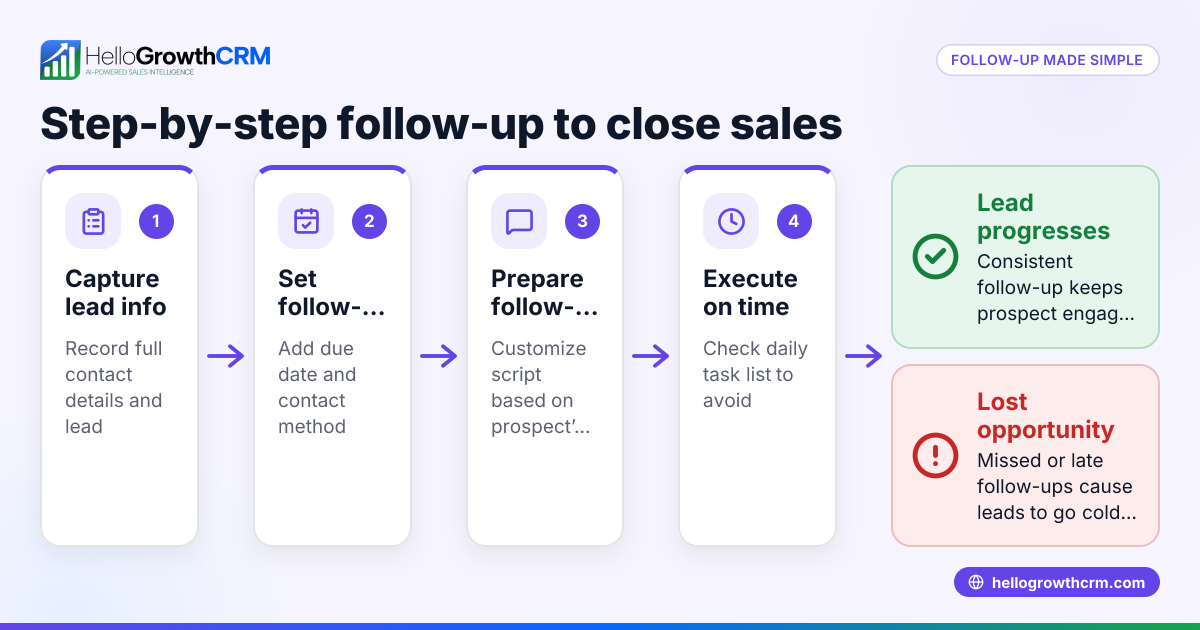
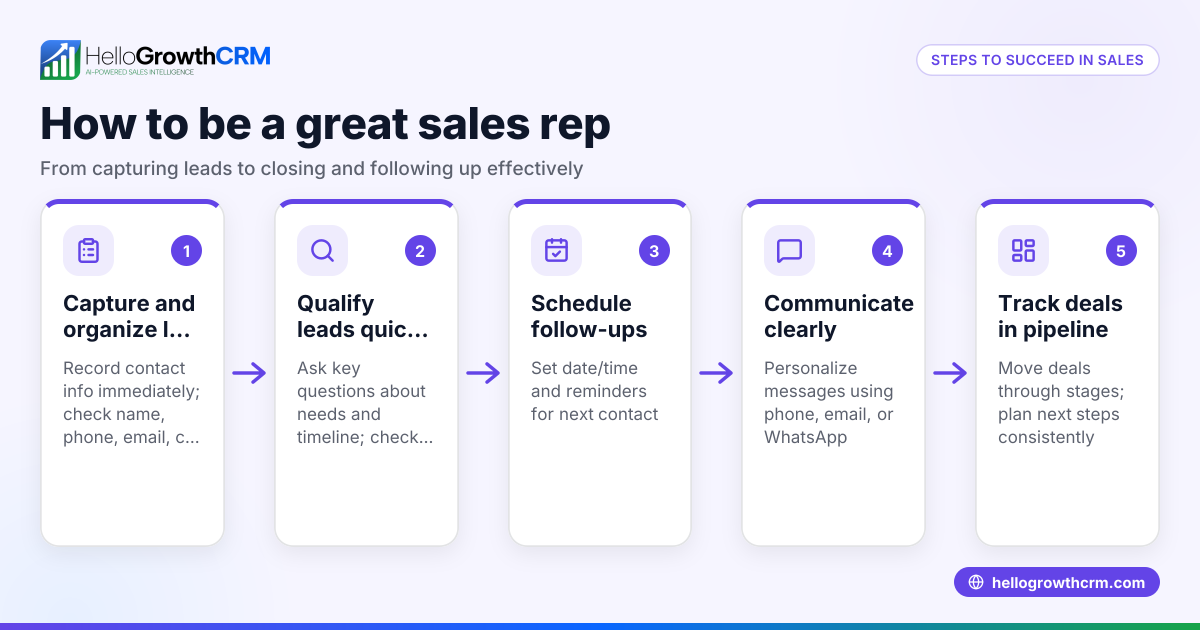
- Capture every lead or customer interaction immediately.
- Use a single place to log contacts, such as a CRM or a dedicated spreadsheet.
- Check that all new leads have a follow-up task created with a due date.
- Create a follow-up task for each contact with a clear due date.
- Assign responsibility to a team member.
- Confirm the follow-up date is realistic and agreed upon.
- Use daily task lists or boards to review all due follow-ups.
- Start each day by checking your follow-up list.
- Prioritize urgent or overdue follow-ups.
- Set reminders or alerts for upcoming follow-ups.
- Use calendar alerts, phone notifications, or CRM task reminders.
- Confirm reminders are received and acknowledged.
- Automate follow-up sequences where possible.
- Create multi-step message sequences over days or weeks.
- Ensure the sequence stops automatically when the customer replies.
- Review and update follow-up status after each contact.
- Mark tasks complete or reschedule if needed.
- Log notes from the interaction for future reference.
- Regularly audit your follow-up system.
- Check for missed or overdue tasks weekly.
- Adjust processes to close any gaps.
Integrate these steps with your sales workflow to make follow-ups a routine, not a chore.
Example (fictional figures)
A B2B software reseller in Denver, Colorado, receives a lead on 07/10/2023 for a $48,000 software package. They set a follow-up call task for 07/12/2023.
- Lead value: $48,000
- Follow-up call scheduled: 07/12/2023
On 07/12/2023, the sales rep calls and leaves a voicemail, then creates a 3-step email sequence:
- Email 1 sent on 07/13/2023
- Email 2 scheduled for 07/17/2023
- Email 3 scheduled for 07/21/2023
If the prospect replies at any point, the sequence stops.
The rep checks the task board daily:
- 07/12/2023: call task due, completed
- 07/13/2023: email 1 sent
- 07/17/2023: email 2 sent
- 07/21/2023: email 3 sent
This process ensures no follow-up is missed and keeps the rep on schedule.
Common mistakes
- Relying on memory: Prevent by using task boards or daily lists to externalize follow-ups.
- No due dates: Always assign a specific date to each follow-up task.
- Ignoring overdue tasks: Review overdue items daily and prioritize them.
- No clear ownership: Assign follow-ups to specific team members to avoid confusion.
- Manual tracking errors: Use automated sequences and reminders to reduce human error (see email automation and sequences).
- Not updating follow-up status: Log each interaction and mark tasks complete to keep the system current (see sales task boards).
Doing this in HelloGrowthCRM
HelloGrowthCRM offers features to keep follow-ups on track:
- Activities and task boards: Each follow-up becomes a task with a due date, and the day’s calls appear as a clear list, removing the need to remember every detail. See sales task boards.
- Sequences and campaigns: Automate a five-step follow-up over two weeks that stops immediately when the prospect replies, ensuring no manual errors. Learn more at email automation and sequences.
- AI agents: Beta AI agents draft follow-up messages after calls, so reps only need to review and send, saving time and reducing delays. Details at /product/ai-crm.
Frequently asked questions
How can I ensure I never miss a follow-up call? Use a task list or CRM with due dates and daily reminders. Review your follow-up tasks at the start of each day to prioritize calls and messages.
What is the best way to automate follow-ups? Set up multi-step sequences that send timed emails or messages until the prospect replies. This reduces manual work and ensures consistent outreach. HelloGrowthCRM supports this with automated sequences (email automation and sequences).
How do I keep track of follow-ups across different communication channels? Centralize all contacts and follow-ups in one system, such as a CRM, that logs emails, WhatsApp, SMS, and calls together. This prevents losing track when switching channels.
What if I get too many follow-ups to manage manually? Use task boards to organize and prioritize follow-ups visually. Assign tasks to team members and use automation to handle routine outreach. HelloGrowthCRM’s task boards help with this (sales task boards).
Can AI help with follow-up messages? Yes, AI agents can draft messages after calls, letting reps review and send quickly. This reduces delays and keeps the follow-up timely.
Key takeaways
- Capture every lead and create a follow-up task with a due date immediately.
- Use daily task lists or boards to review and prioritize follow-ups.
- Automate multi-step follow-up sequences that stop when a reply is received.
- Assign clear ownership and update follow-up statuses after contact.
- Avoid relying on memory by using reminders and task management tools.
- Regularly audit your system to catch missed or overdue follow-ups.
Start organizing your follow-ups today to improve customer retention and sales. You can try these steps with HelloGrowthCRM’s free tools for task boards and sequences.
Start on the Free Forever plan (200 leads, no credit card) at HelloGrowthCRM Free Forever plan.
Ready to put this into practice?
Set up your pipeline, WhatsApp follow-ups, and AI lead scoring in minutes — free, no credit card.
Try HelloGrowthCRM freeGet CRM tips in your inbox
Join thousands of sales professionals who get weekly insights on CRM strategy, AI automation, and pipeline optimization.

The HelloGrowthCRM team publishes guides on CRM strategy, AI sales tools, and revenue operations for small business sales teams.