HelloGrowthCRM software
Built for real small-business sales teams
HelloGrowthCRM helps reps qualify faster, follow up on time, and close more deals—with practical automation in one place.
- AI lead scoring and pipeline visibility
- Built-in dialer, WhatsApp, and email automation
- Sales forecasting and RevOps-ready reporting
Creating a customer support knowledge base helps your Singapore business reduce repetitive queries and improve customer satisfaction by providing quick, reliable answers. Many small businesses struggle with slow follow-up and inconsistent responses when handling support via WhatsApp, email, and spreadsheets. A knowledge base centralises information so customers and staff find solutions quickly and consistently.
Why this comes up / what goes wrong
Small business owners in Singapore often find their support teams overwhelmed with repeated questions through WhatsApp chats, emails, or phone calls. Without a structured knowledge base, support agents may give inconsistent answers or miss requests, leading to frustrated customers and lost sales. This slows down your team and wastes valuable time. A well-maintained knowledge base ensures your team and customers have fast, reliable access to answers, reducing workload and improving satisfaction.
Step-by-step
- Collect common customer questions and issues: Review your WhatsApp messages, emails, and any support tickets to identify frequently asked questions. Make a list of these queries.
- Group questions into logical categories: Organise the questions by themes such as product features, ordering process, delivery, returns, payment, and troubleshooting. Clear grouping helps customers navigate easily.
- Write clear, concise articles for each question: Use simple language and bullet points to explain answers or instructions step-by-step. Avoid jargon and keep paragraphs short.
- Choose a suitable platform for your knowledge base: Pick software that allows easy article creation, editing, and search. The platform should be accessible to customers anytime for self-service.
- Add a search function: Ensure your knowledge base supports keyword or phrase search so customers can quickly find relevant articles.
- Include visuals where helpful: Add screenshots, diagrams, or short videos to clarify complex steps or processes.
- Test the knowledge base with real users: Ask some customers or team members to try it and provide feedback on usability and clarity.
- Regularly update the content: Schedule monthly reviews to keep articles accurate and add new questions based on recent customer feedback.
- Promote your knowledge base: Share the link on your WhatsApp broadcasts, email signatures, website, and customer portal to encourage self-service.
- Monitor usage and identify gaps: Use analytics to track which articles are most viewed and which questions remain unanswered, then update accordingly.
Example (fictional figures)
An F&B supplier based in Woodlands aims to launch a knowledge base by 15/07/2024. From WhatsApp chats, they identify these top 3 questions:
- How to place an order?
- What are the delivery times and areas?
- How to return damaged goods?
They write three articles:
- Article 1: "Placing an Order"
- Article 2: "Delivery Times and Areas"
- Article 3: "Returns Process"
Costs involved:
- Writing and editing: S$1,200
- Platform subscription for 6 months: S$1,800
- Visual content creation: S$500
Total cost calculation: S$1,200 + S$1,800 = S$3,000 S$3,000 + S$500 = S$3,500
They launch the knowledge base on 15/07/2024 and promote it via WhatsApp messages and email newsletters.
Common mistakes
- Not updating the knowledge base regularly: Prevent by scheduling monthly content reviews.
- Using overly technical language: Use simple, clear wording to ensure all customers understand.
- Ignoring customer feedback: Collect feedback and improve articles accordingly.
- No search functionality: Without search, customers struggle to find answers quickly.
- Not integrating with support channels: Link your knowledge base with WhatsApp or email support to guide customers to self-help first. HelloGrowthCRM integrates WhatsApp and SMS CRM to streamline this process (/product/whatsapp-sms-crm).
- Lack of promotion: If customers don’t know about your knowledge base, they won’t use it. Share links on all communication channels.
Doing this in HelloGrowthCRM
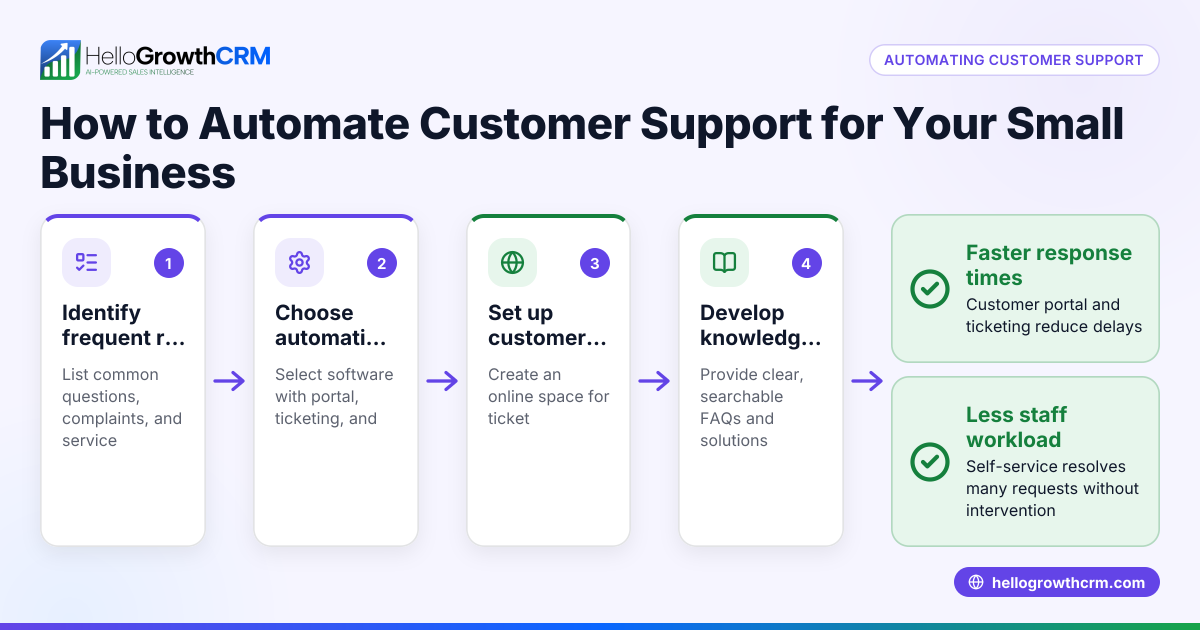
HelloGrowthCRM offers a branded self-service customer portal that includes a knowledge base and support tickets. After a sale, service requests stay linked to the same customer record as the deal, keeping your support organised and efficient. This helps your team track all interactions in one place and provides customers easy access to help articles. Learn more about HelloGrowthCRM for Singapore businesses (/singapore) and how customer health score tracking can improve your support (/product/customer-health-score).
Frequently asked questions
What is a customer support knowledge base? A knowledge base is a collection of articles and FAQs that provide answers to common customer questions. It allows customers to find solutions themselves without contacting support.
How often should I update my knowledge base? You should review and update your knowledge base at least once a month to ensure information remains accurate and relevant.
Can I use WhatsApp for customer support with a knowledge base? Yes. Integrating WhatsApp with your knowledge base helps guide customers to self-help articles before escalating to live support, saving time and improving efficiency.
Is a knowledge base suitable for small businesses? Absolutely. Small businesses benefit by reducing repetitive queries, speeding up response times, and improving customer satisfaction.
How do I measure if my knowledge base is effective? Track article views, search terms used, and unresolved tickets to identify gaps and popular topics for improvement.
What platform should I use for my knowledge base? Choose a platform that supports easy article creation, search functionality, and is accessible to your customers anytime. HelloGrowthCRM offers these features integrated with customer support tools.
Key takeaways
- Identify and organise common customer questions into clear categories.
- Write simple, step-by-step articles with visuals where helpful.
- Choose a platform with search and easy update capabilities.
- Regularly review and update your knowledge base content.
- Integrate your knowledge base with WhatsApp and support channels for better customer self-service.
- Use HelloGrowthCRM’s customer portal and knowledge base features to streamline support and keep service requests linked to deals.
Start building your customer support knowledge base today to improve your Singapore business’s customer service. Start on the Free Forever plan (200 leads, no credit card).
Ready to put this into practice?
Set up your pipeline, WhatsApp follow-ups, and AI lead scoring in minutes — free, no credit card.
Try HelloGrowthCRM freeGet CRM tips in your inbox
Join thousands of sales professionals who get weekly insights on CRM strategy, AI automation, and pipeline optimization.

The HelloGrowthCRM team publishes guides on CRM strategy, AI sales tools, and revenue operations for small business sales teams.