HelloGrowthCRM software
Built for real small-business sales teams
HelloGrowthCRM helps reps qualify faster, follow up on time, and close more deals—with practical automation in one place.
- AI lead scoring and pipeline visibility
- Built-in dialer, WhatsApp, and email automation
- Sales forecasting and RevOps-ready reporting
A sales support manager plays a crucial role in small and mid-sized businesses by supporting sales teams with administrative and operational tasks. They manage communications, track leads and deals, and help coordinate follow-ups so that salespeople can focus on selling. This role is especially important for businesses struggling with lost leads, slow follow-up, or disorganised sales processes.
Why this comes up / what goes wrong
Many Singapore small-business owners find their sales teams overwhelmed by juggling customer communication on WhatsApp, email, and spreadsheets. Leads get lost or forgotten because no one tracks follow-ups systematically. Salespeople spend too much time on paperwork instead of selling. Without someone dedicated to managing these tasks, deals slip through the cracks, causing revenue loss.
A sales support manager solves this by handling the background work: updating pipelines, scheduling follow-ups, preparing quotations, and managing customer queries. They ensure the sales process is organised and efficient, reducing lead loss and improving conversion rates.
Step-by-step
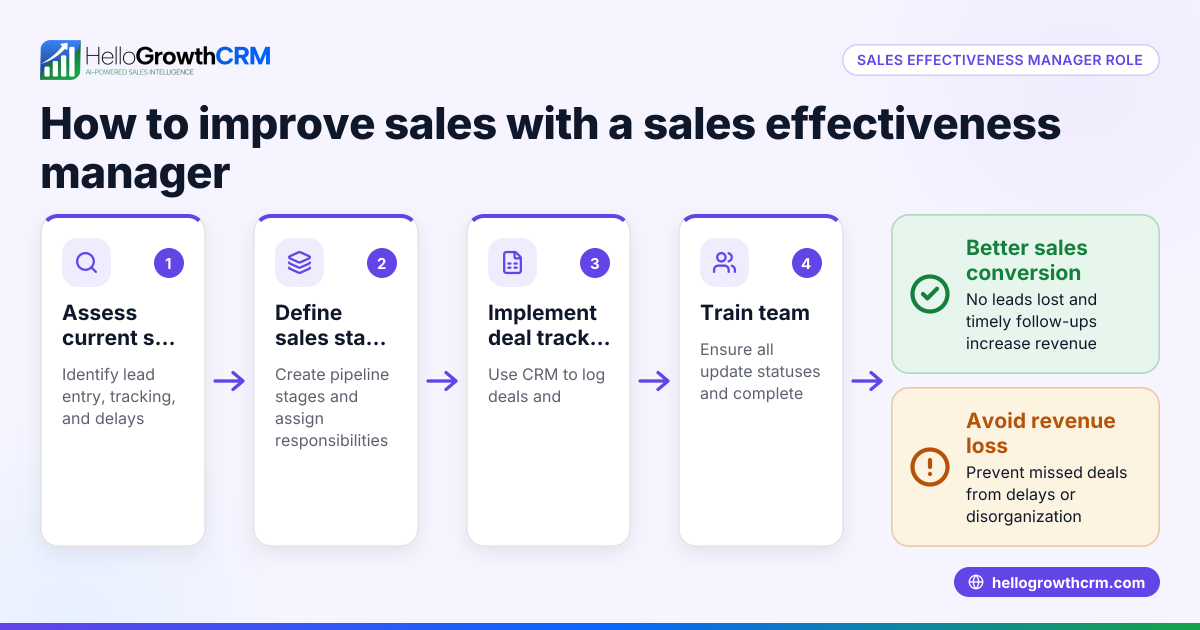
- Assess your sales process and pain points. Identify where leads are lost or delayed. Check if your sales team struggles with follow-up reminders, quotation tracking, or managing customer queries.
- Define the sales support manager’s responsibilities. Typical tasks include managing the sales pipeline, coordinating communication between sales and customers, preparing sales documents, and tracking customer service requests.
- Hire or assign a dedicated sales support manager. Choose someone organised with good communication skills and a basic understanding of sales.
- Set up tools to support the role. Use a CRM to centralise leads, deals, and communications. Check that the CRM can track quotations, follow-up dates, and customer interactions in one place.
- Train the sales support manager on the CRM and sales process. Ensure they know how to update deal stages, log customer requests, and schedule follow-ups.
- Monitor and review performance regularly. Check if leads are followed up faster, deals are tracked better, and customer queries are resolved promptly.
- Adjust roles and tools as needed. If follow-ups are still slow or leads get lost, refine the sales support manager’s tasks or CRM setup.
Example (fictional figures)
A Woodlands-based F&B supplier has monthly sales leads with potential deals valued at S$50,000 but loses some due to slow follow-up. They hire a sales support manager to improve lead tracking.
- Monthly leads value = S$50,000
- Lost leads due to slow follow-up estimated at S$10,000
- After hiring sales support manager, lost leads reduce to S$2,500
- Additional sales recovered = S$10,000 - S$2,500 = S$7,500
This manager uses a CRM to track quotations and follow-ups, ensuring no deal is forgotten.
Common mistakes
- Not clearly defining the sales support manager’s role. Prevent by writing a detailed job description covering all tasks.
- Failing to provide proper tools. Prevent by implementing a CRM that centralises leads, deals, and communication.
- Overloading the sales support manager with unrelated tasks. Prevent by focusing their duties on sales support only.
- Ignoring training and process documentation. Prevent by training the manager on CRM use and sales workflows.
- Not reviewing performance regularly. Prevent by scheduling monthly reviews to measure improvements.
- Using multiple disconnected tools like WhatsApp, email, and spreadsheets without integration. Prevent by adopting a CRM solution that unifies communication and sales data, such as HelloGrowthCRM's WhatsApp and SMS CRM capabilities (/product/whatsapp-sms-crm).
Doing this in HelloGrowthCRM
HelloGrowthCRM helps sales support managers by providing a deals pipeline to track open opportunities from first contact through to close, with stages like 'quote sent' and follow-up dates to avoid forgotten deals (/product/ai-crm). After the sale, service requests stay linked on the same customer record as the deal, making it easy to manage support tickets and referrals (/product/customer-health-score). For businesses with field sales teams or distributors, HelloGrowthCRM offers territory management tools where field reps can log visits from their phones and managers can view daily activities and commissions (/product/territory-management). These features keep sales support managers organised and improve coordination.
Frequently asked questions
What skills should a sales support manager have? A sales support manager should be organised, detail-oriented, and have good communication skills. Basic knowledge of sales processes and CRM software is important to manage leads and follow-ups effectively.
How does a sales support manager improve sales performance? By handling administrative tasks like tracking deals and scheduling follow-ups, they free salespeople to focus on closing. This reduces lost leads and speeds up the sales cycle.
Can a small business afford a sales support manager? If lost leads and slow follow-up are causing revenue loss, hiring a sales support manager can pay for itself by recovering sales. Alternatively, using CRM tools to automate tasks can reduce the need for additional staff.
What CRM features help a sales support manager most? Pipeline management with deal stages and follow-up reminders help keep sales organised. HelloGrowthCRM also offers WhatsApp and SMS messaging workflows and a branded customer portal to enhance engagement and service.
How do I track sales support manager performance? Monitor lead response times, deal closure rates, and customer satisfaction. Use CRM reports to see if follow-ups happen on schedule and no leads are forgotten.
Key takeaways
- A sales support manager handles sales admin and communication to boost sales efficiency.
- Clear role definition and proper CRM tools are essential for success.
- Regular monitoring and training improve sales support outcomes.
- HelloGrowthCRM offers pipeline, customer service, and field operation tools that help sales support managers stay organised.
- Avoid common mistakes like unclear roles, poor tools, and lack of review.
Start improving your sales process today by assigning a sales support manager and using tools designed for small businesses.
Start on the Free Forever plan (200 leads, no credit card) at HelloGrowthCRM.
Ready to put this into practice?
Set up your pipeline, WhatsApp follow-ups, and AI lead scoring in minutes — free, no credit card.
Try HelloGrowthCRM freeGet CRM tips in your inbox
Join thousands of sales professionals who get weekly insights on CRM strategy, AI automation, and pipeline optimization.

The HelloGrowthCRM team publishes guides on CRM strategy, AI sales tools, and revenue operations for small business sales teams.