HelloGrowthCRM software
Built for real small-business sales teams
HelloGrowthCRM helps reps qualify faster, follow up on time, and close more deals—with practical automation in one place.
- AI lead scoring and pipeline visibility
- Built-in dialer, WhatsApp, and email automation
- Sales forecasting and RevOps-ready reporting
To create a customer support ticket system in Canada, you need a structured approach that captures every customer request, assigns it to the right person, tracks its status, and ensures timely resolution. This avoids lost requests and improves customer satisfaction.
Why this comes up / what goes wrong
Many small Canadian businesses handle customer support informally via phone calls, emails, or text messages. Without a ticket system, requests can get lost or forgotten, follow-ups are delayed, and customers become frustrated. A ticket system centralizes all support requests, improves accountability, and keeps a history of interactions. This is especially important for businesses with growing sales teams or multiple communication channels like WhatsApp and SMS.
Step-by-step
- Identify your customer support channels: List all the ways customers contact you, such as email, phone, WhatsApp, SMS, or web forms. Check that you can capture these channels into one system.
- Define ticket categories and priorities: Decide how to classify tickets (e.g., technical issue, billing, general inquiry) and set priority levels (high, medium, low). This helps assign tickets to the right team and escalate urgent issues.
- Choose a ticket tracking method: Use a spreadsheet, email folders, or ideally, a CRM or ticketing software that supports ticket creation, assignment, and status updates.
- Set up ticket fields: Determine what information each ticket must include — customer name, contact info, issue description, date/time, assigned staff, and status.
- Assign responsibilities: Decide who receives new tickets and how they are distributed among your support staff. Define escalation rules for unresolved tickets.
- Establish response and resolution timelines: Set targets for first response and final resolution based on ticket priority.
- Create a ticket intake process: For example, use web forms or WhatsApp integration to automatically create tickets when customers submit requests.
- Train your team: Ensure everyone understands how to create, update, and close tickets following the process.
- Monitor and report: Regularly review ticket volumes, response times, and customer satisfaction to improve your support process.
Example (fictional figures)
Halifax Staffing Solutions, a staffing agency in Halifax, Nova Scotia, wants to implement a ticket system starting 2024-07-01.
- They receive 50 support requests weekly.
- They define 3 categories: Job Placement (40%), Billing (30%), General (30%).
- Priorities: High (20%), Medium (50%), Low (30%).
Step 1: They set up a web form capturing customer name, contact, category, and issue description.
Step 2: Tickets are auto-created in their tracking spreadsheet.
Step 3: They assign tickets as follows:
- High priority: assigned within 1 hour
- Medium priority: within 4 hours
- Low priority: within 24 hours
Step 4: Weekly review meetings check unresolved tickets.
Calculations:
- Weekly tickets = 50
- High priority tickets = 50 × 20% = 10
- Medium priority tickets = 50 × 50% = 25
- Low priority tickets = 50 × 30% = 15
They aim to respond to 10 high priority tickets within 1 hour each, 25 medium within 4 hours, and 15 low within 24 hours.
Common mistakes
- No central system: Using only email or text leads to lost requests. Prevent this by consolidating tickets in one system or CRM.
- Unclear ticket categories: Without clear categories, tickets get misrouted. Define precise categories and priorities.
- No ticket ownership: Tickets without assigned staff delay resolution. Assign tickets promptly and track ownership.
- Ignoring response times: Customers expect timely replies. Set and monitor response targets.
- Lack of training: Staff unfamiliar with the system cause errors. Train your team thoroughly on the process.
- No follow-up process: Tickets left open cause dissatisfaction. Implement regular reviews and escalation rules.
Doing this in HelloGrowthCRM
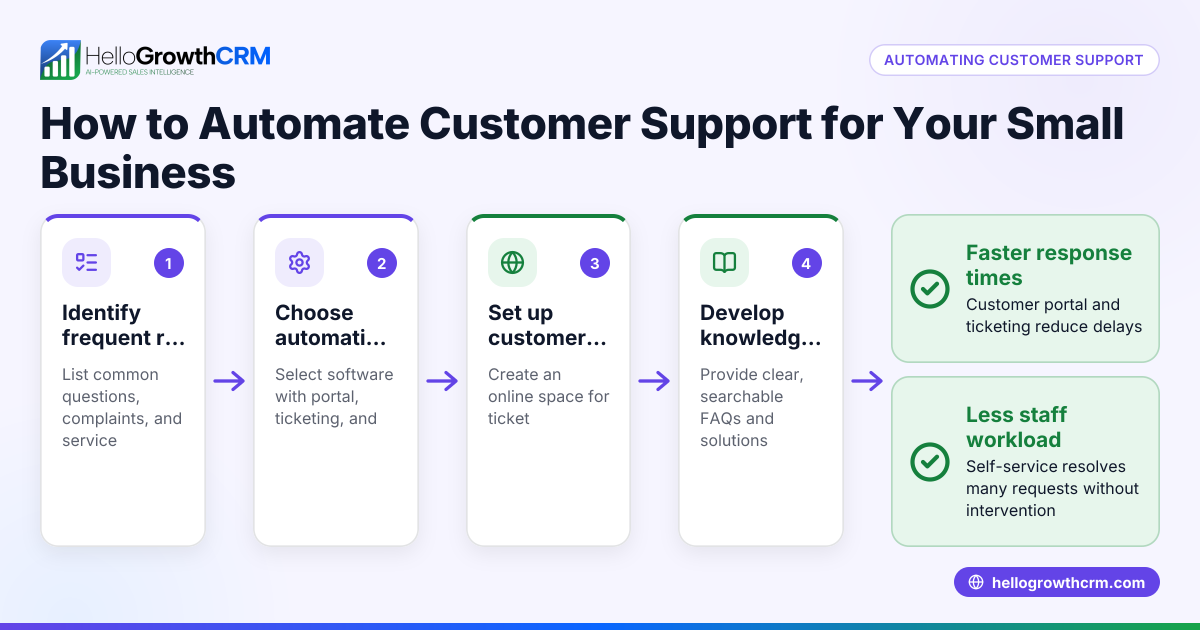
HelloGrowthCRM offers a customer portal, referrals, tickets, and a knowledge base that help manage support requests efficiently. After the sale, service requests stay on the same customer record as the deal, keeping all information organized. The built-in ticket system lets you track, assign, and resolve customer issues in one place. Learn more about how HelloGrowthCRM supports Canadian businesses at HelloGrowthCRM for Canada.
Frequently asked questions
What is a customer support ticket system? A ticket system captures and tracks customer requests as individual tickets, ensuring each issue is addressed and resolved. It improves organisation and response times.
Can I create a ticket system without software? Yes, you can use spreadsheets or email folders, but these methods risk lost tickets and poor tracking. Software or a CRM is recommended for better efficiency.
How do I handle tickets from WhatsApp or SMS? You can integrate WhatsApp and SMS into your ticket system or CRM to automatically capture messages as tickets, streamlining support across channels. See WhatsApp and SMS CRM for options.
Why track ticket categories and priorities? Categories help route tickets to the right team, and priorities ensure urgent issues are handled quickly. This improves customer satisfaction.
How do I measure customer support performance? Track metrics like response time, resolution time, and ticket volume. Using a customer health score can also help monitor customer satisfaction.
Key takeaways
- Centralize customer requests into a single ticket system to avoid lost issues.
- Define clear ticket categories, priorities, and ownership for efficient handling.
- Set response and resolution timelines and monitor adherence.
- Train your team on the ticket process to reduce errors.
- Use tools like HelloGrowthCRM to integrate support tickets with customer records.
Start building your customer support ticket system today and improve your service quality. Start on the Free Forever plan (200 leads, no credit card).
Ready to put this into practice?
Set up your pipeline, WhatsApp follow-ups, and AI lead scoring in minutes — free, no credit card.
Try HelloGrowthCRM freeGet CRM tips in your inbox
Join thousands of sales professionals who get weekly insights on CRM strategy, AI automation, and pipeline optimization.

The HelloGrowthCRM team publishes guides on CRM strategy, AI sales tools, and revenue operations for small business sales teams.