HelloGrowthCRM software
Built for real small-business sales teams
HelloGrowthCRM helps reps qualify faster, follow up on time, and close more deals—with practical automation in one place.
- AI lead scoring and pipeline visibility
- Built-in dialer, WhatsApp, and email automation
- Sales forecasting and RevOps-ready reporting
Creating a sales pipeline helps you organise your sales process and avoid losing leads due to slow follow-up or scattered data. Many Canadian small-business owners struggle to track deals effectively because they rely on text messages, emails, or spreadsheets. A clear sales pipeline gives your team visibility and control over every sales opportunity.
Why this comes up / what goes wrong
Small and mid-sized Canadian businesses often miss sales because they lack a structured way to track leads and deals. Without a pipeline, leads can slip through the cracks, follow-ups get delayed, and sales forecasts are guesswork. Business owners may run sales informally on WhatsApp, email, or Excel, which makes it hard to see which deals are active or stalled. Creating a sales pipeline solves these problems by defining stages and next steps for every opportunity.
Step-by-step
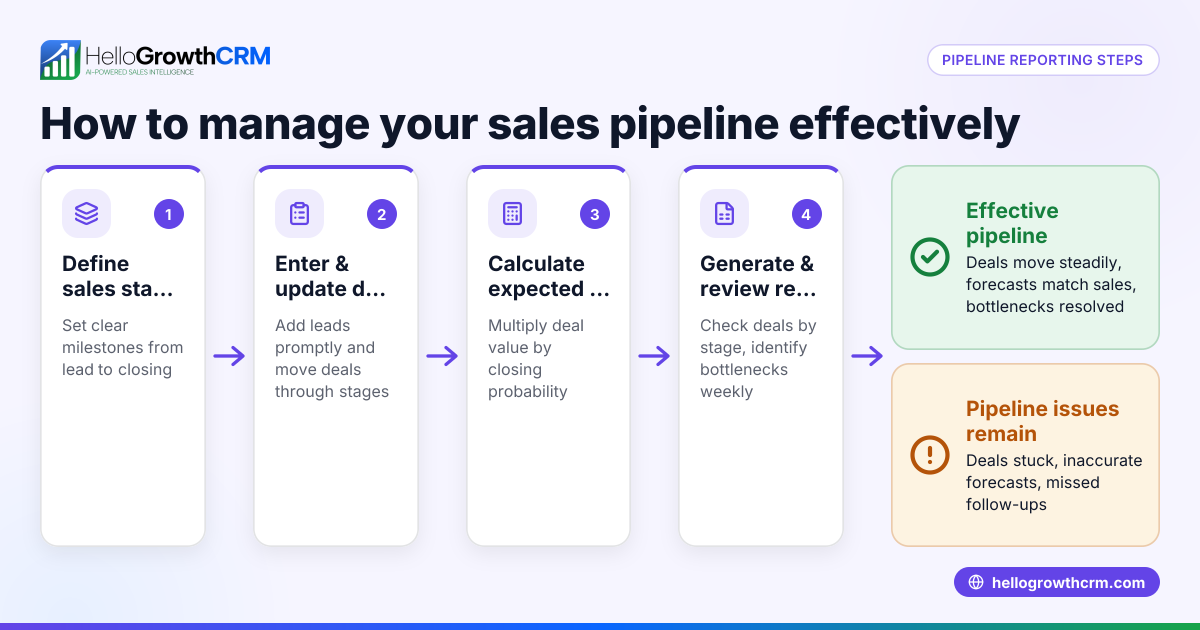
- Identify your sales stages: List the key steps a lead goes through before becoming a customer. Common stages include "New Lead", "Contacted", "Qualified", "Quote Sent", "Negotiation", and "Closed Won/Lost". Check that these stages reflect your actual sales process.
- Define actions for each stage: Specify what your team must do at each stage, such as sending an introductory email, scheduling a demo, or following up on a quote. Check that each stage has clear criteria for moving to the next.
- Set follow-up dates and reminders: Assign deadlines for actions like follow-ups or meetings to avoid delays. Check that these dates are realistic and visible to your team.
- Track deal values and probabilities: Estimate the potential revenue and likelihood of closing for each deal at every stage. Check that these figures are updated regularly.
- Use a pipeline board or CRM tool: Visualise your pipeline with columns for each stage showing all deals. Check that deals move forward or are marked lost in a timely manner.
- Review and forecast regularly: Analyse pipeline health weekly to identify stalled deals and forecast revenue. Check for bottlenecks or stages where deals drop off.
- Train your team: Make sure salespeople understand the stages, actions, and how to update the pipeline. Check that everyone uses the system consistently.
Example (fictional figures)
A bilingual insurance agency in Laval, Quebec, wants to create a sales pipeline to track new client leads. They define these stages: New Lead, Contacted, Quote Sent, Negotiation, Closed Won, Closed Lost.
- On 2024-05-01, they receive a new lead worth C$15,000.
- They contact the lead the same day and move it to "Contacted".
- On 2024-05-03, they send a quote and move the deal to "Quote Sent" with a follow-up date of 2024-05-07.
- They estimate a 60% probability of closing at this stage.
Calculations:
Deal value = C$15,000 Probability = 60% = 0.6 Expected value = C$15,000 × 0.6 = C$9,000
This expected value helps forecast revenue. The agency sets reminders to follow up on 2024-05-07. If the lead accepts, the deal moves to "Closed Won"; if not, to "Closed Lost".
Common mistakes
- Skipping stage definitions: Without clear stages, deals become confusing. Prevent by listing distinct, sequential stages.
- No follow-up deadlines: Leads get forgotten. Prevent by setting and tracking follow-up dates.
- Not updating deal status regularly: Pipeline becomes inaccurate. Prevent by scheduling regular updates.
- Ignoring deal values and probabilities: Forecasts are unreliable. Prevent by estimating and revising these figures.
- Using multiple disconnected tools: Leads scatter across WhatsApp, email, and spreadsheets. Prevent by centralising pipeline management in one system like HelloGrowthCRM.
- Lack of team training: Pipeline is underused. Prevent by training and enforcing consistent use.
Doing this in HelloGrowthCRM
HelloGrowthCRM offers a Deals (pipeline) feature that tracks open opportunities from first contact through close. For example, a quotation sent last week appears as a deal at the "quote sent" stage with a follow-up date, so it is not forgotten. The pipeline forecast and AI insights help owners see which stage deals are stalling without building spreadsheets. For businesses with field sales, territories and visit logging from phones keep managers informed of daily activity. Learn more about HelloGrowthCRM's AI CRM and sales forecasting features, and how it fits Canadian businesses at HelloGrowthCRM for Canada.
Frequently asked questions
What is a sales pipeline and why do I need one? A sales pipeline is a visual representation of your sales process, showing each stage a lead passes through before becoming a customer. It helps you organise leads, plan follow-ups, and forecast revenue, reducing lost sales from missed opportunities.
How many stages should my sales pipeline have? The number of stages depends on your sales process complexity. Typically, 5 to 7 stages cover common steps like lead capture, qualification, quoting, negotiation, and closing. Too many stages can complicate tracking; too few may miss important actions.
How do I estimate deal probabilities? Assign probabilities based on historical conversion rates at each stage or your experience. For example, leads in "Quote Sent" might have a 60% chance of closing. Update these as you gather data.
Can I use HelloGrowthCRM to manage my sales pipeline? Yes, HelloGrowthCRM includes a Deals (pipeline) feature to track stages, set follow-up dates, and forecast revenue with AI insights. It centralises your sales activities from WhatsApp, email, and phone calls.
How often should I update my sales pipeline? Update your pipeline daily or weekly to keep it accurate. Regular reviews help identify stalled deals and improve forecasting.
Key takeaways
- Define clear, sequential sales stages reflecting your actual process.
- Assign specific actions and follow-up deadlines for each stage.
- Track deal values and probabilities to forecast revenue.
- Use a visual pipeline board or CRM to manage deals in one place.
- Update the pipeline regularly and train your team for consistent use.
- Avoid common mistakes like skipping stages or neglecting follow-ups.
Creating a sales pipeline is a foundational step to improve sales efficiency and revenue predictability for Canadian small businesses. To start managing your pipeline with AI-assisted forecasting and deal tracking, try HelloGrowthCRM. Start on the Free Forever plan (200 leads, no credit card) today.
Ready to put this into practice?
Set up your pipeline, WhatsApp follow-ups, and AI lead scoring in minutes — free, no credit card.
Try HelloGrowthCRM freeGet CRM tips in your inbox
Join thousands of sales professionals who get weekly insights on CRM strategy, AI automation, and pipeline optimization.

The HelloGrowthCRM team publishes guides on CRM strategy, AI sales tools, and revenue operations for small business sales teams.