HelloGrowthCRM software
Built for real small-business sales teams
HelloGrowthCRM helps reps qualify faster, follow up on time, and close more deals—with practical automation in one place.
- AI lead scoring and pipeline visibility
- Built-in dialer, WhatsApp, and email automation
- Sales forecasting and RevOps-ready reporting
To create sales stages for a business in the UAE, start by defining clear, sequential steps that your sales team follows from lead capture to closing a deal. Each stage should represent a milestone in the buyer's journey and include criteria for progression. This article covers why sales stages matter, step-by-step instructions, a worked example with AED figures, common mistakes, and how HelloGrowthCRM supports managing sales stages.
Why this comes up / what goes wrong
Many small business owners in the UAE run sales informally using WhatsApp chats, phone calls, and spreadsheets. Without clearly defined sales stages, leads can get lost, follow-up slows down, and forecasting becomes unreliable. A founder or sales leader often struggles to track which prospects are ready to buy or need more nurturing. This leads to missed sales opportunities and inconsistent team performance.
Step-by-step
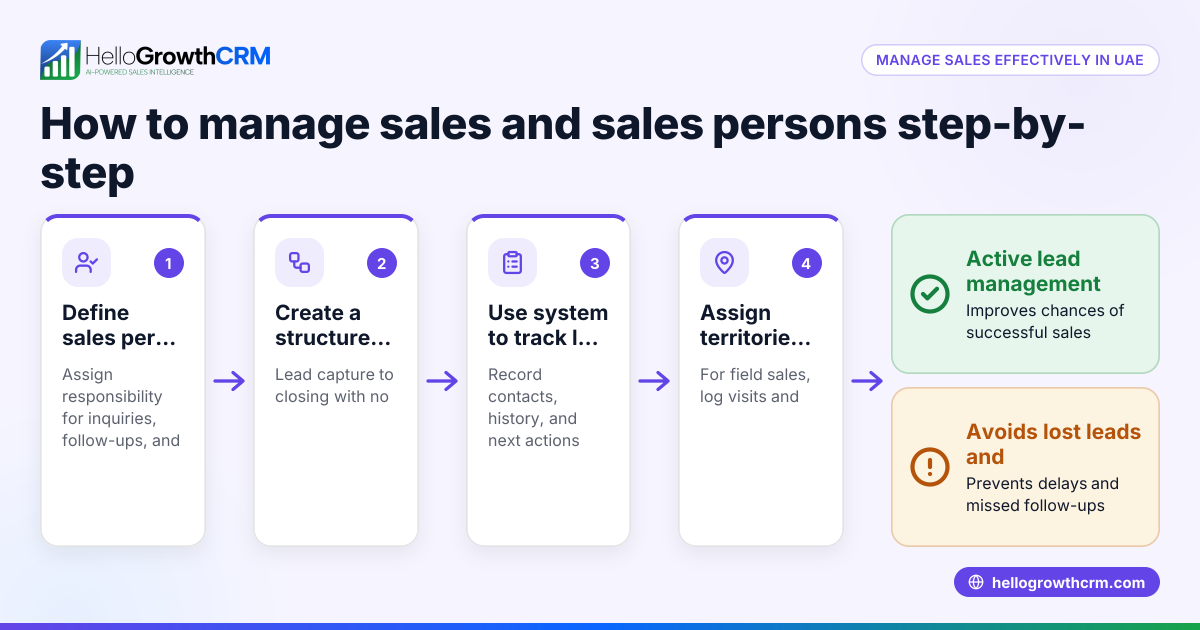
- Identify your typical sales process: Write down the main steps your sales team currently takes from first contact to closing. Include discovery, qualification, proposal, negotiation, and closing.
- Define clear criteria for each stage: For example, "Lead contacted and qualified" means the prospect has expressed interest and fits your ideal customer profile.
- Keep stages sequential and manageable: Limit to 5-7 stages to keep the pipeline clear and actionable.
- Assign follow-up tasks per stage: Decide what action is needed at each stage, such as sending a quotation or scheduling a demo.
- Set expected timeframes for each stage: This helps identify stalled deals and improves forecasting.
- Use consistent naming for stages: Use terms everyone on your team understands clearly.
- Review and adjust regularly: Sales stages should evolve as your business grows or market changes.
Check that each stage:
- Represents a meaningful step in the buyer’s journey
- Has clear entry and exit criteria
- Aligns with your sales activities and team workflow
Example (fictional figures)
An interior fit-out contractor in Sharjah wants to create sales stages for their projects. Here are the stages and what they mean:
- Lead Captured: New enquiry received (e.g. from website form).
- Contacted: Sales team called the prospect and gathered requirements.
- Quote Sent: A detailed quotation was emailed on 15/05/2024.
- Negotiation: Client requested changes to scope and pricing.
- Contract Signed: Agreement signed and deposit received.
- Project Started: Work commenced on site.
For a project quoted at AED 1,200,000:
- At "Quote Sent", expected close probability is 40%.
- Expected value = AED 1,200,000 × 40% = AED 480,000.
If the deal moves to "Negotiation" with a 70% probability:
- Expected value = AED 1,200,000 × 70% = AED 840,000.
This helps forecast revenue accurately and prioritise follow-up.
Common mistakes
- Too many stages: Overcomplicating the pipeline makes it hard to manage. Prevent by limiting to key milestones.
- Vague criteria: Without clear definitions, team members guess when to move deals. Prevent by documenting what each stage means.
- Ignoring stalled deals: Deals stuck in one stage waste resources. Prevent by setting time limits and alerts.
- Not aligning stages with sales activities: If stages don’t reflect what the team actually does, adoption will be low. Prevent by involving your sales team when defining stages.
- Failing to review stages regularly: Business changes can make stages obsolete. Prevent by scheduling quarterly reviews.
Using a CRM with a pipeline feature like HelloGrowthCRM’s Deals (pipeline) helps visualise and manage these stages effectively.
Doing this in HelloGrowthCRM
HelloGrowthCRM supports managing your sales stages through its Deals (pipeline) feature, which tracks open opportunities from first contact to close. For example, a quotation sent last week appears as a deal at the "quote sent" stage with a follow-up date, so it is not forgotten. If you don't have a sales manager, the Managed RevOps service assigns a specialist to work your follow-up queue weekly, ensuring no lead is missed. For businesses with field sales teams, the Territories, field operations and commissions feature allows logging visits and managing routes directly from mobile devices. Learn more about these capabilities at HelloGrowthCRM for the United Arab Emirates.
Frequently asked questions
How many sales stages should a small business in the UAE use? Typically, 5 to 7 stages keep your sales pipeline clear and manageable. This range covers key buyer journey steps without overwhelming your team.
What criteria should I use to move a deal from one stage to another? Use clear, objective actions such as "quotation sent", "client responded", or "contract signed". These milestones ensure consistent progress tracking.
Can I change sales stages as my business grows? Yes, sales stages should be reviewed regularly to reflect changes in your sales process or market conditions.
How can I avoid losing leads between stages? Set follow-up tasks and reminders at each stage. Using a CRM with a built-in dialer and follow-up queue, like HelloGrowthCRM’s built-in CRM dialer, helps automate this.
Should I include a stage for negotiation? Yes, negotiation is a common stage where pricing or terms are discussed. Including it helps forecast deal closure more accurately.
Key takeaways
- Define 5-7 clear, sequential sales stages aligned with your sales process.
- Set objective criteria and follow-up tasks for each stage.
- Use time limits to spot and act on stalled deals.
- Review and adjust sales stages regularly.
- Leverage CRM tools like HelloGrowthCRM’s Deals (pipeline) and Managed RevOps to manage stages and follow-ups.
Start organising your sales process today to improve lead follow-up and close rates. Start on the Free Forever plan (200 leads, no credit card) with HelloGrowthCRM and see how easy managing sales stages can be.
Ready to put this into practice?
Set up your pipeline, WhatsApp follow-ups, and AI lead scoring in minutes — free, no credit card.
Try HelloGrowthCRM freeGet CRM tips in your inbox
Join thousands of sales professionals who get weekly insights on CRM strategy, AI automation, and pipeline optimization.

The HelloGrowthCRM team publishes guides on CRM strategy, AI sales tools, and revenue operations for small business sales teams.