HelloGrowthCRM software
Built for real small-business sales teams
HelloGrowthCRM helps reps qualify faster, follow up on time, and close more deals—with practical automation in one place.
- AI lead scoring and pipeline visibility
- Built-in dialer, WhatsApp, and email automation
- Sales forecasting and RevOps-ready reporting
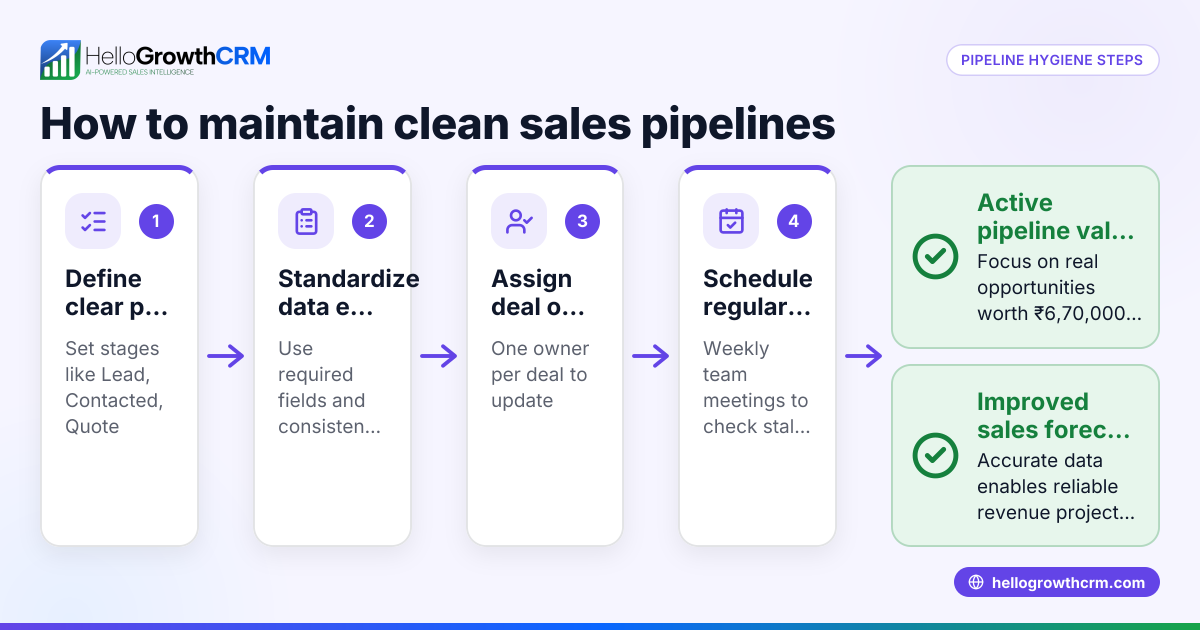
To keep your sales pipeline clean and useful, you must regularly check that every deal is current, correctly staged, and actively progressing. This prevents leads from falling through the cracks and ensures your sales forecasts reflect reality. This article explains why pipeline hygiene is important for small UK businesses, provides detailed weekly or monthly steps, a practical example with figures, common errors to avoid, and how HelloGrowthCRM’s features support this process.
Why this comes up / what goes wrong
Small business owners often struggle with pipeline hygiene because their sales data is scattered across WhatsApp, email, and spreadsheets. Without a consistent routine, deals can linger too long in one stage, follow-ups get missed, and the pipeline becomes cluttered with outdated opportunities. This leads to inaccurate forecasting, wasted effort chasing cold leads, and lost sales. Maintaining pipeline hygiene weekly or monthly ensures your team focuses on viable deals and improves sales efficiency.
Step-by-step
- Set a regular review schedule: Decide whether weekly or monthly reviews suit your business size and sales cycle. Weekly suits fast-moving deals; monthly works for longer sales cycles.
- List all open deals: Gather every active opportunity from your CRM or wherever you track leads.
- Check each deal’s stage: Confirm the deal is in the correct stage (e.g., prospecting, quote sent, negotiation). Move deals that have progressed or stalled.
- Verify follow-up dates: Ensure every deal has a next action date. If no follow-up is scheduled, set one or decide if the deal should be closed.
- Assess deal activity: For deals with no recent contact or progress, reach out or mark as dormant.
- Remove dead deals: Close or archive deals that are lost or no longer viable to keep your pipeline focused.
- Update deal values and probabilities: Confirm the expected deal amounts and likelihood of closing are current.
- Review pipeline forecast: Use your CRM’s forecasting tools to identify bottlenecks or stages where deals stall.
- Assign tasks to team members: Ensure follow-ups and actions are delegated and tracked.
- Document changes and insights: Keep notes on deal updates to maintain context for future reviews.
Example (fictional figures)
A letting agency in Manchester reviews its pipeline on 15/05/2024. They have 10 open deals with a total expected value of £250,000.
- Step 1: List all 10 deals.
- Step 2: Check stages and find 3 deals stuck in 'quote sent' for over 3 weeks.
- Step 3: Contact these 3 clients; 2 agreed to proceed, 1 is lost.
- Step 4: Move 2 deals to 'negotiation', close 1 as lost.
- Step 5: Update expected values: £50,000 and £30,000 for the progressing deals.
- Step 6: Set follow-up dates: 22/05/2024 for both.
- Step 7: Remove the lost deal value of £15,000 from the pipeline.
- Step 8: Review forecast: pipeline now shows £235,000 expected value.
Calculations: £250,000 (initial pipeline) - £15,000 (lost deal) = £235,000 (updated pipeline)
This keeps the pipeline realistic and focused on deals likely to close.
Common mistakes
- Ignoring stale deals: Letting deals linger without updates skews forecasts. Prevent by setting strict review dates.
- No follow-up dates: Without next steps, deals fall through. Always schedule next actions.
- Overvaluing deals: Not adjusting deal values or probabilities inflates pipeline worth. Regularly confirm figures.
- Skipping team updates: Lack of communication causes missed opportunities. Assign and track tasks clearly.
- Using multiple tools without integration: Leads get lost across WhatsApp, email, spreadsheets. Consolidate tracking to one system.
- Not using forecasting tools: Manual forecasting is error-prone. Use AI insights to spot bottlenecks early.
Doing this in HelloGrowthCRM
HelloGrowthCRM helps maintain pipeline hygiene by showing every deal as a stage-based entry with follow-up dates. For example, a quotation sent last week appears as a deal at the 'quote sent' stage with a scheduled follow-up, so it is not forgotten. The pipeline forecast and AI insights feature lets you see which stages deals are stalling in without needing to build spreadsheets. This makes weekly or monthly pipeline reviews faster and more accurate. Learn more about the AI CRM and sales forecasting features, designed for UK businesses managing sales pipelines.
Frequently asked questions
How often should I clean my sales pipeline? It depends on your sales cycle speed. Weekly reviews suit fast sales, while monthly is enough for longer processes. Regularity ensures no deals are forgotten.
What is the best way to track follow-ups? Use a CRM to set and remind you of follow-up dates. Without this, deals can stall unnoticed. HelloGrowthCRM offers follow-up scheduling integrated with deal stages.
How do I decide when to remove a deal? If a deal shows no progress after repeated attempts or the client has declined, mark it as lost or archive it. Keeping dead deals inflates pipeline size and wastes effort.
Can pipeline hygiene improve sales forecasting? Yes. A clean pipeline with accurate deal stages and values leads to more reliable forecasts. AI-assisted forecasting tools can highlight stalls and conversion probabilities, reducing guesswork.
How do I manage pipeline hygiene with a small team? Assign clear responsibilities for pipeline reviews and follow-ups. Use tools that centralise communication and tracking to avoid duplicated or missed efforts.
Is it possible to do this without CRM software? Yes, but it is time-consuming and error-prone. Using a CRM like HelloGrowthCRM helps automate reminders, stage tracking, and forecasting, saving time and improving accuracy.
Key takeaways
- Schedule regular weekly or monthly pipeline reviews to keep data current.
- Check deal stages, follow-up dates, and update values consistently.
- Remove or close deals that are no longer viable to focus on active opportunities.
- Use CRM forecasting and AI insights to identify bottlenecks without spreadsheets.
- Assign clear follow-up tasks to team members and track progress.
- Consolidate all sales tracking into one system to avoid lost leads.
Maintaining pipeline hygiene is essential for accurate sales forecasting and efficient sales management. Start today by setting a review routine, checking all deals, and updating follow-ups. To simplify this process, consider using HelloGrowthCRM, which supports deal tracking with follow-up dates and AI pipeline insights. Start on the Free Forever plan (200 leads, no credit card).
Ready to put this into practice?
Set up your pipeline, WhatsApp follow-ups, and AI lead scoring in minutes — free, no credit card.
Try HelloGrowthCRM freeGet CRM tips in your inbox
Join thousands of sales professionals who get weekly insights on CRM strategy, AI automation, and pipeline optimization.

The HelloGrowthCRM team publishes guides on CRM strategy, AI sales tools, and revenue operations for small business sales teams.