HelloGrowthCRM software
Built for real small-business sales teams
HelloGrowthCRM helps reps qualify faster, follow up on time, and close more deals—with practical automation in one place.
- AI lead scoring and pipeline visibility
- Built-in dialer, WhatsApp, and email automation
- Sales forecasting and RevOps-ready reporting
Measuring customer support resolution time means finding out how long it takes your team to resolve customer issues after they first contact you. For New Zealand small businesses, this helps improve service quality and customer satisfaction. This article covers why measuring resolution time matters, detailed steps to calculate it, a worked example with NZD figures, common mistakes to avoid, and how HelloGrowthCRM’s customer portal and ticket features support this process.
Why this comes up / what goes wrong
Small business owners in New Zealand often lose track of how quickly their support team resolves customer issues. This can happen when support requests come through multiple channels like email, WhatsApp, or phone, and are logged in spreadsheets or text messages. Without accurate measurement, it’s hard to know if customers wait too long or if your team meets service expectations. This leads to lost customers and poor reputation. Measuring resolution time clearly identifies bottlenecks and areas for improvement.
Step-by-step
- Define what counts as a support request start and resolution: Usually, the start time is when the customer first contacts your support (ticket creation), and the resolution time is when the issue is fully closed.
- Record timestamps for each support ticket: For every support request, note the date and time it was received and when it was resolved. This can be done manually in a spreadsheet or automatically if you use a CRM with ticket management.
- Calculate resolution time for each ticket: Subtract the start timestamp from the resolution timestamp to get the total time taken for that ticket.
- Convert resolution time into a standard unit: Use hours or days depending on the typical support cycle of your business.
- Calculate average resolution time over a period: Sum all resolution times for tickets resolved in a chosen period (e.g., one month) and divide by the number of tickets resolved.
- Review and analyse results regularly: Identify unusually long resolution times and investigate causes.
- Set benchmarks and targets: Decide what a good resolution time is for your business and track progress.
Check that your data is complete and consistent. Missing timestamps or partial records will skew your results.
Example (fictional figures)
A Queenstown tourism operator received 5 support tickets in March 2024. The resolution times in hours were:
- Ticket 1: Received 01/03/2024 09:00, resolved 01/03/2024 15:00 → 6 hours
- Ticket 2: Received 05/03/2024 14:00, resolved 06/03/2024 10:00 → 20 hours
- Ticket 3: Received 10/03/2024 11:00, resolved 10/03/2024 13:00 → 2 hours
- Ticket 4: Received 15/03/2024 16:00, resolved 18/03/2024 10:00 → 66 hours
- Ticket 5: Received 20/03/2024 09:00, resolved 20/03/2024 12:00 → 3 hours
Calculate total resolution time:
6 + 20 + 2 + 66 + 3 = 97 hours
Calculate average resolution time:
97 hours ÷ 5 tickets = 19.4 hours
So, the average customer support resolution time for March 2024 was 19.4 hours.
Common mistakes
- Not defining clear start and end points: Prevent this by setting exact rules for when a ticket starts and is considered resolved.
- Mixing different communication channels without central tracking: Use a system that consolidates requests, like a CRM with a customer portal and tickets, to avoid missing data.
- Ignoring tickets still open: Only include fully resolved tickets in calculations to avoid skewed averages.
- Failing to update resolution times promptly: Train your team to close tickets as soon as issues are resolved.
- Calculating averages without filtering out outliers: Consider median or exclude extreme cases to get a more realistic measure.
Using a CRM with ticket management and a customer portal can help avoid these mistakes by keeping all service requests on the same customer record and providing clear tracking.
Doing this in HelloGrowthCRM
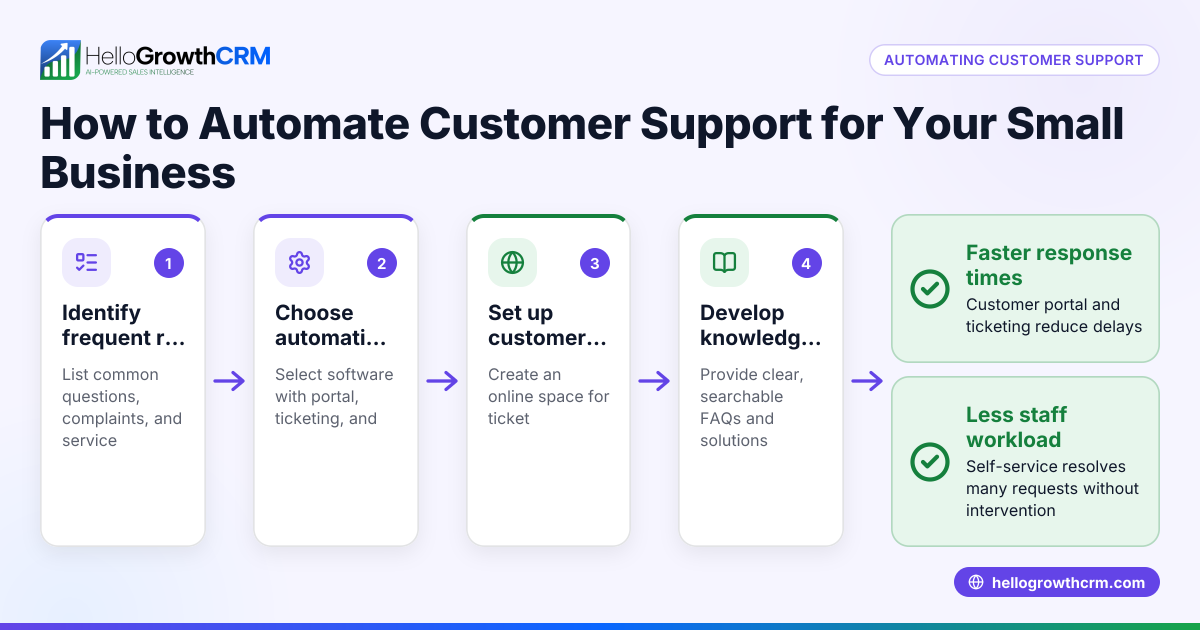
HelloGrowthCRM offers a branded self-service customer portal where customers can submit support tickets. These tickets stay linked to the same customer record as the deal, ensuring all service requests are tracked in one place. The system also includes a knowledge base to help customers find answers quickly and a referral programme for ongoing engagement. This setup simplifies measuring resolution times and improves customer service efficiency. Learn more about the customer health score and how HelloGrowthCRM supports New Zealand businesses on the HelloGrowthCRM for New Zealand page.
Frequently asked questions
What is customer support resolution time? Customer support resolution time is the duration between when a customer submits a support request and when the issue is fully resolved. It helps measure how quickly your team handles customer problems.
Why is measuring resolution time important for small businesses? It helps identify delays in your support process, improve customer satisfaction, and set realistic service goals. It also highlights training needs or resource gaps in your team.
How can I track resolution time without a CRM? You can use spreadsheets with columns for ticket received and resolved timestamps, then calculate the difference. However, this requires strict discipline to keep data accurate and complete.
Can WhatsApp and SMS support be included in resolution time measurement? Yes, but you need to centralise these requests in one place to measure accurately. HelloGrowthCRM’s WhatsApp and SMS CRM features help consolidate messages and tickets for easier tracking.
How often should I review my resolution time metrics? Regular reviews, such as weekly or monthly, help spot trends and act on issues quickly. Frequent checks keep your support process efficient and responsive.
Key takeaways
- Measure resolution time by tracking when support requests start and end.
- Calculate average resolution time over a defined period for meaningful insights.
- Avoid common mistakes like incomplete data and unclear definitions.
- Use a CRM with customer portal and ticket features to centralise support and improve accuracy.
- Regularly review and set targets to improve customer support performance.
Start measuring your customer support resolution time today to improve service quality and customer satisfaction. Start on the Free Forever plan (200 leads, no credit card).
Ready to put this into practice?
Set up your pipeline, WhatsApp follow-ups, and AI lead scoring in minutes — free, no credit card.
Try HelloGrowthCRM freeGet CRM tips in your inbox
Join thousands of sales professionals who get weekly insights on CRM strategy, AI automation, and pipeline optimization.

The HelloGrowthCRM team publishes guides on CRM strategy, AI sales tools, and revenue operations for small business sales teams.