HelloGrowthCRM software
Built for real small-business sales teams
HelloGrowthCRM helps reps qualify faster, follow up on time, and close more deals—with practical automation in one place.
- AI lead scoring and pipeline visibility
- Built-in dialer, WhatsApp, and email automation
- Sales forecasting and RevOps-ready reporting
To measure your email campaign conversion rate in India, use this formula: take the number of recipients who completed your campaign goal, divide it by the total number of emails successfully delivered, then multiply by 100 to get a percentage. This percentage shows how effective your email campaign is at turning recipients into customers or leads.
Why this comes up / what goes wrong
Many Indian small business owners run email campaigns to boost sales or generate leads but struggle to measure success clearly. They often send emails to hundreds or thousands of contacts but lose track of how many actually responded by buying, signing up, or requesting a quote. Without measuring conversion rate, they cannot improve campaigns or justify marketing expenses. Common problems include confusing open rates with conversion rates, not defining a clear conversion goal, or lacking proper tracking methods. This leads to wasted effort and missed growth opportunities.
Step-by-step
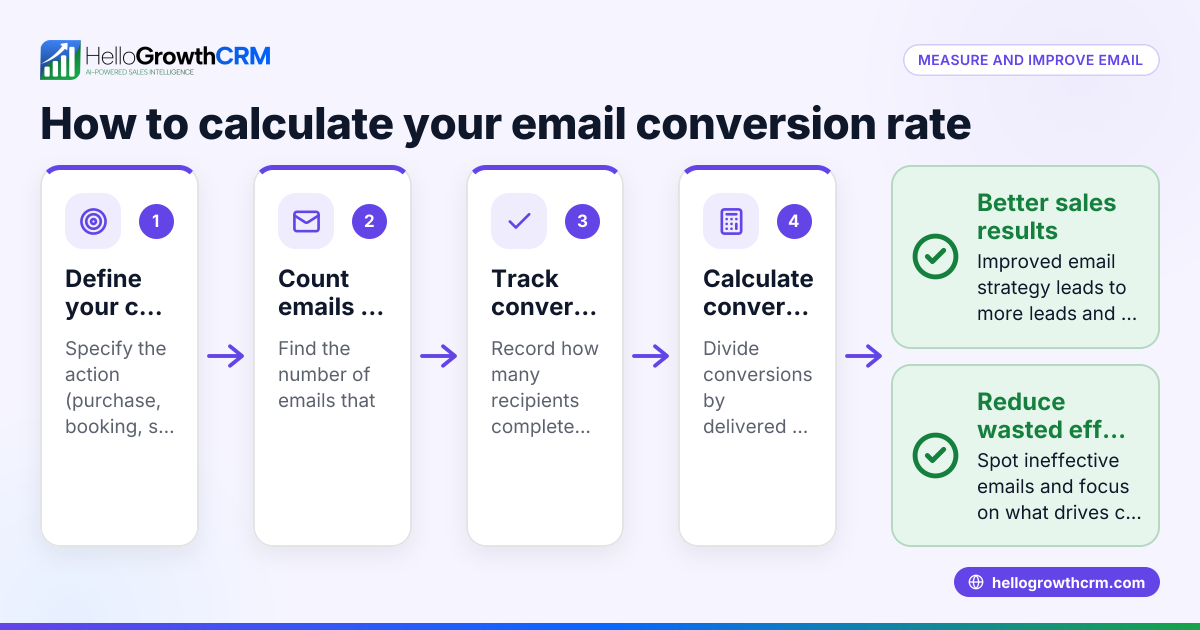
- Define the conversion goal clearly. Decide what counts as a conversion for your campaign — for example, a purchase, a form submission, a phone call, or a reply email. This goal must be measurable.
- Obtain the total number of emails delivered. This excludes bounced or invalid emails. Check your email service provider’s delivery report or CRM data to find this number.
- Count the number of conversions. Track how many recipients completed the goal within the campaign period. Use sales records, website analytics, or CRM entries.
- Calculate the conversion rate. Use the formula:
\[\text{Conversion Rate} = \left(\frac{\text{Number of Conversions}}{\text{Emails Delivered}}\right) \times 100\]%
- Segment and review results. Break down conversions by customer segment, campaign message, or time to identify what worked best.
- Repeat the process for each campaign. Track over time to see trends and improve.
Ensure your tracking methods are reliable. Use unique links, coupon codes, or reply tracking to attribute conversions correctly. This is especially important if sales happen offline or via phone.
Example (fictional figures)
A Delhi-based online fashion retailer ran an email campaign from 01/03/2024 to 15/03/2024 to promote a new collection.
- Emails sent: 15,000
- Bounced emails: 750
- Emails delivered = 15,000 - 750 = 14,250
- Purchases made from the campaign: 570
- Average purchase value: ₹2,500
Calculate conversion rate:
\[\text{Conversion Rate} = \left(\frac{570}{14,250}\right) \times 100 = 4\%\]
Calculate total revenue from conversions:
570 × ₹2,500 = ₹14,25,000
This means 4% of the delivered emails resulted in a purchase, generating ₹14,25,000 in revenue. This shows the campaign’s effectiveness and helps justify marketing spend.
Common mistakes
- Confusing open rate with conversion rate. Open rate measures interest but not action. Always measure actual conversions to assess success.
- Not defining a clear conversion goal. Without a specific action to track, you cannot calculate conversion rate accurately.
- Using total emails sent instead of delivered emails. Bounced emails should be excluded to avoid underestimating the conversion rate.
- Failing to track conversions properly. Use CRM or analytics tools to link conversions to the campaign and avoid missing data.
- Ignoring multiple touchpoints. Some conversions happen after follow-ups; track sequences to capture these delayed responses.
- Not segmenting data. Different customer groups respond differently; segmenting helps improve targeting and results.
Prevent these mistakes by setting clear goals, verifying delivery reports, and using proper tracking methods such as unique coupon codes or reply tracking. Tools like HelloGrowthCRM support these processes and help you avoid these errors. For more on automating follow-ups, see email automation and sequences.
Doing this in HelloGrowthCRM
HelloGrowthCRM offers Sequences and campaigns, which automate a five-step follow-up over two weeks. This runs on its own and stops the moment the prospect replies, helping capture conversions that occur after initial contact. The HelloMail shared inbox lets your team view replies to quotation emails collectively, without switching apps, making it easier to track conversions from email replies. Learn more about email automation and sequences and how HelloGrowthCRM supports Indian SMBs at HelloGrowthCRM for India.
Frequently asked questions
What is a good email campaign conversion rate in India? Conversion rates vary by industry and campaign type but generally range from 1% to 5%. Focus on improving your specific campaigns rather than comparing to averages.
How can I track conversions if customers buy offline? Use unique coupon codes, ask customers how they heard about you, or manually record responses in your CRM to link offline sales to your email campaigns.
Can I measure conversion rate on WhatsApp campaigns too? Yes, if you track responses or sales resulting from WhatsApp messages. HelloGrowthCRM supports WhatsApp and SMS CRM to help manage these channels efficiently. See WhatsApp and SMS CRM.
How often should I measure email campaign conversion rates? Measure after each campaign ends and regularly (monthly or quarterly) to track trends and improve your marketing.
What if I get many email opens but low conversions? This means there is interest but poor follow-through. Review your call-to-action, landing pages, and follow-up sequences to convert interest into action. HelloGrowthCRM’s sequences can help automate these follow-ups.
Key takeaways
- Conversion rate = (Conversions ÷ Emails Delivered) × 100
- Define a clear conversion goal before the campaign
- Exclude bounced emails from total emails sent
- Track conversions accurately using CRM or analytics
- Use follow-up sequences to increase conversions
- Segment data to understand customer behaviour
Start improving your email campaigns today with clear measurement and follow-up.
Start on the Free Forever plan (200 leads, no credit card) at HelloGrowthCRM.
Ready to put this into practice?
Set up your pipeline, WhatsApp follow-ups, and AI lead scoring in minutes — free, no credit card.
Try HelloGrowthCRM freeGet CRM tips in your inbox
Join thousands of sales professionals who get weekly insights on CRM strategy, AI automation, and pipeline optimization.

The HelloGrowthCRM team publishes guides on CRM strategy, AI sales tools, and revenue operations for small business sales teams.