HelloGrowthCRM software
Built for real small-business sales teams
HelloGrowthCRM helps reps qualify faster, follow up on time, and close more deals—with practical automation in one place.
- AI lead scoring and pipeline visibility
- Built-in dialer, WhatsApp, and email automation
- Sales forecasting and RevOps-ready reporting
AI lead scoring for B2B inbound leads helps your team decide which new leads deserve attention first. In the United States, the best setup combines your CRM data, clear sales stages, and rules your team can explain, audit, and improve over time.
Key takeaways
- AI lead scoring ranks inbound leads based on fit, intent, and likely sales readiness.
- A strong setup starts with clean CRM data and a clear definition of a qualified lead.
- US teams should align scoring with email, phone, and form compliance, including CAN-SPAM and TCPA where outreach applies.
- The best models use both firmographic and behavioral data, then update as outcomes change.
- Sales and RevOps should review scores often so reps trust the system and actually use it.
- Keep the model simple at first, then expand once you can measure conversion by score band.
What is AI lead scoring for B2B inbound leads?
AI lead scoring for B2B inbound leads is a way to rank incoming leads by their chance of becoming real sales opportunities. Instead of treating every form fill, demo request, and content download the same, you use historical data and live buying signals to assign a score.
For a US B2B team, that matters because inbound volume is often uneven. A software company in Chicago might get 50 demo requests in one week and 8 the next. A manufacturer in Detroit might get steady website inquiries, but only a few match its ideal customer profile. Without scoring, reps either chase everything or rely on gut instinct.
A good scoring model helps your team answer three questions fast:
- Is this company a fit?
- Is this buyer showing real intent?
- Should sales act now, later, or not at all?
That sounds simple, but many teams struggle because they build scoring before fixing process. If your CRM is missing industry, company size, lead source, or outcome data, the score will be noisy. If your sales team does not agree on what counts as a sales-qualified lead, the score will be ignored.
That is why setup matters more than the algorithm. The goal is not a perfect number. The goal is a repeatable system that helps reps spend more time on the right inbound leads.
Why does AI lead scoring matter for US B2B teams?
It helps US B2B teams respond faster to high-intent inbound leads, route the right accounts to the right reps, and improve pipeline quality. A strong model also reduces wasted follow-up on low-fit inquiries and gives RevOps a better view of forecast risk.
Inbound lead volume can look healthy while pipeline quality falls. That is common when marketing campaigns drive a lot of responses from companies outside your target market. Your dashboard may show more leads, but your reps still miss quota because too few are worth pursuing.
AI lead scoring helps correct that. It uses patterns from your past wins, losses, and stalled deals to prioritize leads more consistently than manual review alone. It can also spot combinations that humans miss, such as:
- Certain industries that convert well only above a specific employee count
- Buyers who request a demo after visiting pricing pages more than once
- Repeat visitors from the same company using different email addresses
- Leads from a specific campaign that book meetings but rarely progress
For US companies, speed matters because buyers often contact multiple vendors at once. If a lead from Houston submits a demo request at 9:10 AM and your rep follows up tomorrow, the opportunity may be gone. Scoring helps route that lead to immediate action.
Used well, an ai-powered scoring system supports sales without replacing judgment. Reps still need context. Managers still need call reviews. RevOps still needs clean lifecycle definitions. But scoring gives everyone a shared starting point.
Start with your definition of a qualified inbound lead
Before you touch any model, define what "good" means in your business. If you skip this step, your score will reflect noise instead of revenue.
Most US B2B teams should document at least these fields:
- Ideal industries
- Company size range
- Geographic service area in the United States
- Buyer roles you care about
- Minimum use case or pain point
- Disqualifiers, such as students, job seekers, or vendors
- What counts as an MQL
- What counts as an SQL
- What counts as a real opportunity
Keep the definitions practical. A "good lead" should be tied to outcomes your CRM can measure. For example, "companies with 50 to 500 employees in industrial services that requested a demo and booked a discovery call" is useful. "Leads that seem interested" is not.
Build scoring around fit, intent, and timing
Most reliable models use three buckets.
Fit means how closely the company matches your target account profile. Industry, employee count, revenue band, location, and tech stack can all matter.
Intent means what the lead did. A contact who requested a demo, returned to your pricing page, and opened follow-up emails shows stronger buying intent than someone who downloaded one top-of-funnel guide.
Timing means whether the lead needs help now. An inbound form that mentions an active initiative, contract deadline, hiring plan, or tool replacement is usually worth faster action.
This is where an ai tool can help. It can evaluate combinations across these buckets faster than manual rules alone, especially once your volume grows.
What data should go into the model?
Use CRM, marketing, and website engagement data that your team can trust. Start with fields that are complete, current, and tied to opportunity outcomes. Avoid feeding in messy data just because your systems happen to collect it.
At a minimum, consider these inputs:
- Lead source
- Campaign or form type
- Company name and website
- Industry
- Employee count
- State or region served
- Job title or department
- Website visits
- Key page views, such as pricing or demo pages
- Form submissions
- Email engagement
- Meeting booked
- Previous conversations or activities
- Opportunity created
- Opportunity stage progression
- Closed won or closed lost outcome
If your business uses calls or texts, be careful with compliance and consent tracking. For US outreach, keep your records clear so your team knows when phone or SMS follow-up is appropriate under TCPA-related practices. For email, make sure your process supports CAN-SPAM obligations.
Clean your data before you score it
Scoring cannot fix bad data. If half your inbound leads have missing company names or vague job titles, your model will overvalue weak signals.
Review these issues first:
- Duplicate records from repeat form fills
- Inconsistent lifecycle stage names
- Missing source attribution
- Free email addresses with no enrichment
- Closed-lost reasons that are blank or inconsistent
- Reps skipping activity logging
- Old lead statuses that no longer match current process
This is one reason teams move scoring into an AI CRM. The CRM can unify lead capture, activities, routing, and outcomes in one place, which gives your model cleaner training data.
How do you set up AI lead scoring step by step?
Start with a simple model tied to your real sales outcomes. Use clean inbound data, define what counts as success, test score bands against conversions, and adjust monthly so reps trust the ranking.
Here is a practical setup process for a US B2B team.
1. Choose the conversion event that matters
Do not start by scoring for clicks or email opens. Score toward a sales outcome that matters. For most teams, that is one of these:
- Meeting booked
- Sales-qualified lead
- Opportunity created
- Closed won
If your inbound volume is moderate, "opportunity created" is often the best starting point. It is closer to revenue than an MQL, but happens often enough to produce patterns.
2. Segment inbound lead types
Not all inbound leads should share one model. A demo request is different from a webinar registration. A partner inquiry is different from a pricing page hand-raise.
Start with 2 to 4 segments, such as:
- Demo requests
- Contact us forms
- Content downloads
- Returning known accounts
Each segment can use different thresholds. A demo request from a high-fit account may deserve instant rep assignment. A content download may go into nurture unless other signals stack up.
3. Select your scoring inputs
Choose a mix of fit and behavior. Avoid too many variables at first. Simple beats clever when your team is building trust.
A basic starting model might weigh:
- Industry match
- Employee count range
- Target job function
- Demo request form completion
- Pricing page visits
- Repeat visits within 7 days
- Meeting booking
- Email reply
- Existing account match
- Spam or competitor indicators
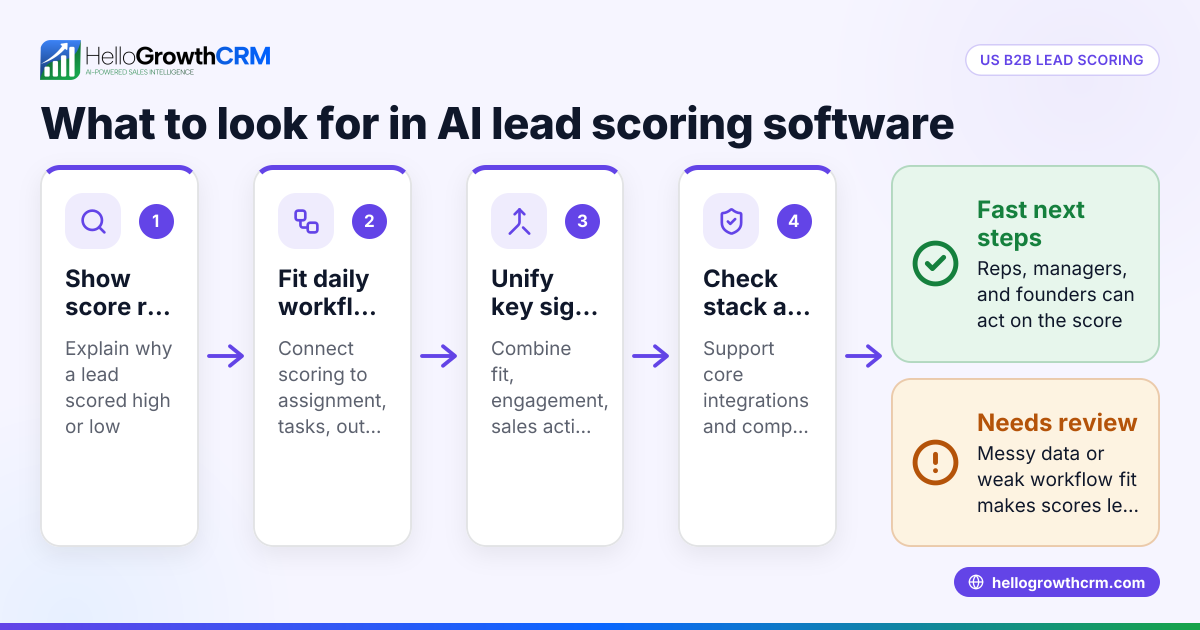
If you use AI lead scoring, document which fields matter most so sales leaders can explain why a lead was ranked highly.
4. Create score bands and actions
A score only matters if it changes behavior. Set clear ranges and tie each range to an action.
Example:
- 80-100: assign to rep immediately, same-day follow-up
- 60-79: rep review within 1 business day
- 40-59: nurture with marketing and monitor activity
- 0-39: hold, disqualify, or route for enrichment
These actions should live in your workflow, not just in a slide deck. Good ai automation makes this easier by routing, assigning, and notifying the right people based on the score.
5. Add service-level rules for speed
For top-score inbound leads, define response expectations. If your team promises fast replies, make it measurable.
For example:
- Instant owner assignment
- Slack or email alert to the rep
- Task due in 15 minutes
- Automatic first-touch email
- Call attempt if phone consent is present
- Manager alert if untouched after 30 minutes
This is where email automation can help support fast, consistent follow-up without making every response feel robotic.
6. Test against actual outcomes
Run the model for a few weeks and compare score bands to what happens next. High-score leads should convert better than medium-score leads. If they do not, change the inputs.
Look for:
- Meeting rate by score band
- Opportunity rate by score band
- Closed-won rate by score band
- Average sales cycle by score band
- Rep response time by score band
If your low-score leads outperform your high-score leads, your model is not learning the right signals.
Should you use rules, machine learning, or both?
Most US B2B teams should use both. Start with clear rules based on fit and disqualifiers, then layer AI on top to find patterns in behavior and conversion history that your team might miss.
Rules are useful because they are easy to understand. They help you filter obvious cases fast. For example, you can downscore student inquiries, vendor pitches, personal email addresses, or companies outside your service area.
Machine learning is useful because it sees combinations. A lead may look average on one field, but strong across six fields together. That is hard to catch with static rules alone.
The best approach is hybrid:
- Rules for basic qualification and disqualification
- AI for ranking likely outcomes among viable leads
- Human review for edge cases and high-value accounts
If your team is small, keep this simple. You do not need a complicated data science project. You need an ai software workflow your reps understand and your RevOps manager can maintain.
Build trust with sales or the score will fail
A scoring model can be technically sound and still fail in practice. It fails when reps do not trust it, managers override it constantly, or no one can explain why a lead got its score.
To avoid that, make the score visible and useful.
Show the "why" behind the score
Reps should see the top reasons for a lead's rank, such as:
- Target industry match
- Requested a demo
- Visited pricing page twice
- Existing account domain match
- Booked a meeting
- Low fit because employee count is too small
When reps understand the score, they are more likely to act on it.
Review exceptions every month
Pull a list of:
- High-score leads that went nowhere
- Low-score leads that converted well
- Leads sales marked as bad that later became opportunities
- Accounts with multiple inbound contacts
These cases help you refine the model. This work is often easier when RevOps owns the process and meets with sales regularly. Some teams use managed RevOps when they need help setting definitions, workflows, and reporting without adding headcount.
What mistakes should you avoid?
Do not overbuild early. The biggest mistakes are using bad data, scoring the wrong outcome, hiding the logic from sales, and never reviewing performance after launch.
A few specific problems show up often.
Mistake 1: Scoring too many lead types together
If you mix demo requests, newsletter signups, support contacts, and partner forms in one model, the output gets muddy. Segment first.
Mistake 2: Using vanity signals
Email opens, random page views, or broad content downloads can help, but they should not dominate the score. Tie the model to actions that move pipeline.
Mistake 3: Ignoring operations after the score
A strong score means little if no one follows up. The lead must be routed, assigned, and contacted quickly. The workflow needs to be automated with ai and audited by RevOps.
Mistake 4: Never removing old assumptions
Your ideal customer profile can change. Your campaigns can change. Your market can change. Review the model at least monthly, and do a deeper check each quarter.
Mistake 5: Skipping forecasting links
Inbound lead quality affects future pipeline and revenue. If your score improves, your forecast inputs should improve too. If your high-score volume drops, that may be an early warning sign. That is why many teams connect scoring with sales forecasting.
How do you measure success after launch?
Measure whether higher-scored leads convert better, move faster, and produce more pipeline. Also track rep response times and routing accuracy so you know the score is improving operations, not just analytics.
Use a simple scorecard. Review it every month.
Core metrics to track
Start with these:
- Inbound lead volume by segment
- Percentage of leads in each score band
- Median response time for high-score leads
- Meeting rate by score band
- Opportunity creation rate by score band
- Closed-won rate by score band
- Pipeline value generated by score band
- Disqualification rate by score band
- No-show rate by score band
Add operational metrics too
Do not stop at conversion metrics. Watch whether the process is being followed.
Track:
- Percentage of scored leads assigned correctly
- Percentage of top-score leads contacted on time
- Percentage of leads with missing data
- Percentage of leads manually overridden by reps
- Number of duplicate inbound records
When these operational metrics drift, performance usually follows.
Connect scoring to the rest of your stack
Read next
This article covers one part of a bigger topic. For the complete picture, read our guide to ai lead scoring.
Ready to put this into practice?
Set up your pipeline, WhatsApp follow-ups, and AI lead scoring in minutes — free, no credit card.
Try HelloGrowthCRM freeGet CRM tips in your inbox
Join thousands of sales professionals who get weekly insights on CRM strategy, AI automation, and pipeline optimization.

The HelloGrowthCRM team publishes guides on CRM strategy, AI sales tools, and revenue operations for small business sales teams.