HelloGrowthCRM software
Built for real small-business sales teams
HelloGrowthCRM helps reps qualify faster, follow up on time, and close more deals—with practical automation in one place.
- AI lead scoring and pipeline visibility
- Built-in dialer, WhatsApp, and email automation
- Sales forecasting and RevOps-ready reporting
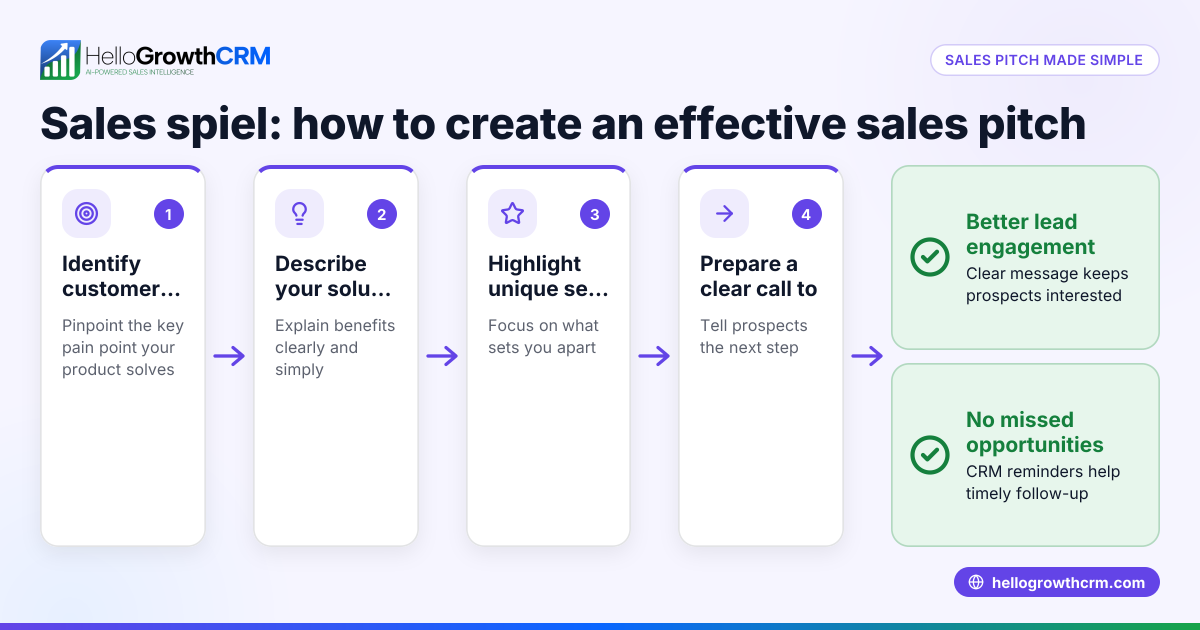
Writing a sales pitch means creating a short, clear message that convinces a potential customer to take action. Begin by identifying a specific problem your prospect faces. Then explain how your product or service solves that problem in a way that stands out. End with a clear next step the prospect should take.
Why this comes up / what goes wrong
Small-business owners often struggle with sales pitches because they rely on improvisation or unclear messaging. Without a clear structure, pitches may miss the customer's key pain points or fail to explain benefits clearly. This leads to lost sales opportunities, especially when follow-up is slow or disorganized. Many owners also use a mix of text messages, email, and spreadsheets to manage sales, causing confusion and missed leads.
Step-by-step
- Identify the Prospect’s Problem
- Research and list the main pain points your target customer faces.
- Check that the problem is specific and relevant to the prospect.
- Introduce Your Solution
- Clearly explain how your product or service solves the problem.
- Highlight what makes your solution unique or better than competitors.
- Explain the Benefits
- Focus on outcomes the customer cares about, such as saving time or reducing costs.
- Use simple, direct language without jargon.
- Provide Credibility or Social Proof
- Briefly mention relevant experience, case studies, or satisfied customers.
- Keep this short and focused.
- Make a Clear Call to Action (CTA)
- Tell the prospect exactly what to do next (e.g., schedule a call, request a demo).
- Make the action easy and low-risk.
- Keep It Concise and Tailored
- Limit your pitch to 30-60 seconds if spoken, or one short paragraph if written.
- Customize your pitch for each prospect’s industry or role.
- Review and Practice
- Read your pitch aloud to check flow and clarity.
- Ask a colleague or friend for feedback.
- Use Tools to Track and Follow Up
- Organize your leads and pitches with a CRM.
- Set reminders to follow up promptly. For example, use email automation and sequences to streamline follow-ups.
Example (fictional figures)
Lisa owns a B2B software reseller in Denver, Colorado. She is pitching a cloud backup solution to a mid-sized law firm.
- Problem: Law firms worry about data loss and compliance risks.
- Solution: Lisa offers a cloud backup service with encrypted storage and automatic compliance reports.
- Benefits: Saves IT time by automating backups; reduces risk of data breaches.
- Credibility: Lisa has worked with local firms and understands their needs.
- CTA: "Schedule a free 15-minute demo this week to see how it fits your needs."
Lisa’s written pitch:
"Many law firms struggle with data loss and compliance risks. Our cloud backup service automates encrypted data storage and compliance reporting, saving your IT team 10 hours per month and reducing breach risks. The service costs $1,200 per year and can save approximately $3,600 annually in avoided downtime and fines. Schedule a free 15-minute demo this week to see how it can protect your practice."
Calculations Lisa might use to explain benefits:
IT hours saved: 10 hours/month × 12 months = 120 hours/year
Cost savings from avoided downtime and fines: $3,600/year (assumed illustrative figure)
Service cost: $1,200/year
Net benefit: $3,600 - $1,200 = $2,400/year saved
Common mistakes
- Being too vague: Avoid generic statements. Prevent this by researching your prospect’s specific problems.
- Overloading with features: Focus on benefits, not just features. Prevent by translating features into clear customer outcomes.
- No clear call to action: Without a next step, prospects hesitate. Prevent by always ending with a simple, direct CTA.
- Ignoring follow-up: Many pitches fail due to slow or no follow-up. Prevent by using CRM tools to track and remind you.
- Not tailoring the pitch: A generic pitch feels impersonal. Prevent by customizing for each prospect’s industry or role.
Using a CRM like HelloGrowthCRM helps avoid missed follow-ups by tracking deals and setting follow-up dates.
Doing this in HelloGrowthCRM
HelloGrowthCRM helps you manage your sales process by tracking deals through stages like 'quote sent' with follow-up dates so leads don’t get forgotten. For example, a quotation sent last week appears as a deal in the pipeline with a follow-up reminder. This keeps your sales organized and timely. Learn more about HelloGrowthCRM for US businesses at HelloGrowthCRM for the United States.
Frequently asked questions
How do I write a sales email? Start with a personalized greeting, state the problem you solve, briefly introduce your solution, mention a benefit or social proof, and end with a clear call to action. Keep it concise and focused.
How do I close a sales pitch? End by clearly stating the next step you want the prospect to take, such as scheduling a call or requesting a quote. Confirm their interest and set a timeline to follow up.
How do I write a sales letter? A sales letter follows a similar structure to a pitch but is longer. Start with a hook addressing the reader’s pain, explain your solution and benefits in detail, provide testimonials or proof, and finish with a strong call to action.
For managing communication sequences, including emails and texts, explore the WhatsApp and SMS CRM features.
Key takeaways
- Identify and focus on the customer’s specific problem.
- Clearly explain your unique solution and its benefits.
- Always end with a simple, direct call to action.
- Tailor your pitch to each prospect.
- Use CRM tools to track pitches and follow-ups.
- Avoid vague language and feature overload.
Writing an effective sales pitch takes practice, but with these steps, you can create one today that engages prospects and drives action. Organize your leads and follow-ups easily with HelloGrowthCRM — Start on the Free Forever plan (200 leads, no credit card).
This article is general information, not tax or legal advice. Rules change; confirm the current position with the IRS or your state's department of revenue, or with your CPA, before acting.
Ready to put this into practice?
Set up your pipeline, WhatsApp follow-ups, and AI lead scoring in minutes — free, no credit card.
Try HelloGrowthCRM freeGet CRM tips in your inbox
Join thousands of sales professionals who get weekly insights on CRM strategy, AI automation, and pipeline optimization.

The HelloGrowthCRM team publishes guides on CRM strategy, AI sales tools, and revenue operations for small business sales teams.