HelloGrowthCRM software
Built for real small-business sales teams
HelloGrowthCRM helps reps qualify faster, follow up on time, and close more deals—with practical automation in one place.
- AI lead scoring and pipeline visibility
- Built-in dialer, WhatsApp, and email automation
- Sales forecasting and RevOps-ready reporting
Predicting future sales means estimating the revenue your business will generate in upcoming periods based on current data and trends. This involves analyzing your sales pipeline, customer behavior, and market conditions. This article explains why predicting sales matters, provides clear steps to do it, shows a practical example, highlights common mistakes, and describes how HelloGrowthCRM can help streamline the process.
Why this comes up / what goes wrong
Small business owners often struggle to predict future sales because they rely on scattered information like text messages, emails, and spreadsheets. Without a clear view of open opportunities or follow-ups, leads fall through the cracks. This leads to missed revenue and poor planning. Owners may not know which deals are likely to close or when, making cash flow and inventory management difficult. Predicting sales accurately helps allocate resources, manage staff, and plan marketing efforts effectively.
Step-by-step
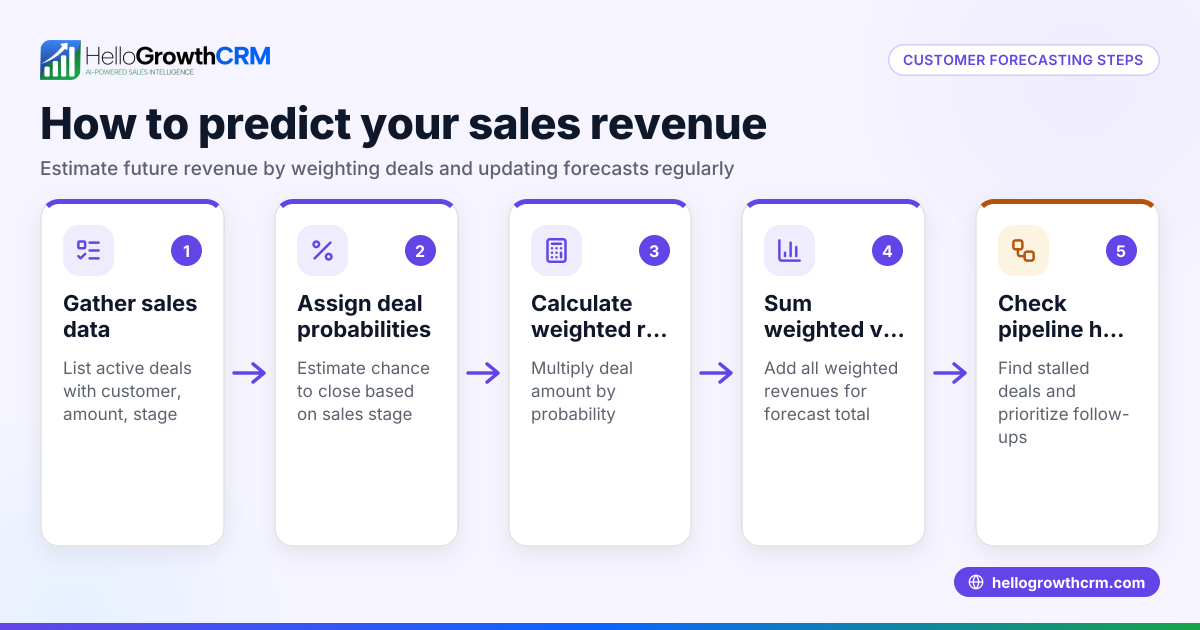
- Collect current sales data: Gather all active leads, quotes, and deals from your sales channels. Check your records for any recent quotations or proposals sent.
- Organize your sales pipeline: Group your deals by stage (e.g., prospecting, quote sent, negotiation, closing). This helps prioritize follow-ups.
- Assign probabilities to each stage: Estimate the chance each deal will close based on its stage. For example, a quote sent might have a 50% chance.
- Calculate expected value per deal: Multiply the deal amount by its probability to get the expected revenue.
- Sum expected values by time period: Group deals by expected close date (week or month) and add their expected values.
- Adjust for seasonality and market trends: Consider if sales typically rise or fall in certain seasons or due to economic factors.
- Review and update regularly: Sales pipelines change daily. Review your forecast weekly to keep it accurate.
- Use tools to automate tracking: Employ CRM software that tracks deals, stages, and follow-ups to avoid missed opportunities and improve accuracy. See how HelloGrowthCRM’s Deals (pipeline) feature supports this.
Example (fictional figures)
A landscaping contractor in Charlotte, North Carolina, wants to predict sales for March 2026.
- Deal 1: $15,000 quote sent on 02/20/2026, 50% chance, expected close 03/10/2026
- Deal 2: $8,000 negotiation stage, 70% chance, expected close 03/15/2026
- Deal 3: $5,000 prospecting, 20% chance, expected close 03/25/2026
Calculate expected values:
$15,000 × 50% = $7,500 $8,000 × 70% = $5,600 $5,000 × 20% = $1,000
Sum expected sales for March:
$7,500 + $5,600 + $1,000 = $14,100
The contractor can expect approximately $14,100 in sales for March 2026 based on current deals.
Common mistakes
- Ignoring deal stages and probabilities: Treating all deals as equally likely inflates forecasts. Prevent this by assigning realistic probabilities.
- Failing to update forecasts regularly: Old data leads to inaccurate predictions. Schedule weekly reviews.
- Overlooking follow-up dates: Missing follow-ups delays closing deals. Use CRM reminders to stay on track.
- Not accounting for seasonality: Sales may fluctuate by season. Adjust forecasts accordingly.
- Relying on scattered data sources: Tracking sales in emails and spreadsheets causes errors. Consolidate data in one system like HelloGrowthCRM’s Deals (pipeline).
Doing this in HelloGrowthCRM
HelloGrowthCRM helps small businesses predict future sales by organizing deals in a pipeline with clear stages and follow-up dates. A quotation sent last week appears as a deal at the 'quote sent' stage with a follow-up date, so it is not forgotten. This keeps your sales process on track and your forecasts accurate. For businesses with field sales teams, the Territories, field operations and commissions feature lets reps log visits from their phones, and managers see the day's activity. Founders without a sales manager can use Managed RevOps to have a specialist work the follow-up queue weekly, ensuring no lead is lost. Learn more about these features at HelloGrowthCRM for the United States.
Frequently asked questions
How often should I update my sales forecast? Update your sales forecast at least weekly to reflect new deals, stage changes, and follow-up outcomes. Frequent updates keep predictions reliable.
Can I predict sales without a CRM? Yes, but it is harder and less accurate. You must manually track leads, stages, and follow-ups, often in spreadsheets or notes, increasing the risk of errors and lost deals.
What role do probabilities play in sales forecasting? Probabilities estimate how likely a deal is to close based on its stage and history. Multiplying deal amounts by these probabilities gives a realistic expected revenue.
How does HelloGrowthCRM help with sales forecasting? HelloGrowthCRM’s Deals (pipeline) feature tracks open opportunities by stage and follow-up dates, preventing deals from being forgotten. It supports accurate forecasting and timely follow-up.
What if I don’t have a sales manager? HelloGrowthCRM offers Managed RevOps, where a revenue specialist manages follow-ups and pipeline hygiene weekly, helping founders keep forecasts and sales activities on track.
Can field sales data improve forecasting? Yes, using Territories, field operations and commissions, field reps log visits and activities in real time, giving managers accurate data to update forecasts and plan resources.
Key takeaways
- Predict future sales by analyzing your sales pipeline and assigning probabilities to deals.
- Regularly update your forecast based on deal stages, follow-ups, and market trends.
- Avoid common mistakes like ignoring deal probabilities and relying on scattered data.
- Use tools like HelloGrowthCRM to organize deals, track follow-ups, and improve forecast accuracy.
- Managed RevOps and field operations features help small businesses maintain pipeline hygiene and real-time data.
Start predicting your sales more accurately today. Start on the Free Forever plan (200 leads, no credit card) and see how HelloGrowthCRM can help you keep every deal on track.
Ready to put this into practice?
Set up your pipeline, WhatsApp follow-ups, and AI lead scoring in minutes — free, no credit card.
Try HelloGrowthCRM freeGet CRM tips in your inbox
Join thousands of sales professionals who get weekly insights on CRM strategy, AI automation, and pipeline optimization.

The HelloGrowthCRM team publishes guides on CRM strategy, AI sales tools, and revenue operations for small business sales teams.