HelloGrowthCRM software
Built for real small-business sales teams
HelloGrowthCRM helps reps qualify faster, follow up on time, and close more deals—with practical automation in one place.
- AI lead scoring and pipeline visibility
- Built-in dialer, WhatsApp, and email automation
- Sales forecasting and RevOps-ready reporting
Call center forecasting means estimating the number of calls your center will receive, how many agents you need, and the expected sales results. This helps small businesses manage resources well, reduce customer wait times, and increase sales success. In this article, you'll learn why forecasting is important, how to do it step-by-step, see a worked example with clear calculations, discover common mistakes, and learn how HelloGrowthCRM can assist.
Why this comes up / what goes wrong
Small business owners with call centers often struggle to predict call volumes and sales outcomes. Without forecasting, they may schedule too few agents during busy hours, causing long wait times and lost sales. Or they may overstaff during slow periods, wasting payroll budget. Many rely on manual spreadsheets or scattered tools like text messages and email, which makes it hard to track pipeline stages or spot where deals stall. This leads to missed sales opportunities and inefficient operations.
Step-by-step
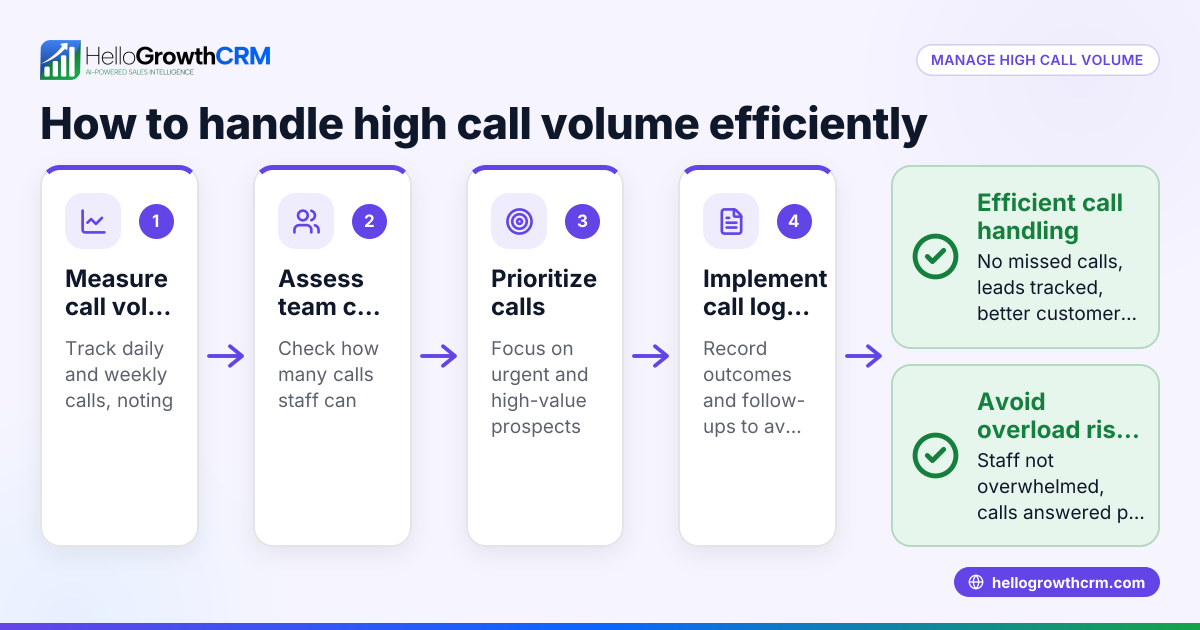
- Gather historical call data: Collect past data on daily and hourly call volumes, average call duration, and peak call times. Check for seasonal patterns or special events that affect calls.
- Project future call volume: Use historical data to estimate expected calls for the upcoming period. Adjust for upcoming marketing campaigns, product launches, or holidays.
- Calculate staffing needs: Multiply forecasted calls by average handling time to get total call time, then divide by agent working minutes per shift to determine how many agents you need.
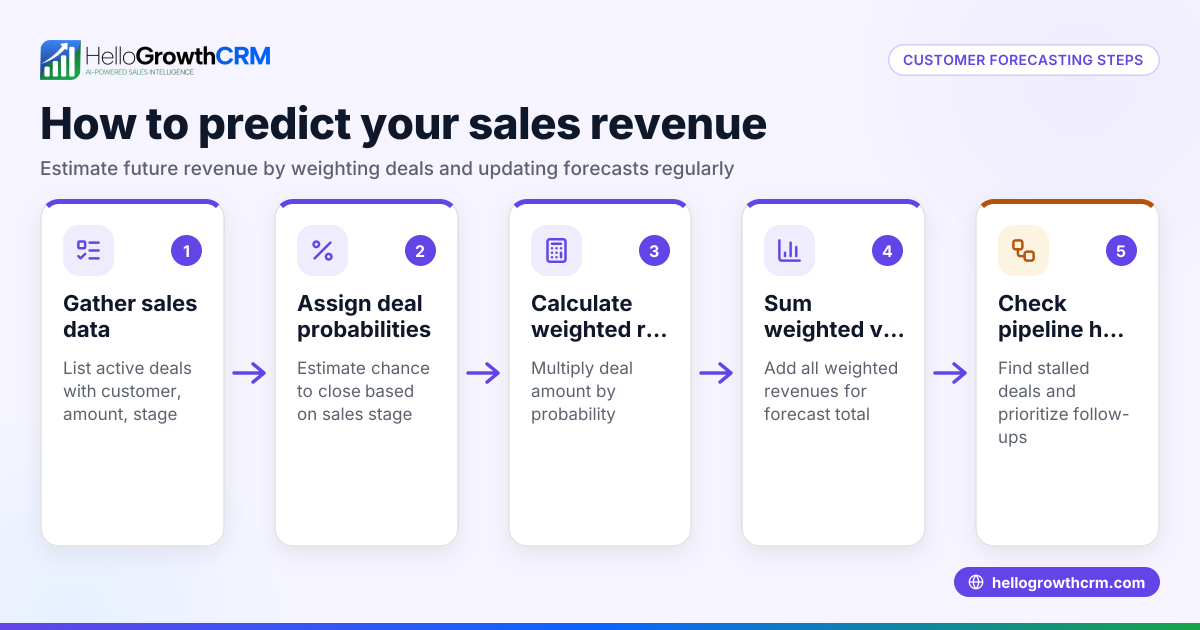
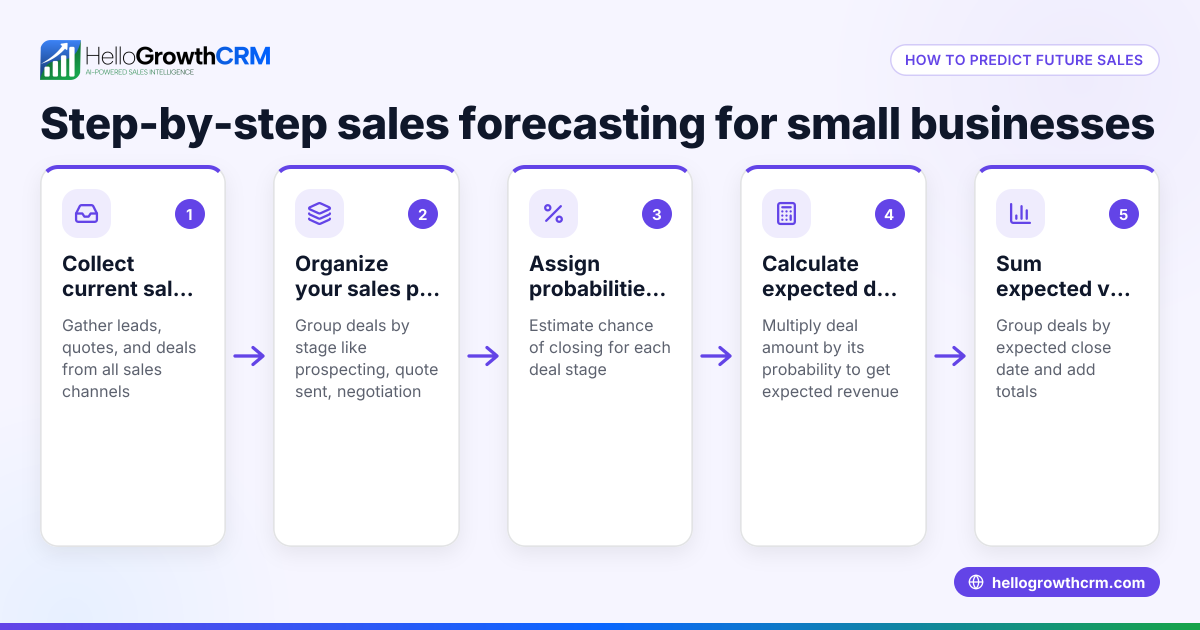
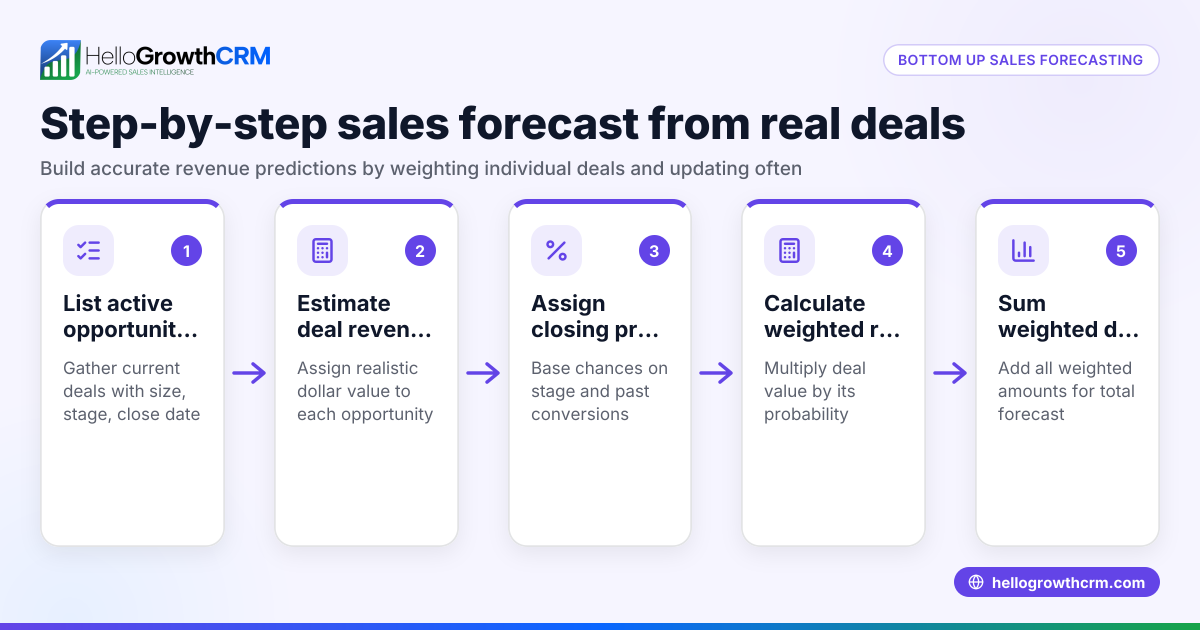
- Forecast sales results: Analyze your historical conversion rate from calls to sales and apply it to the projected calls to estimate sales numbers.
- Monitor sales pipeline stages: Track leads through your sales process to identify where deals tend to stall, adjusting forecasts accordingly.
- Review and update forecasts regularly: Update your forecasts weekly or monthly using actual call and sales data to keep predictions accurate.
Using tools like HelloGrowthCRM’s pipeline forecast and AI insights can automate sales outcome projections and highlight stalled deals without building complex spreadsheets. The built-in CRM dialer helps agents log call outcomes directly, improving data accuracy.
Example (fictional figures)
A landscaping contractor in Charlotte, North Carolina, wants to forecast calls and sales for July 2026.
- Historical average calls per day in July: 100
- Average call duration: 6 minutes
- Conversion rate from call to sale: 15%
- Average sale value: $1,200
- Agent working hours per day: 7 hours (420 minutes)
Step 1: Calculate total call handling time per day 100 calls × 6 minutes = 600 minutes
Step 2: Calculate number of agents needed 600 minutes ÷ 420 minutes per agent = 1.43 agents → round up to 2 agents
Step 3: Forecast daily sales 100 calls × 15% = 15 sales
Step 4: Forecast daily revenue 15 sales × $1,200 = $18,000
This means the business should schedule 2 agents each day in July and expect daily revenue of $18,000.
Common mistakes
- Ignoring seasonal trends: Prevent this by analyzing data over multiple years to identify patterns.
- Using outdated data: Keep forecasts current by updating them regularly to reflect recent changes.
- Not accounting for variability in call handling time: Track actual call durations and adjust staffing accordingly.
- Relying solely on manual spreadsheets: Use CRM tools with forecasting features to reduce errors and save time.
- Failing to monitor pipeline bottlenecks: Use AI insights to detect stalled deals and adjust forecasts.
Doing this in HelloGrowthCRM
HelloGrowthCRM offers a built-in dialer that lets reps call prospects from inside the CRM and log call outcomes directly on each lead. This improves data accuracy for forecasting. The platform’s pipeline forecast and AI insights provide AI-assisted revenue projections based on current pipeline stages, deal velocity, and historical conversion patterns. This helps owners spot which sales stages are stalling without building spreadsheets, so they can adjust staffing and sales strategies quickly.
Frequently asked questions
What is the main goal of call center forecasting? The main goal is to predict call volumes and sales outcomes to schedule the right number of agents, improving customer service and maximizing revenue.
How often should I update my call center forecast? You should review and update forecasts at least monthly, or more often if your business experiences rapid changes or seasonal shifts.
Can small businesses do call center forecasting without software? Yes, but it requires careful manual tracking of call data and sales results, which can be time-consuming and prone to errors. CRM tools with built-in forecasting features simplify this process.
How does AI improve call center forecasting? AI analyzes historical data and current pipeline health to predict sales outcomes and identify stalled deals, providing more accurate forecasts and actionable insights.
What key metrics are important for call center forecasting? Important metrics include call volume, average call duration, conversion rates, sales pipeline stages, and agent availability.
How can I improve forecasting accuracy? Regularly update data, monitor pipeline stages, use AI insights, and log call outcomes accurately with tools like HelloGrowthCRM’s built-in dialer.
Key takeaways
- Call center forecasting predicts call volumes, staffing needs, and sales outcomes to optimize operations.
- Use historical data and adjust for upcoming campaigns, seasonality, and events.
- Calculate staffing by dividing total call time by agent working minutes.
- Update forecasts regularly to reflect actual performance and market changes.
- Avoid common mistakes like ignoring seasonality and relying only on spreadsheets.
- HelloGrowthCRM’s built-in dialer and AI pipeline forecast simplify forecasting and improve data accuracy.
Start improving your call center forecasting today by trying HelloGrowthCRM’s free plan with 200 leads and no credit card required at Start on the Free Forever plan (200 leads, no credit card).
Ready to put this into practice?
Set up your pipeline, WhatsApp follow-ups, and AI lead scoring in minutes — free, no credit card.
Try HelloGrowthCRM freeGet CRM tips in your inbox
Join thousands of sales professionals who get weekly insights on CRM strategy, AI automation, and pipeline optimization.

The HelloGrowthCRM team publishes guides on CRM strategy, AI sales tools, and revenue operations for small business sales teams.