HelloGrowthCRM software
Built for real small-business sales teams
HelloGrowthCRM helps reps qualify faster, follow up on time, and close more deals—with practical automation in one place.
- AI lead scoring and pipeline visibility
- Built-in dialer, WhatsApp, and email automation
- Sales forecasting and RevOps-ready reporting
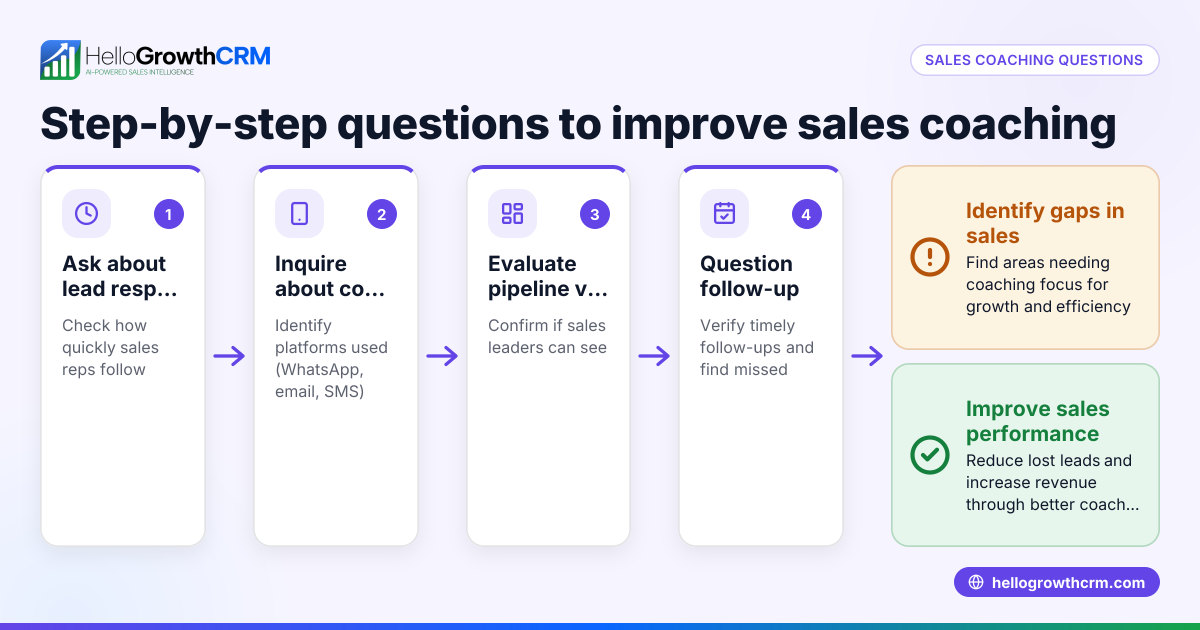
Question based selling is a sales technique focused on asking purposeful questions to uncover the customer’s true needs and pain points. Instead of pushing a product, you guide the conversation to discover what matters most to the prospect. This leads to more relevant solutions and higher close rates.
Why this comes up / what goes wrong
Many small-business owners and sales teams struggle with slow follow-up or losing leads because their sales conversations are too scripted or product-focused. They often talk at prospects rather than with them, missing key information that could help close the sale. Without understanding the customer’s specific challenges, sales pitches may feel generic and fail to connect.
Question based selling addresses this by shifting the focus from selling a product to solving a problem through dialogue. It’s especially useful for US small and mid-sized businesses that run sales on text messages, email, and spreadsheets but want a more interactive, customer-centric approach.
Step-by-step
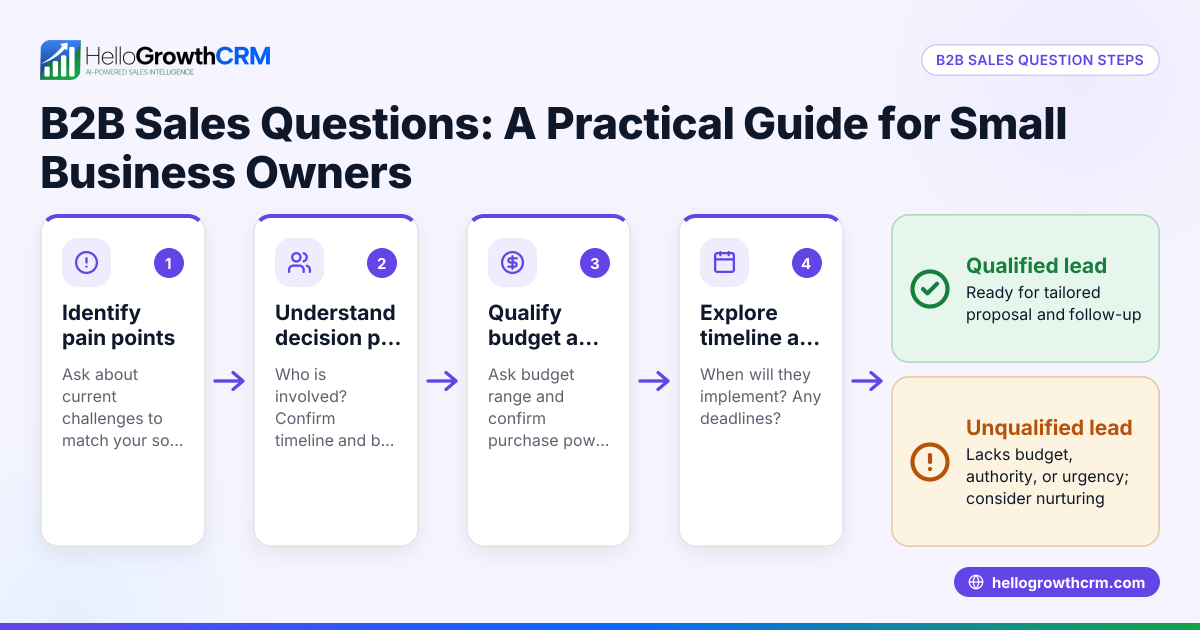
- Prepare your questions: List open-ended questions that explore your prospect’s business challenges, goals, budget, timeline, and decision-making process. Check that questions are clear and relevant.
- Start with rapport: Begin your call or meeting by building trust with light conversation. Check your tone is friendly and professional.
- Ask open-ended questions: Use your prepared questions to encourage detailed answers. Check you listen actively and take notes.
- Probe deeper: When a prospect mentions a problem or goal, follow up with "why" or "how" questions to understand the root cause. Check you avoid interrupting.
- Summarize and confirm: Restate what you heard to confirm understanding. Check you captured the key points correctly.
- Tailor your pitch: Based on the answers, present your product or service as the solution to their specific needs. Check your pitch addresses the pain points uncovered.
- Handle objections by asking: If the prospect raises concerns, ask clarifying questions to understand the objection fully before responding.
- Close with a next step: Ask what the prospect’s preferred next step is, whether it’s a demo, proposal, or follow-up call. Check you agree on a clear action.
Using a CRM with a built-in CRM dialer or a WhatsApp and SMS CRM can help manage your questions and follow-ups efficiently.
Example (fictional figures)
Imagine a residential real-estate team in Phoenix, Arizona, using question based selling to close a deal.
- They ask, "What is your timeline for buying a home?"
- The prospect answers, "Within 6 months."
- They ask, "What challenges have you faced finding the right property?"
- The prospect says, "Limited listings in my price range and slow responses from agents."
- The team summarizes, "So, your main concerns are finding affordable listings quickly and timely communication."
- They present their solution: "We specialize in properties under $400,000 and guarantee responses within 24 hours."
- The prospect agrees to a consultation.
This approach helps the team focus on what matters to the buyer, increasing their chance of closing.
Common mistakes
- Asking yes/no questions: Avoid questions that can be answered with a simple yes or no. Prevent this by preparing open-ended questions.
- Talking too much: Salespeople often dominate the conversation. Prevent by practicing active listening and pausing after questions.
- Not following up on answers: Missing deeper insights leads to weak pitches. Prevent by probing with "why" and "how" questions.
- Ignoring objections: Responding defensively can lose trust. Prevent by asking clarifying questions about objections.
- Failing to confirm understanding: Misunderstandings waste time. Prevent by summarizing and confirming key points.
Using a CRM designed for US small businesses like HelloGrowthCRM can help track questions and responses systematically, improving follow-up and lead management. See HelloGrowthCRM for the United States for more.
Frequently asked questions
What types of questions are most effective in question based selling? Open-ended questions that encourage detailed answers work best. Examples include "What challenges are you facing?" or "How do you currently handle this issue?" These help uncover needs and motivations.
How do I prepare questions without sounding scripted? Prepare a flexible list of questions but adapt them naturally based on the conversation flow. Listen actively and ask follow-ups rather than reciting a fixed script.
Can question based selling work for all industries? Yes, it’s effective in many industries, especially where understanding customer needs deeply improves the solution fit. Small and mid-sized businesses using WhatsApp and SMS CRM can apply it across sectors.
How do I handle prospects who don’t want to answer questions? Explain that your goal is to understand their needs better to offer the most relevant solution. Keep questions simple and non-intrusive.
What if I don’t have time for long sales calls? Prioritize key questions that reveal the biggest pain points. Use tools like a built-in CRM dialer to streamline calls and follow-ups.
Key takeaways
- Question based selling focuses on understanding customer needs through targeted questions.
- Prepare open-ended questions and listen actively to uncover pain points.
- Summarize answers and tailor your pitch to the prospect’s specific situation.
- Avoid common mistakes like yes/no questions, talking too much, and ignoring objections.
- Use CRM tools designed for small businesses to manage your questions and follow-ups efficiently.
Start applying question based selling today to improve your sales conversations and close more deals. To manage your leads and conversations easily, Start on the Free Forever plan (200 leads, no credit card).
Ready to put this into practice?
Set up your pipeline, WhatsApp follow-ups, and AI lead scoring in minutes — free, no credit card.
Try HelloGrowthCRM freeGet CRM tips in your inbox
Join thousands of sales professionals who get weekly insights on CRM strategy, AI automation, and pipeline optimization.

The HelloGrowthCRM team publishes guides on CRM strategy, AI sales tools, and revenue operations for small business sales teams.