HelloGrowthCRM software
Built for real small-business sales teams
HelloGrowthCRM helps reps qualify faster, follow up on time, and close more deals—with practical automation in one place.
- AI lead scoring and pipeline visibility
- Built-in dialer, WhatsApp, and email automation
- Sales forecasting and RevOps-ready reporting
A rolling cash forecast helps you predict your business’s cash position by continuously updating expected receipts and payments over the next several months. Unlike a static forecast, it rolls forward each month, adding a new future period so you always have a current view of cash flow. This is crucial for small businesses to avoid surprises, plan expenses, and manage growth.
Why this comes up / what goes wrong
Many small-business owners struggle with cash flow because they rely on outdated or one-time cash forecasts. They may prepare a budget at the start of the year but don’t update it regularly. This leads to blind spots, missed payments, or lost opportunities because they don’t see when cash will be tight or plentiful. Without a rolling cash forecast, you risk running out of cash or missing chances to invest or hire.
Step-by-step
- Set your rolling period length: Choose how many months ahead you want to forecast, typically 12 months. This gives a long enough horizon to plan but is manageable to update.
- Gather your historical cash flow data: Collect past records of cash inflows (sales receipts, loans, investments) and outflows (bills, payroll, purchases). Check for seasonal patterns.
- Estimate future cash inflows: Project your expected receipts for each future month. Use sales forecasts, customer payment terms, and any contract schedules. Adjust for expected growth or slowdowns.
- Estimate future cash outflows: List all expected payments, including fixed costs (rent, salaries) and variable costs (inventory, marketing). Confirm payment due dates.
- Calculate net cash flow for each month: Subtract total outflows from inflows to get net cash flow per month.
- Update your cash balance each month: Start with your current cash balance, then add the net cash flow for each month cumulatively to get the projected ending cash balance.
- Review and adjust monthly: As actual data comes in, update your forecast by replacing estimates with real numbers and extend the forecast by another month to keep the rolling window.
- Check for cash shortfalls or surpluses: Identify months where cash might be low or excess cash is available. Plan actions like securing financing or investing surplus.
- Incorporate sales pipeline data: Use your sales forecast to refine inflows. Track deal stages and expected close dates to improve accuracy.
Example (fictional figures)
Phoenix Residential Real Estate Team, 07/01/2026
- Current cash balance: $150,000
- Forecast period: 12 months
| Month | Expected Inflows | Expected Outflows | Net Cash Flow | Ending Cash Balance |
|---|---|---|---|---|
| Jul 2026 | $200,000 | $180,000 | $20,000 | $150,000 + $20,000 = $170,000 |
| Aug 2026 | $220,000 | $210,000 | $10,000 | $170,000 + $10,000 = $180,000 |
| Sep 2026 | $180,000 | $190,000 | -$10,000 | $180,000 - $10,000 = $170,000 |
| Oct 2026 | $210,000 | $200,000 | $10,000 | $170,000 + $10,000 = $180,000 |
| Nov 2026 | $230,000 | $220,000 | $10,000 | $180,000 + $10,000 = $190,000 |
| Dec 2026 | $250,000 | $240,000 | $10,000 | $190,000 + $10,000 = $200,000 |
This rolling forecast updates monthly by removing the past month and adding a new future month, keeping the 12-month window current.
Common mistakes
- Using static forecasts without updates: Prevent by setting a monthly review and update schedule.
- Ignoring payment timing differences: Prevent by tracking actual payment dates, not just invoice dates.
- Overly optimistic sales inflows: Prevent by basing projections on realistic sales pipeline data and historical conversion rates.
- Missing variable expenses: Prevent by regularly reviewing all costs and adjusting for seasonal or one-time expenses.
- Not planning for cash shortfalls: Prevent by identifying low cash months early and preparing financing or cost-cutting measures.
- Relying on spreadsheets without automation: Prevent by using tools that integrate sales data and automate updates.
Doing this in HelloGrowthCRM
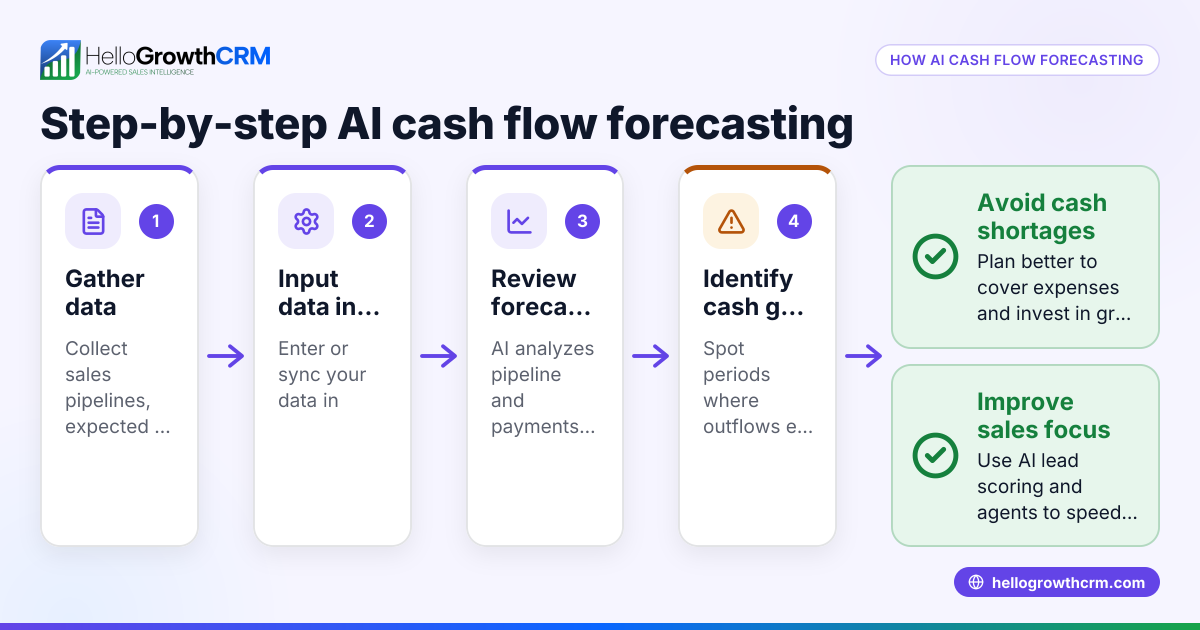
HelloGrowthCRM offers pipeline forecast and AI insights that help small-business owners see which stage deals are stalling in without building a spreadsheet. This AI-assisted revenue forecasting projects expected close amounts based on your current pipeline stage, velocity, and historical conversion patterns. The AI-generated analysis of pipeline health, rep performance, and revenue signals gives you a clearer picture of expected cash inflows, improving your rolling cash forecast accuracy. Learn more about AI CRM and sales forecasting features.
Frequently asked questions
What is the difference between a rolling cash forecast and a static cash forecast? A rolling cash forecast updates regularly by adding a new future period and dropping the past one, keeping a constant forecast window (e.g., 12 months). A static forecast is fixed for a set period and doesn’t update, making it less responsive to changes.
How often should I update my rolling cash forecast? You should update it at least monthly to replace estimates with actuals and extend the forecast by another month. More frequent updates can improve accuracy, especially in fast-changing businesses.
Can I use sales pipeline data to improve my cash forecast? Yes. Incorporating sales pipeline stages and expected close dates helps you estimate when cash inflows from sales will occur, making your forecast more accurate.
What if my forecast shows a cash shortfall? If your forecast predicts low cash, plan actions such as delaying expenses, securing short-term financing, or accelerating receivables collection to avoid running out of cash.
Is a rolling cash forecast only for large businesses? No. Small and mid-sized businesses benefit greatly from rolling cash forecasts because they help manage tight cash flow and plan growth effectively.
Key takeaways
- A rolling cash forecast continuously updates cash inflows and outflows over a future period.
- Regular updates and realistic assumptions keep the forecast accurate and useful.
- Integrating sales pipeline data improves cash inflow estimates.
- Identifying cash shortfalls early allows proactive cash management.
- Avoid common mistakes like ignoring timing or relying solely on static forecasts.
- HelloGrowthCRM’s pipeline forecast and AI insights simplify sales-related cash flow forecasting.
Start managing your cash flow confidently by using a rolling cash forecast. To try tools that help you track your sales pipeline and forecast revenue without spreadsheets, start on the Free Forever plan (200 leads, no credit card).
Ready to put this into practice?
Set up your pipeline, WhatsApp follow-ups, and AI lead scoring in minutes — free, no credit card.
Try HelloGrowthCRM freeGet CRM tips in your inbox
Join thousands of sales professionals who get weekly insights on CRM strategy, AI automation, and pipeline optimization.

The HelloGrowthCRM team publishes guides on CRM strategy, AI sales tools, and revenue operations for small business sales teams.