HelloGrowthCRM software
Built for real small-business sales teams
HelloGrowthCRM helps reps qualify faster, follow up on time, and close more deals—with practical automation in one place.
- AI lead scoring and pipeline visibility
- Built-in dialer, WhatsApp, and email automation
- Sales forecasting and RevOps-ready reporting
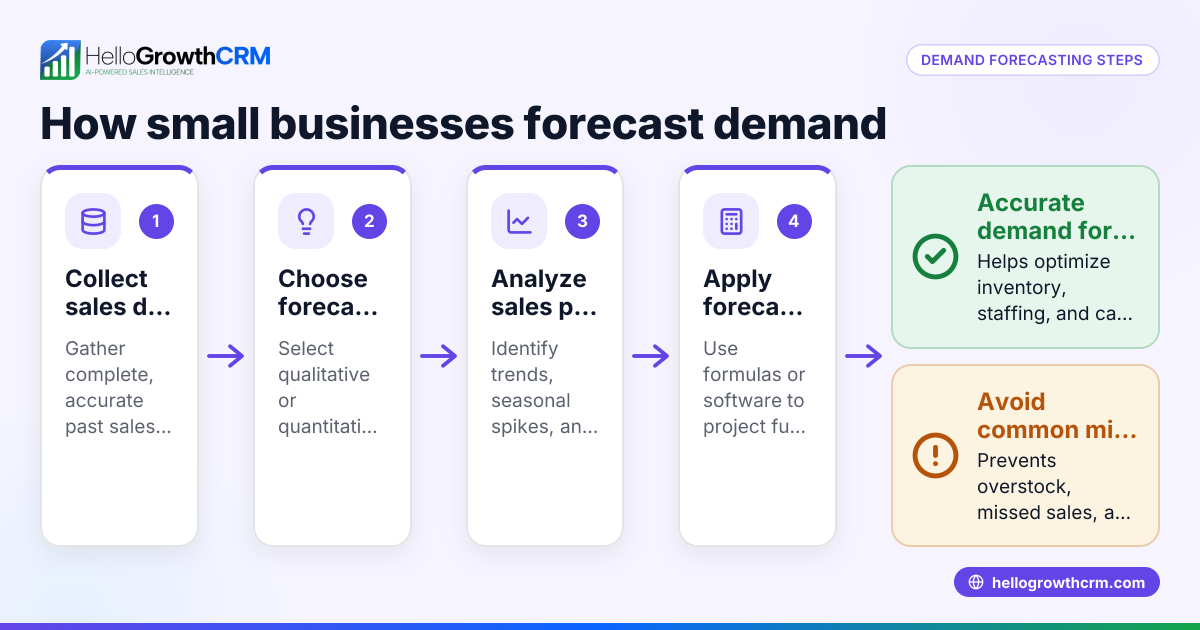
Sales forecast methods are essential for small businesses to estimate future revenue, plan resources, and set realistic goals. These methods use various data points like past sales, current leads, and market trends to predict sales outcomes. This guide covers why sales forecasting is important, practical steps to create forecasts, a worked example with realistic figures, common pitfalls to avoid, and how HelloGrowthCRM supports your sales forecasting efforts.
Why this comes up / what goes wrong
Small-business owners often struggle with sales forecasting because they rely on inconsistent data sources like spreadsheets, emails, or text messages. This leads to inaccurate or outdated forecasts, missed sales opportunities, and poor resource planning. Without a clear method, it’s hard to know which deals will close and when, causing cash flow surprises and inefficient sales efforts. Owners want a straightforward way to predict sales that aligns with their real sales process and team activity.
Step-by-step
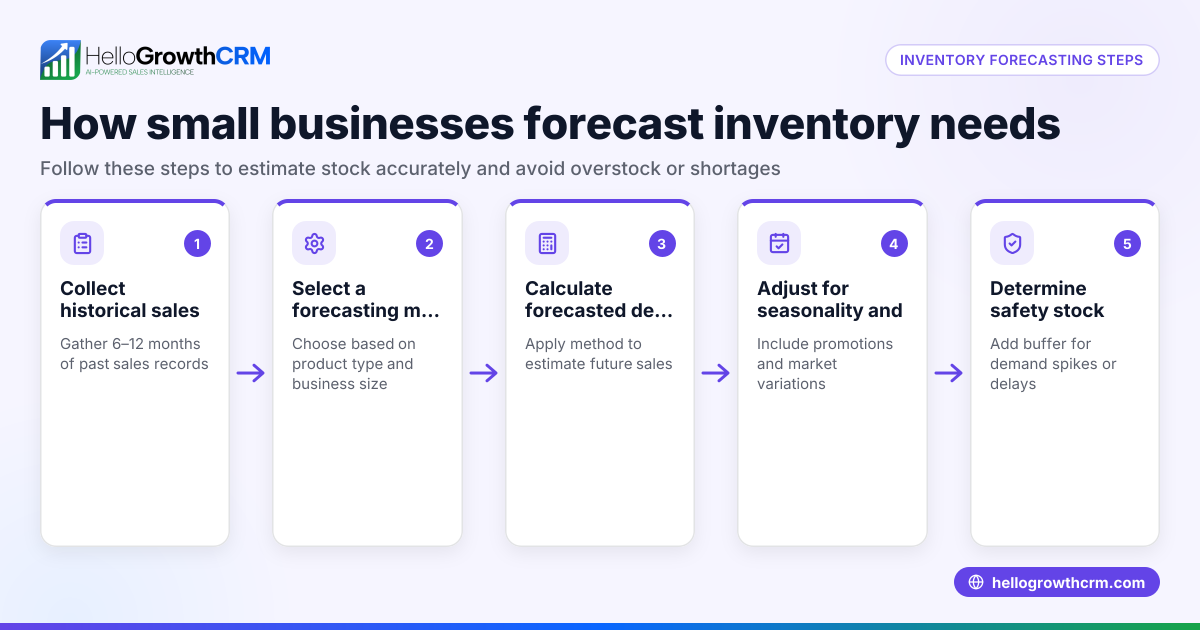
- Gather historical sales data
- Collect past sales figures for at least the last 6-12 months.
- Check for seasonal trends or fluctuations.
- Segment your sales pipeline
- Define clear stages like prospecting, qualification, quote sent, negotiation, and closed.
- Verify that each deal is assigned to a stage with a follow-up date.
- Assign probabilities to each stage
- Estimate the likelihood of closing deals at each stage (e.g., 10% for prospecting, 70% for quote sent).
- Check that these probabilities reflect your historical conversion rates.
- Calculate weighted sales values
- Multiply each deal’s potential value by its stage probability.
- Sum these weighted values to get a forecasted revenue amount.
- Adjust for sales cycle timing
- Consider how long deals typically take to close.
- Include only deals likely to close within your forecast period.
- Review pipeline health and deal velocity
- Identify stalled deals or bottlenecks.
- Check if the number of new leads supports your revenue goals.
- Update forecasts regularly
- Set a routine (weekly or monthly) to update deal statuses and forecast figures.
- Verify that follow-up tasks are completed to keep the pipeline moving.
Example (fictional figures)
A residential real-estate team in Phoenix, Arizona, wants to forecast sales for Q3 2026 ending 09/30/2026. They have these deals in their pipeline:
| Deal | Stage | Value ($) | Probability (%) | Weighted Value ($) |
|---|---|---|---|---|
| Deal A | Prospecting | 150,000 | 10 | 150,000 × 10% = 15,000 |
| Deal B | Quote Sent | 300,000 | 70 | 300,000 × 70% = 210,000 |
| Deal C | Negotiation | 200,000 | 85 | 200,000 × 85% = 170,000 |
Total forecasted revenue = 15,000 + 210,000 + 170,000 = $395,000
They check that Deal A is new and unlikely to close this quarter, so they exclude it for this forecast period.
Adjusted forecast = 210,000 + 170,000 = $380,000
This forecast helps them plan staffing and marketing budgets for Q3.
Common mistakes
- Ignoring pipeline stage probabilities: Prevent this by assigning realistic percentages based on past data.
- Using outdated or incomplete data: Prevent by updating deal statuses and values regularly.
- Not accounting for sales cycle length: Prevent by including only deals likely to close in the forecast period.
- Overlooking stalled deals: Prevent by reviewing pipeline health and following up on stalled opportunities.
- Relying solely on gut feeling: Prevent by combining data-driven methods with sales team input.
- Failing to update forecasts consistently: Prevent by scheduling regular forecast reviews.
Doing this in HelloGrowthCRM
HelloGrowthCRM helps small businesses forecast sales with its Pipeline forecast and AI insights. The AI-assisted revenue forecasting projects expected close amounts based on current pipeline stage, velocity, and historical conversion patterns. You can see which stage deals are stalling in without building a spreadsheet. The Deals (pipeline) feature tracks open opportunities from first contact through close — for example, a quotation sent last week shows up as a deal at the 'quote sent' stage with a follow-up date, so it is not forgotten. For businesses with field sales, Territories, field operations and commissions let reps log visits from their phones and managers see the day's beat. Learn more about AI CRM, sales forecasting, and HelloGrowthCRM for the United States.
Frequently asked questions
What is the most accurate sales forecast method? Accuracy depends on your data quality and sales process. Weighted pipeline forecasting combined with historical conversion rates and deal velocity is commonly effective for small businesses.
How often should I update my sales forecast? Update forecasts regularly, at least monthly or weekly if your sales cycle is short, to reflect real-time deal progress and adjust plans accordingly.
Can small businesses forecast sales without software? Yes, using spreadsheets and manual tracking is possible but prone to errors and time-consuming. Tools like HelloGrowthCRM automate tracking and forecasting for better accuracy.
How do probabilities affect sales forecasts? Probabilities weight each deal's potential value based on its stage, making forecasts more realistic by accounting for the likelihood of closing.
What if my sales pipeline is too small to forecast? Focus on lead generation and pipeline building first. Without enough deals, forecasts will be unreliable. Track activities that grow your pipeline.
Key takeaways
- Use historical data and clear pipeline stages to build sales forecasts.
- Assign realistic probabilities to each pipeline stage based on past performance.
- Calculate weighted sales values to estimate expected revenue.
- Regularly update forecasts and review pipeline health to avoid surprises.
- Avoid common mistakes like ignoring sales cycle timing and stalled deals.
- HelloGrowthCRM offers AI-powered pipeline forecasting and deal tracking to simplify this process.
Start improving your sales forecasting today. Start on the Free Forever plan (200 leads, no credit card).
Ready to put this into practice?
Set up your pipeline, WhatsApp follow-ups, and AI lead scoring in minutes — free, no credit card.
Try HelloGrowthCRM freeGet CRM tips in your inbox
Join thousands of sales professionals who get weekly insights on CRM strategy, AI automation, and pipeline optimization.

The HelloGrowthCRM team publishes guides on CRM strategy, AI sales tools, and revenue operations for small business sales teams.