HelloGrowthCRM software
Built for real small-business sales teams
HelloGrowthCRM helps reps qualify faster, follow up on time, and close more deals—with practical automation in one place.
- AI lead scoring and pipeline visibility
- Built-in dialer, WhatsApp, and email automation
- Sales forecasting and RevOps-ready reporting
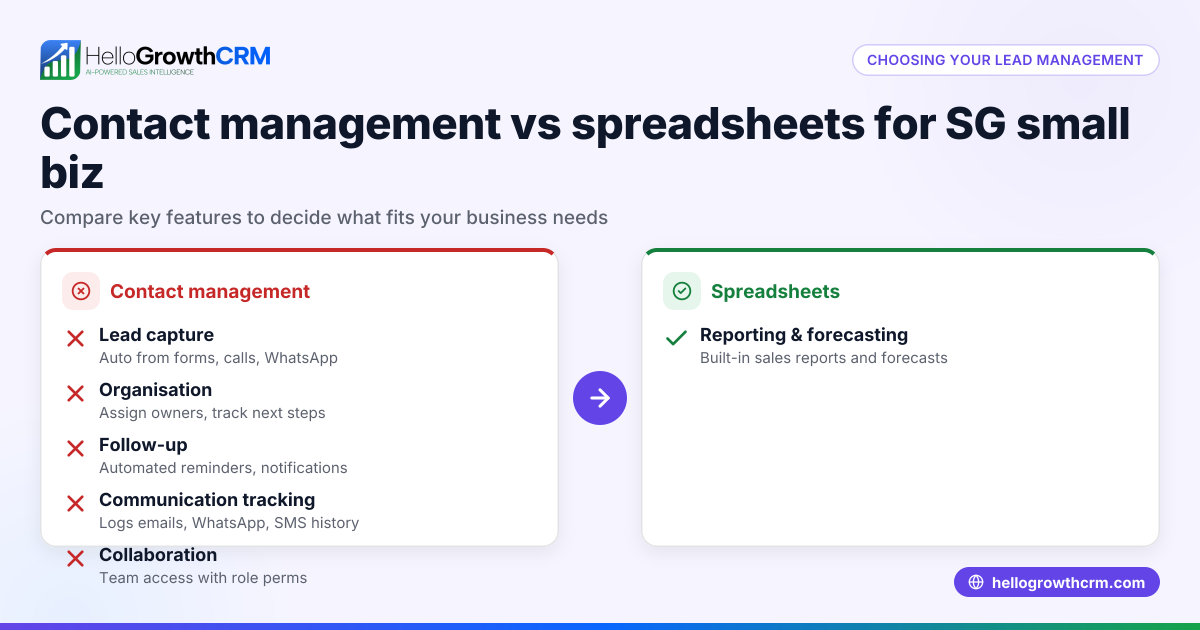
Sales automation and spreadsheets are two common tools Singapore small businesses consider to manage sales. While spreadsheets are familiar and inexpensive, sales automation provides features that save time and reduce lost leads. This article covers why business owners face this choice, a detailed comparison table, a worked example, common mistakes, and how HelloGrowthCRM can support your sales process.
Why this comes up / what goes wrong
Many small business owners in Singapore start their sales tracking with spreadsheets because they are easy to use and free with software like Microsoft Excel or Google Sheets. However, as the business grows beyond a few leads or salespeople, spreadsheets can become cumbersome. They lack automation for follow-ups, lead assignment, and real-time updates. This leads to slow responses, missed opportunities, and manual errors.
On the other hand, sales automation tools are designed to streamline these processes but require some investment and learning. Business owners wonder if the cost and effort are justified compared to their current spreadsheet setup. This comparison helps clarify which option suits different business sizes and needs.
Step-by-step
| Criteria | Sales Automation | Spreadsheets |
|---|---|---|
| Ease of Use | Moderate learning curve; designed for sales tasks | Very easy; familiar interface |
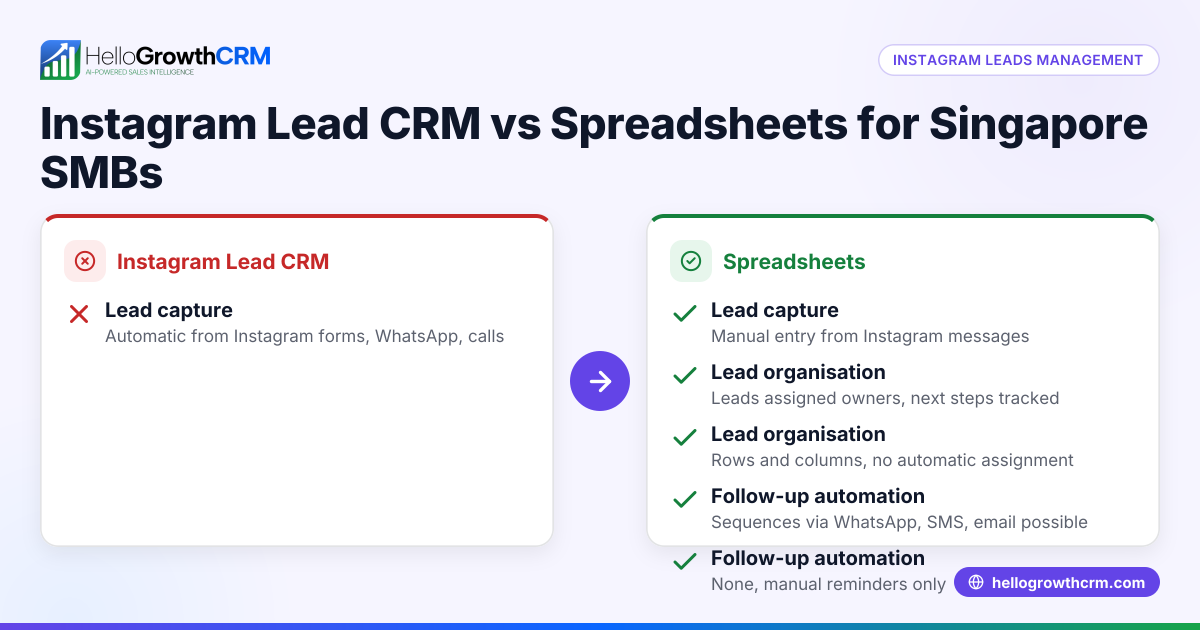
| Lead Capture | Automated from web forms and integrations | Manual entry or copy-paste |
| Follow-up | Automated multi-step sequences stopping on reply | Manual reminders; risk of missed follow-ups |
| Lead Assignment | Automated routing by territory, score or round-robin | Manual assignment; prone to errors |
| Collaboration | Real-time updates; task boards and notifications | Shared sheets but version conflicts possible |
| Reporting & Forecasting | Built-in sales forecasting and reports | Requires manual data analysis |
| Cost | Monthly subscription; value depends on usage | Usually free or low-cost with existing software |
Who should pick which?
- Sales Automation: Growing teams (5+ salespeople), businesses with frequent leads, and those wanting faster, consistent follow-up and reporting.
- Spreadsheets: Very small teams (1-2 people), low lead volume, simple sales processes, and tight budgets.
For Singapore businesses looking to scale sales efficiently, sales automation is often worth the investment.
Example (fictional figures)
A property agency in Novena receives 50 leads monthly and has 3 sales agents.
Using spreadsheets:
- Time spent manually entering and assigning leads: 2 hours/week
- Cost of sales staff time (S$20/hour): 2 × 4 × 20 = S$160/month
- Missed follow-ups estimated at 10%, losing potential S$10,000 in sales
Using sales automation:
- Monthly subscription: S$200 (assumed illustrative)
- Time saved on manual tasks: 8 hours/month
- Value of saved time: 8 × 20 = S$160
- Reduced missed follow-ups to 2%, increasing sales by S$8,000
Calculation:
Spreadsheets total cost = S$160 (time) + S$0 (software) = S$160
Sales automation total cost = S$200 (software) - S$160 (time saved) = S$40 net
Increased sales value = S$8,000 - S$10,000 (missed sales difference) = +S$2,000
This shows sales automation can save time and increase revenue despite software costs.
Common mistakes
- Relying solely on spreadsheets for growing sales: Leads to missed follow-ups and errors. Prevent by upgrading to sales automation when leads or team size increase.
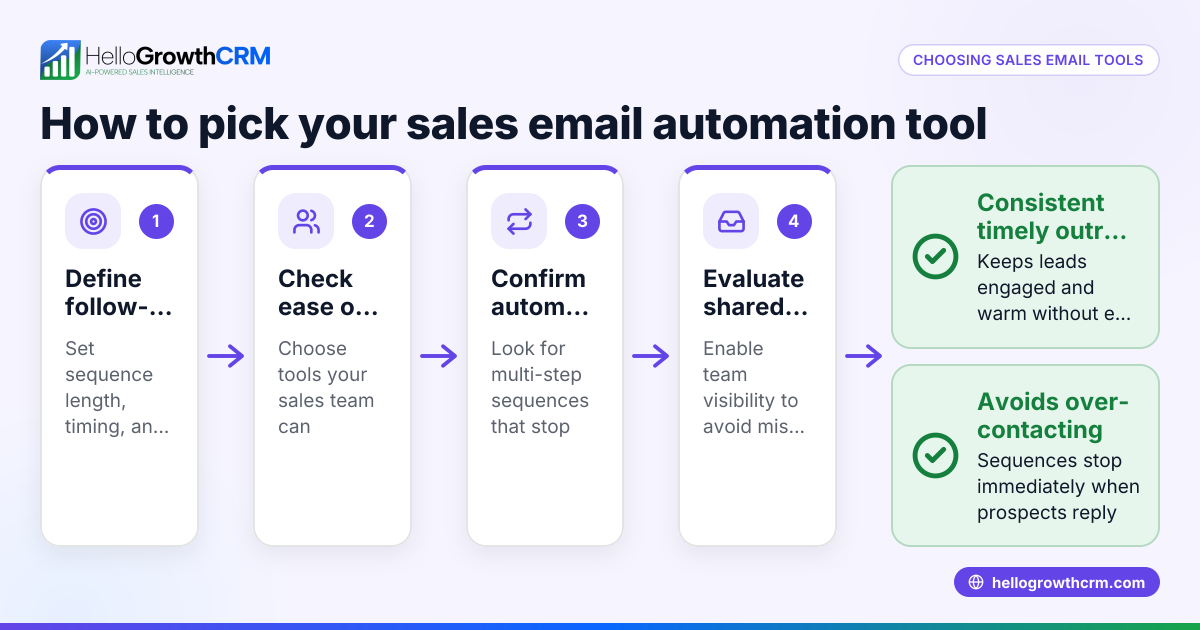
- Ignoring automation features like sequences: Manual follow-up wastes time. Use automated sequences that stop when prospects reply to avoid spamming.
- Not assigning leads properly: Manual lead assignment causes delays. Use lead routing rules to assign automatically by territory or round-robin.
- Overcomplicating spreadsheets: Complex formulas and multiple sheets confuse users. Keep spreadsheets simple or move to a CRM.
- Failing to track sales performance: Without reporting, it’s hard to improve. Use built-in sales forecasting and reporting tools.
Doing this in HelloGrowthCRM
HelloGrowthCRM offers sales automation features tailored for Singapore small and mid-sized businesses. You can set up sequences and campaigns that run a five-step follow-up over two weeks and stop the moment the prospect replies. AI agents draft follow-up messages after calls for quick review and sending. Workflows, lead routing, and validation rules automate lead assignment and task creation, such as assigning new IndiaMART enquiries round-robin with first-call tasks created automatically. Learn more about HelloGrowthCRM’s AI CRM capabilities here and how it fits Singapore businesses here.
Frequently asked questions
Is sales automation suitable for very small businesses? Sales automation can be useful for small businesses with consistent leads and multiple salespeople. However, very small teams with few leads might find spreadsheets sufficient until they scale.
Can spreadsheets handle sales follow-up effectively? Spreadsheets lack automation for follow-up sequences and reminders, increasing the risk of missed leads. Sales automation tools provide timely, automatic follow-up to improve conversion.
How does lead assignment work in sales automation? Sales automation platforms can assign leads automatically based on rules like territory, lead source, or round-robin distribution, reducing delays and errors compared to manual assignment.
Are sales automation tools expensive for Singapore SMEs? Costs vary by provider and features. While there is a subscription fee, the time saved and increased sales often outweigh the cost. Spreadsheets have no direct cost but can cause hidden productivity losses.
Can I switch from spreadsheets to sales automation easily? Many sales automation tools support importing data from spreadsheets and offer training resources to help teams transition smoothly.
For more on choosing the right CRM and automation tools, see our compare CRMs guide.
Key takeaways
- Sales automation saves time and reduces lost leads with automated follow-up and lead routing.
- Spreadsheets are simple and low-cost but become inefficient as sales volume or team size grows.
- Automation improves collaboration with real-time updates and task management.
- Consider your team size, lead volume, and sales process complexity when choosing.
- HelloGrowthCRM offers AI-driven automation features suited for Singapore SMEs.
Start managing your sales more efficiently today. You can start on the Free Forever plan (200 leads, no credit card) to try HelloGrowthCRM.
Ready to put this into practice?
Set up your pipeline, WhatsApp follow-ups, and AI lead scoring in minutes — free, no credit card.
Try HelloGrowthCRM freeGet CRM tips in your inbox
Join thousands of sales professionals who get weekly insights on CRM strategy, AI automation, and pipeline optimization.

The HelloGrowthCRM team publishes guides on CRM strategy, AI sales tools, and revenue operations for small business sales teams.