HelloGrowthCRM software
Built for real small-business sales teams
HelloGrowthCRM helps reps qualify faster, follow up on time, and close more deals—with practical automation in one place.
- AI lead scoring and pipeline visibility
- Built-in dialer, WhatsApp, and email automation
- Sales forecasting and RevOps-ready reporting
For New Zealand small businesses, lead management systems offer structured, automated ways to capture, track and prioritise leads, unlike spreadsheets which often become disorganised and slow as sales volume increases. Choosing between these options depends on your business size, sales complexity and need for automation. This article compares lead management and spreadsheets on key factors, provides a realistic example, common pitfalls and how HelloGrowthCRM can help.
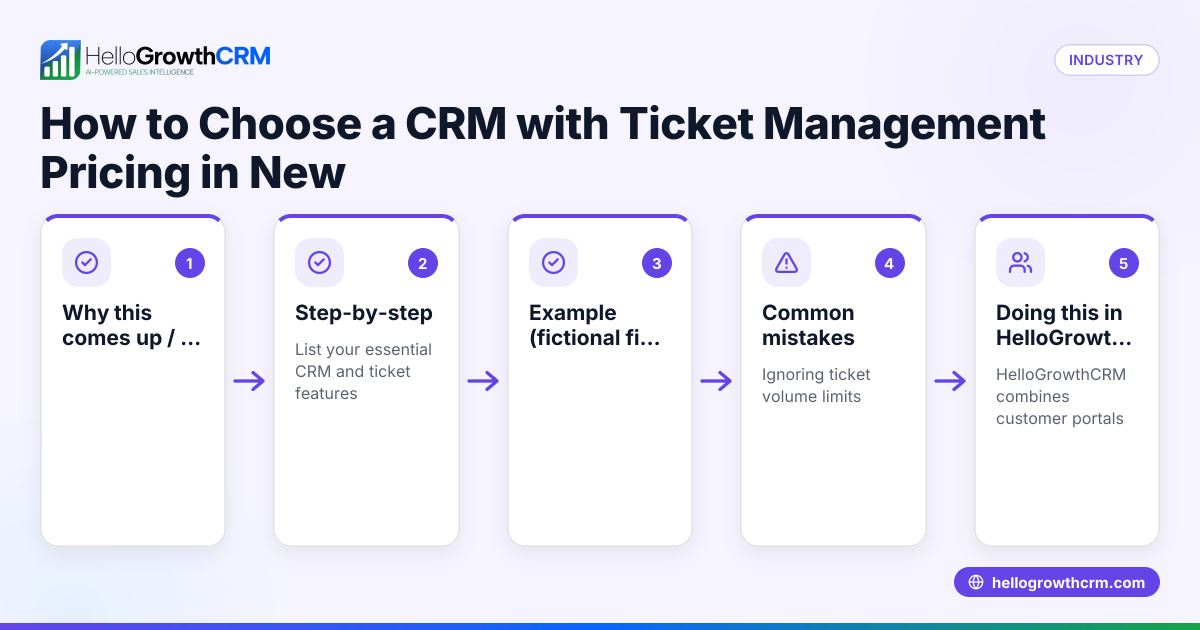
Why this comes up / what goes wrong
Many small businesses in New Zealand start tracking leads using spreadsheets because they are free and familiar. However, as enquiries increase, spreadsheets become cumbersome. Leads can be lost, follow-ups delayed, and sales opportunities missed. Sales teams often run sales processes on text messages, email and spreadsheets, leading to slow follow-up and lost leads. Owners struggle to get clear visibility on pipeline health or forecast sales accurately.
This search arises because business owners want to know if investing time and money in a lead management system is worth it compared to sticking with spreadsheets.
Step-by-step
| Criteria | Lead Management System | Spreadsheets |
|---|---|---|
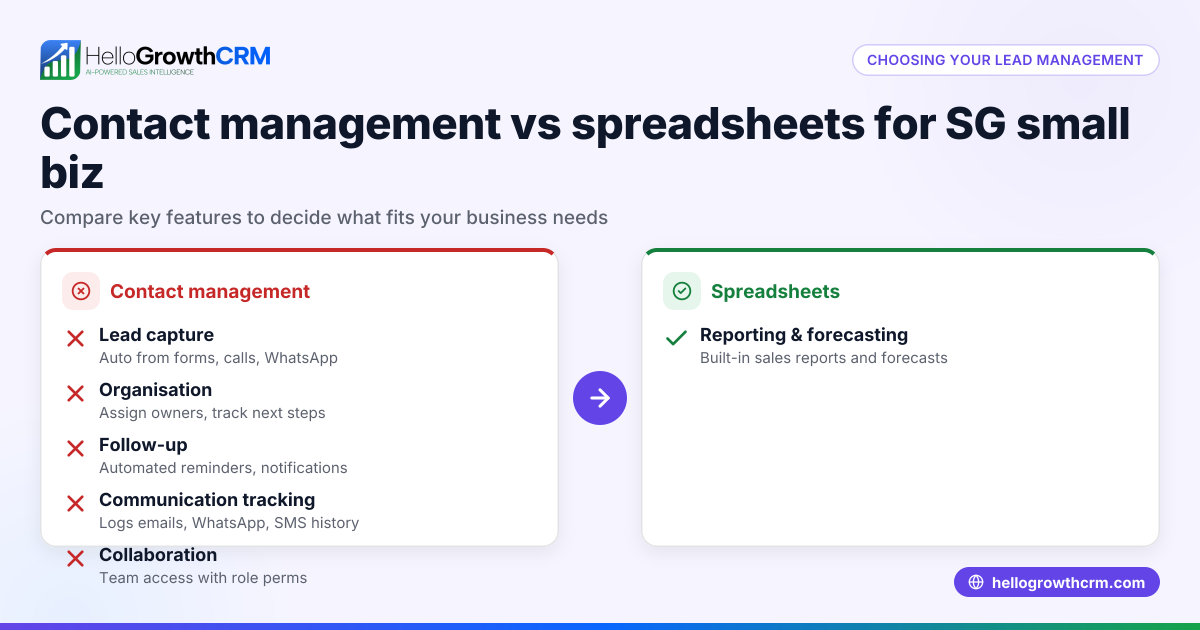
| Organisation | Automated capture from web forms, calls, WhatsApp; leads assigned owners and next steps | Manual entry prone to errors and missed leads |
| Lead Prioritisation | AI lead scoring helps focus on leads most likely to convert | No automatic prioritisation; manual sorting needed |
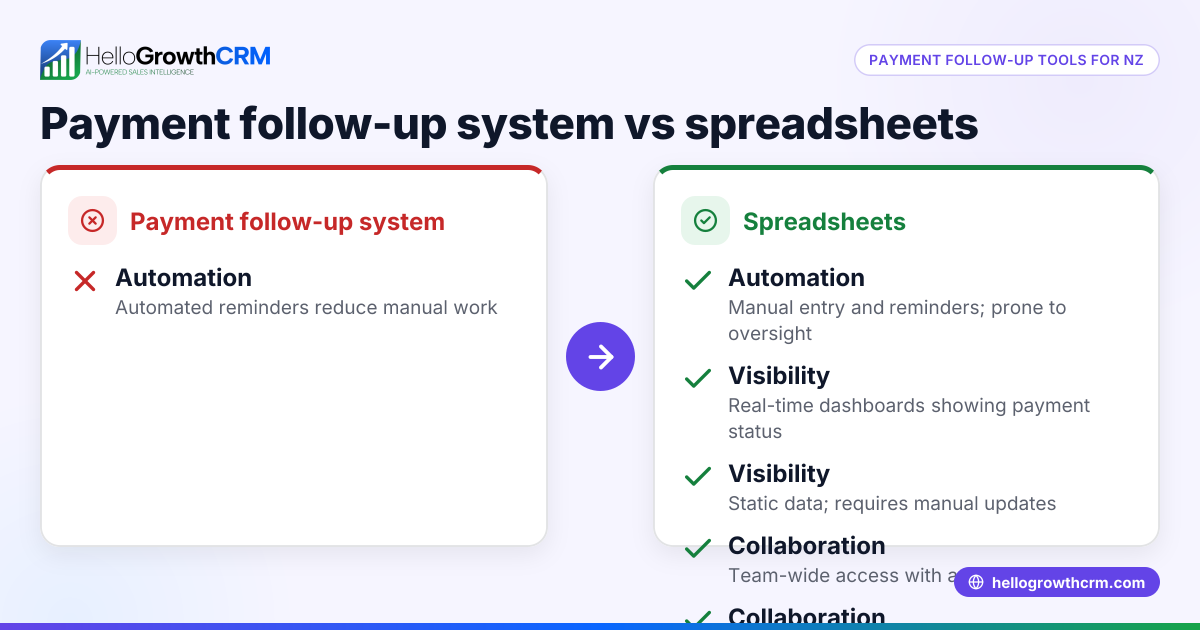
| Follow-up Automation | Workflows create tasks, reminders, and assign leads automatically | Manual tracking and reminders; easy to forget |
| Collaboration | Shared pipeline and task boards visible to team in real time | Multiple versions, difficult to share updates instantly |
| Sales Forecasting | Built-in reporting and forecasting tools available | Requires manual calculations and data consolidation |
| Scalability | Scales with business growth; handles increasing leads easily | Becomes slow and error-prone as data grows |
| Integration | Integrates with web forms, calls, WhatsApp, email sequences | No direct integrations; manual data import/export |
Who should pick what?
- If you have fewer than 20 leads a month and a simple sales process, spreadsheets may suffice.
- If your business handles more leads, needs prioritisation, faster follow-up, and team collaboration, a lead management system is better.
Example (fictional figures)
A real estate agency in Auckland receives 50 new leads monthly.
Using spreadsheets:
- Time spent entering and updating leads: 2 hours/week = 8 hours/month
- Average hourly wage of sales admin: NZ$25/hour
- Cost = 8 × NZ$25 = NZ$200/month
- Estimated lost leads due to slow follow-up: 5 leads
- Average commission per lead: NZ$3,000
- Lost revenue = 5 × NZ$3,000 = NZ$15,000/month
Using lead management system:
- Subscription cost (assumed): NZ$100/month NEEDS EXPERT REVIEW
- Time spent managing leads: 30 minutes/week = 2 hours/month
- Cost of time = 2 × NZ$25 = NZ$50/month
- Estimated lost leads due to delays: 1 lead
- Lost revenue = 1 × NZ$3,000 = NZ$3,000/month
Total monthly cost and losses:
- Spreadsheets: NZ$200 + NZ$15,000 = NZ$15,200
- Lead management: NZ$100 + NZ$50 + NZ$3,000 = NZ$3,150
This example shows how lead management systems reduce lost revenue and save time despite subscription costs.
Common mistakes
- Underestimating lead volume growth
- Prevent by reviewing lead numbers quarterly and planning system upgrades early.
- Ignoring follow-up speed
- Use reminders and task automation to ensure timely contact.
- Relying on manual data entry
- Automate lead capture from web forms and WhatsApp to reduce errors.
- Poor team communication
- Use shared pipelines and task boards visible to all sales members.
- Not tracking lead quality
- Implement AI lead scoring to focus on promising leads; see AI lead scoring.
- Avoiding sales forecasting
- Use built-in sales forecasting tools to plan better; learn more at sales forecasting.
Doing this in HelloGrowthCRM
HelloGrowthCRM captures every enquiry from forms, calls or WhatsApp as a lead with an owner and a next step, keeping leads organised instead of lost in notebooks. Its AI lead scoring helps telecallers prioritise leads most likely to convert first. Workflows and lead routing automate assigning enquiries and creating first-call tasks automatically. Learn how this can fit your New Zealand business at HelloGrowthCRM for New Zealand.
Frequently asked questions
What are the main advantages of lead management systems over spreadsheets? Lead management systems automate lead capture, prioritisation, follow-up tasks and reporting. They reduce manual errors and improve team collaboration, unlike spreadsheets which require manual updates and are prone to mistakes.
Can small businesses with very few leads benefit from lead management software? If your lead volume is very low and sales process simple, spreadsheets might suffice. But as soon as you want faster follow-up, better organisation, or team collaboration, a lead management system becomes valuable.
How does AI lead scoring improve sales efforts? AI lead scoring analyses lead data to predict which leads are most likely to convert, helping sales teams focus their efforts on high-potential prospects and improve conversion rates. See AI lead scoring.
Is it difficult to switch from spreadsheets to a lead management system? Switching requires importing existing data and training your team. Many CRMs offer import tools and onboarding support to make the transition smoother.
Can lead management systems integrate with existing tools like email and WhatsApp? Yes, many systems integrate with popular communication channels to capture leads automatically and send follow-up sequences, reducing manual work.
How does lead management help with sales forecasting? By tracking lead stages and conversion probabilities, lead management systems provide data-driven sales forecasts, unlike spreadsheets which require manual calculations. Learn more at sales forecasting.
Key takeaways
- Spreadsheets can work for very small lead volumes but become inefficient as leads grow.
- Lead management systems automate lead capture, prioritisation and follow-up, improving sales efficiency.
- AI lead scoring focuses sales efforts on leads most likely to convert.
- Automation and shared pipelines improve team collaboration and reduce lost leads.
- Sales forecasting tools in CRMs provide better visibility and planning.
- HelloGrowthCRM offers integrated lead capture, AI lead scoring, and automated workflows tailored for small and mid-sized NZ businesses.
Start improving your lead follow-up and sales process today. Start on the Free Forever plan (200 leads, no credit card).
Ready to put this into practice?
Set up your pipeline, WhatsApp follow-ups, and AI lead scoring in minutes — free, no credit card.
Try HelloGrowthCRM freeGet CRM tips in your inbox
Join thousands of sales professionals who get weekly insights on CRM strategy, AI automation, and pipeline optimization.

The HelloGrowthCRM team publishes guides on CRM strategy, AI sales tools, and revenue operations for small business sales teams.