HelloGrowthCRM software
Built for real small-business sales teams
HelloGrowthCRM helps reps qualify faster, follow up on time, and close more deals—with practical automation in one place.
- AI lead scoring and pipeline visibility
- Built-in dialer, WhatsApp, and email automation
- Sales forecasting and RevOps-ready reporting
Sales force effectiveness measures how well your sales team converts leads into customers and drives revenue. It focuses on the productivity and impact of your salespeople. This article explains why sales force effectiveness matters, practical steps to evaluate and improve it, common mistakes to avoid, and how HelloGrowthCRM supports better sales management.
Why this comes up / what goes wrong
Small-business owners often struggle with sales force effectiveness because their sales efforts are scattered, untracked, or inconsistent. They may lose leads due to slow follow-up, rely heavily on informal communication like text messages and spreadsheets, or lack clear visibility into sales progress. This leads to missed opportunities, wasted time, and unpredictable revenue. Without a structured way to measure and manage sales activities, owners can’t pinpoint where the sales process breaks down or how to improve it.
Step-by-step
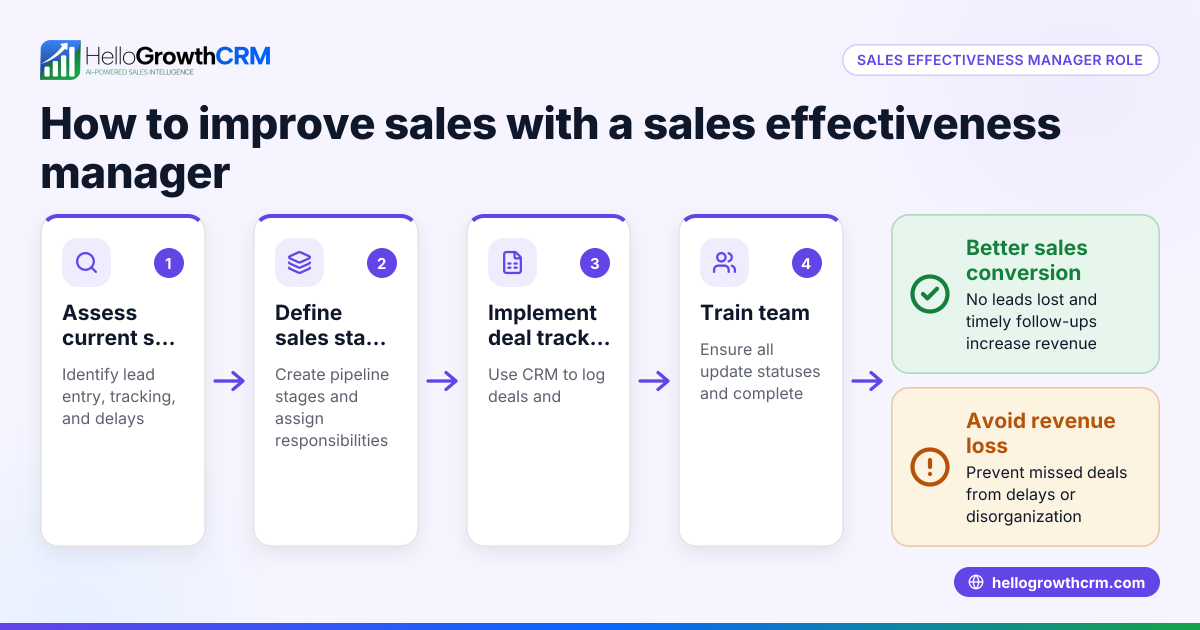
- Define clear sales goals and KPIs. Decide what success looks like for your sales team, such as number of deals closed, revenue targets, or conversion rates. Track these metrics regularly.
- Map your sales process stages. Break down your sales funnel into stages like lead capture, qualification, proposal, negotiation, and closing. Assign criteria for moving deals between stages.
- Track leads and deals systematically. Use a tool or method to record every lead and its status. Check that no leads fall through the cracks by reviewing follow-up dates and next steps.
- Measure individual and team performance. Monitor sales activities such as calls made, meetings held, and deals closed per salesperson. Compare against targets.
- Analyze conversion rates and sales cycle length. Calculate the percentage of leads that convert at each stage and how long deals take to close. Identify bottlenecks.
- Gather feedback from your sales team. Understand challenges they face and ideas for improving processes or tools.
- Implement improvements and track results. Adjust sales tactics, provide training, or automate follow-ups. Measure the impact on your KPIs.
- Regularly review and update your sales strategy. Market conditions and customer needs change; keep your sales force aligned and effective.
Example (fictional figures)
A residential real-estate team in Phoenix, Arizona, wants to measure sales force effectiveness for Q1 2026.
- Total leads captured: 200
- Leads contacted within 24 hours: 150
- Leads qualified: 100
- Proposals sent: 60
- Deals closed: 30
- Average deal value: $350,000
Calculate conversion rates:
Leads contacted / Total leads = 150 / 200 = 0.75 (75%)
Leads qualified / Leads contacted = 100 / 150 = 0.67 (67%)
Proposals sent / Leads qualified = 60 / 100 = 0.60 (60%)
Deals closed / Proposals sent = 30 / 60 = 0.50 (50%)
Calculate total revenue:
Deals closed × Average deal value = 30 × $350,000 = $10,500,000
This shows the team converts half of proposals into sales and generates $10.5 million in Q1. They can focus on improving the initial contact rate from 75% closer to 100% to increase pipeline size.
Common mistakes
- Failing to track leads consistently. Prevent this by using a CRM or system where every lead is entered and assigned a follow-up date.
- Ignoring follow-up tasks. Prevent lost deals by setting reminders and follow-up sequences, not relying on memory or scattered notes.
- Not analyzing sales data. Prevent stagnation by reviewing conversion rates and sales cycle times monthly to spot issues.
- Overlooking individual performance differences. Prevent uneven results by coaching low performers and sharing best practices.
- Using multiple disconnected tools. Prevent inefficiency by centralizing sales activities in one platform, such as a CRM with pipeline and communication features.
- Not aligning sales process with customer journey. Prevent drop-offs by mapping sales stages to customer needs and objections.
Doing this in HelloGrowthCRM
HelloGrowthCRM helps small businesses improve sales force effectiveness with these features:
- Deals (pipeline): Track open opportunities from first contact through close. A quotation sent last week appears at the 'quote sent' stage with a follow-up date, so no deal is forgotten. Learn more about the pipeline feature.
- Territories, field operations and commissions: Field reps log visits from their phone and managers see the day's activity, improving accountability and coverage. More details at territory management.
- Managed RevOps: For founders without a sales manager, HelloGrowthCRM offers done-for-you revenue operations support including weekly follow-up execution and pipeline cleanup. See how managed RevOps can help.
Frequently asked questions
What is the best way to measure sales force effectiveness? Track key metrics like lead conversion rates, average deal size, sales cycle length, and individual salesperson performance. Use a consistent sales process and review data regularly.
How can small businesses improve sales follow-up? Set clear follow-up tasks with deadlines and reminders. Automate sequences via email, WhatsApp, or SMS to maintain timely contact without manual effort. HelloGrowthCRM supports WhatsApp and SMS CRM features to help with this.
Why do some sales teams have low effectiveness? Common reasons include poor lead management, inconsistent processes, lack of training, and insufficient tracking of activities and results.
Can a CRM improve sales force effectiveness? Yes, a CRM centralizes lead and deal tracking, automates follow-ups, and provides visibility into sales pipelines and team performance. HelloGrowthCRM offers a built-in CRM dialer to streamline calls and follow-ups.
How often should sales performance be reviewed? Weekly or monthly reviews help catch issues early and keep the team aligned with goals.
What role does territory management play in sales effectiveness? Defining territories and tracking field visits ensures coverage, reduces overlap, and helps managers monitor reps’ activities.
Key takeaways
- Sales force effectiveness measures how well your team converts leads and drives revenue.
- Define clear sales goals, map your sales process, and track leads systematically.
- Analyze conversion rates and sales cycle times to identify improvement areas.
- Avoid common mistakes like inconsistent tracking and poor follow-up.
- Use tools like HelloGrowthCRM to manage pipelines, field operations, and follow-up efficiently.
Start improving your sales force effectiveness today. Start on the Free Forever plan (200 leads, no credit card).
Ready to put this into practice?
Set up your pipeline, WhatsApp follow-ups, and AI lead scoring in minutes — free, no credit card.
Try HelloGrowthCRM freeGet CRM tips in your inbox
Join thousands of sales professionals who get weekly insights on CRM strategy, AI automation, and pipeline optimization.

The HelloGrowthCRM team publishes guides on CRM strategy, AI sales tools, and revenue operations for small business sales teams.