HelloGrowthCRM software
Built for real small-business sales teams
HelloGrowthCRM helps reps qualify faster, follow up on time, and close more deals—with practical automation in one place.
- AI lead scoring and pipeline visibility
- Built-in dialer, WhatsApp, and email automation
- Sales forecasting and RevOps-ready reporting
A sales pipeline spreadsheet template for Singapore businesses is a ready-made Excel or Google Sheets file that helps you track leads, stages, and follow-ups in one place. This article provides a simple step-by-step guide to using such a template, highlights common errors to avoid, and shows how HelloGrowthCRM can simplify pipeline management with AI insights and free templates.
Why this comes up / what goes wrong
Many small business owners in Singapore rely on WhatsApp, email, and spreadsheets to manage sales leads. Without a structured format, leads can be lost or forgotten, follow-ups delayed, and sales stages unclear. A sales pipeline spreadsheet template provides a clear layout to organise leads by stage, set follow-up dates, and calculate potential revenue. However, building a useful spreadsheet from scratch is time-consuming and prone to errors. Owners want a ready-to-use Singapore-specific template that matches local sales practices and currency formatting.
Step-by-step
- Download a Singapore sales pipeline spreadsheet template: Use a free template designed for small businesses, which includes columns for lead details, stages (e.g., New, Contacted, Quote Sent, Negotiation, Closed), follow-up dates, and estimated deal values. Check that currency is in SGD and date format is DD/MM/YYYY.
- Enter your leads and deals: Fill in each lead's name, contact info, source, and current pipeline stage. Check for duplicates and ensure contact details are accurate.
- Set follow-up dates for each deal stage: Assign realistic follow-up dates to keep sales moving. Check that dates are not in the past and align with your sales cycle.
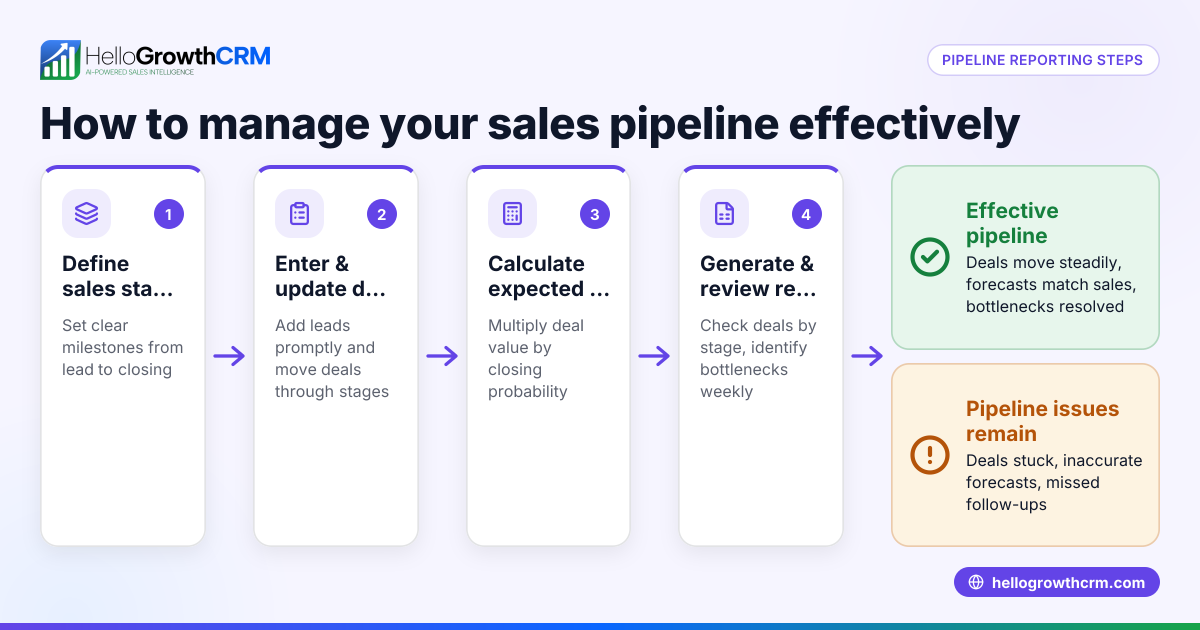
- Calculate deal values and expected revenue: Input the estimated value of each deal. Use formulas to sum totals by stage and forecast potential revenue. Check formulas for accuracy.
- Update regularly: Review and update the spreadsheet daily or weekly. Check that stage changes and follow-ups are recorded promptly.
- Analyse pipeline health: Use built-in charts or conditional formatting to spot stalled deals or bottlenecks. Check that deal counts and values align with your sales goals.
Example (fictional figures)
A property agency in Novena uses a sales pipeline spreadsheet to track 5 deals as of 15/06/2024.
| Lead | Stage | Follow-up Date | Deal Value (SGD) |
|---|---|---|---|
| Lee Properties | Quote Sent | 20/06/2024 | S$1,200,000 |
| Green Homes | Negotiation | 18/06/2024 | S$850,000 |
| Sky Residences | Contacted | 22/06/2024 | S$950,000 |
| Sunlight Villas | New | 25/06/2024 | S$700,000 |
| Blue Lake | Closed Won | 10/06/2024 | S$1,400,000 |
Total expected revenue calculation:
S$1,200,000 + S$850,000 + S$950,000 + S$700,000 + S$1,400,000 = S$5,100,000
This total helps the agency forecast monthly sales and prioritise follow-ups.
Common mistakes
- Not updating the spreadsheet regularly: Leads and deals can slip through the cracks. Prevent by setting a daily or weekly review routine.
- Using inconsistent date formats: This causes confusion and errors in follow-up scheduling. Prevent by standardising to DD/MM/YYYY.
- Missing follow-up dates: Without dates, leads stagnate. Prevent by making follow-up dates mandatory fields.
- Duplicating leads: Duplicate entries inflate pipeline size and waste effort. Prevent by checking for duplicates before adding new leads.
- Overcomplicating the spreadsheet: Too many columns or complex formulas can confuse users. Prevent by keeping the template simple and focused.
- Ignoring pipeline health analysis: Not reviewing stalled deals leads to lost revenue. Prevent by using conditional formatting or charts to highlight bottlenecks.
Doing this in HelloGrowthCRM
HelloGrowthCRM offers a Deals (pipeline) feature where a quotation sent last week automatically appears as a deal at the 'quote sent' stage with a follow-up date, ensuring no deal is forgotten. You can also download free sales tools, templates, and calculators including pipeline templates without needing an account at free sales tools and calculators. For deeper insight, the pipeline forecast and AI insights feature shows which stage deals are stalling without building a spreadsheet, helping you focus your sales efforts more effectively. Learn more about the CRM's pipeline features at AI CRM and sales forecasting.
Frequently asked questions
What should a sales pipeline spreadsheet include? A good sales pipeline spreadsheet for Singapore SMEs includes columns for lead name, contact details, sales stage, follow-up date, deal value in SGD, and notes. It should use the DD/MM/YYYY date format and allow easy updating.
Can I use Google Sheets or Excel for my sales pipeline? Yes, both Google Sheets and Excel work well. Google Sheets allows easy sharing with your team online, while Excel offers powerful functions offline. Choose the one your team is most comfortable with.
How often should I update my sales pipeline spreadsheet? Ideally, update it daily or at least weekly to keep track of new leads, stage changes, and follow-ups. Regular updates prevent leads from being forgotten and keep forecasts accurate.
Is there a free sales pipeline template for Singapore businesses? Yes, you can download free sales pipeline templates tailored for Singapore SMEs from HelloGrowthCRM's free sales tools and calculators page without any account or sign-up.
What are common pitfalls when using a sales pipeline spreadsheet? Common pitfalls include inconsistent data entry, missing follow-up dates, duplicate leads, and not reviewing pipeline health. Prevent these by following a clear process and using simple templates.
Key takeaways
- Use a ready-to-use sales pipeline spreadsheet template with SGD currency and DD/MM/YYYY date format.
- Enter leads, stages, follow-up dates, and deal values accurately and update regularly.
- Avoid common mistakes like missing follow-ups, duplicates, and inconsistent dates.
- Analyse pipeline health to spot stalled deals and improve sales forecasting.
- HelloGrowthCRM offers pipeline management, free templates, and AI insights to simplify sales tracking.
Start tracking your sales pipeline more effectively today. You can also Start on the Free Forever plan (200 leads, no credit card) with HelloGrowthCRM to manage your deals and follow-ups digitally.
Ready to put this into practice?
Set up your pipeline, WhatsApp follow-ups, and AI lead scoring in minutes — free, no credit card.
Try HelloGrowthCRM freeGet CRM tips in your inbox
Join thousands of sales professionals who get weekly insights on CRM strategy, AI automation, and pipeline optimization.

The HelloGrowthCRM team publishes guides on CRM strategy, AI sales tools, and revenue operations for small business sales teams.