HelloGrowthCRM software
Built for real small-business sales teams
HelloGrowthCRM helps reps qualify faster, follow up on time, and close more deals—with practical automation in one place.
- AI lead scoring and pipeline visibility
- Built-in dialer, WhatsApp, and email automation
- Sales forecasting and RevOps-ready reporting
Sales training for real estate agents focuses on skills like timely lead follow-up, client communication, and managing deals to increase sales success. This article covers why real estate-specific training matters, a step-by-step approach, common mistakes, a US-based example, and how HelloGrowthCRM features like pipeline management and activity tracking can help your team.
Why this comes up / what goes wrong
Real estate business owners and accountants often face challenges because agents lose leads due to slow or inconsistent follow-up. Agents frequently manage sales using text messages, emails, and spreadsheets that don’t integrate well, causing leads to slip through the cracks. Without sales training tailored to real estate, agents may lack skills in qualifying buyers, handling objections, and using sales tools effectively. This leads to wasted time, missed sales, and difficulty growing the business.
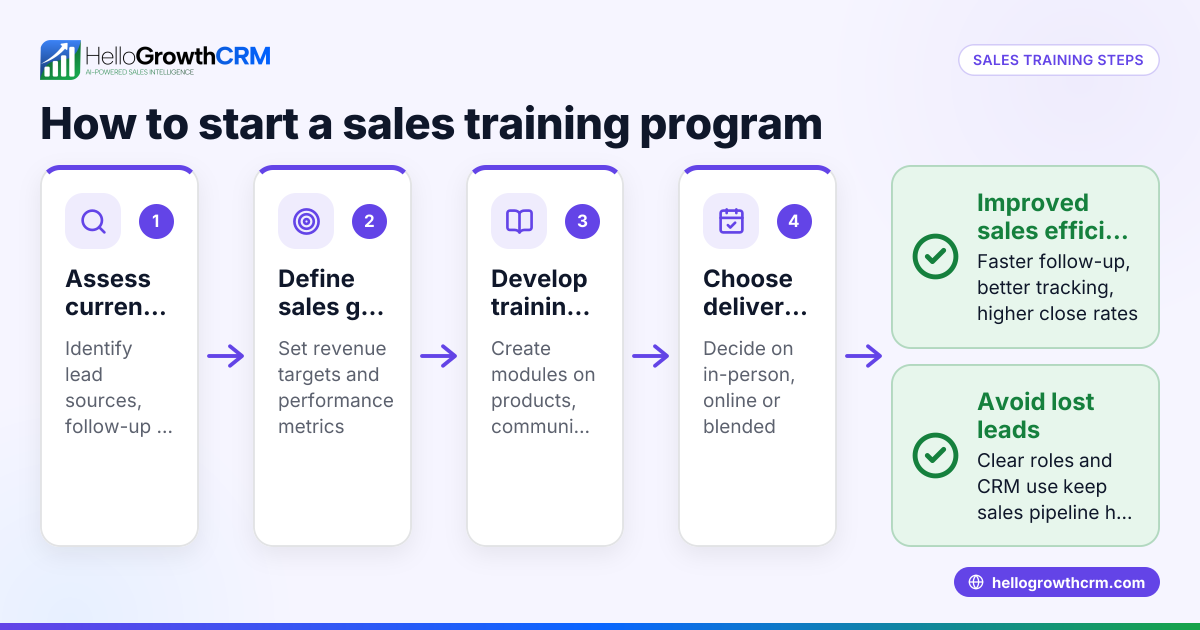
Step-by-step
- Assess your team's current skills and challenges
- Survey agents or hold interviews to identify areas like lead follow-up or objection handling where they need improvement.
- Review how they currently track leads and deals to spot inefficiencies.
- Choose real estate-focused training content
- Focus on prospecting, qualifying leads, negotiation, closing deals, and managing communications via phone, email, WhatsApp, and SMS.
- Select training delivery methods
- Combine live workshops, online courses, role-playing exercises, and shadowing experienced agents.
- Ensure materials are relevant to your local market.
- Implement a structured follow-up process
- Teach agents to follow a schedule for contacting leads and setting follow-up reminders.
- Use tools that support pipeline and task management.
- Train agents on CRM technology
- Show how to log contacts, update deal stages, and schedule follow-ups in a CRM.
- Integrate communication channels into the CRM to centralize interactions.
- Monitor progress and provide feedback
- Set measurable goals such as follow-up rates and conversion percentages.
- Hold regular coaching sessions to reinforce skills.
- Adjust training based on results
- Analyze what works and update training materials accordingly.
Learn more about managing sales processes at Real estate and builders.
Example (fictional figures)
Jessica runs a real estate agency in Austin, Texas, with 6 agents. Before training, they struggled to follow up quickly and lost leads. Jessica implements sales training focused on follow-up discipline and CRM use.
- Jessica's agency receives 400 leads per month.
- After training, follow-up improved significantly, increasing the number of leads contacted promptly.
Calculations:
Assuming after training, agents follow up on 300 leads monthly.
Assuming an average commission of $4,000 per closed deal and a 12% conversion rate from follow-up to sale:
Sales after training = 300 × 12% = 36 deals
Commission after training = 36 × $4,000 = $144,000
This example shows how focused sales training can increase commissions by improving lead follow-up.
Common mistakes
- Skipping needs assessment: Without identifying skill gaps, training may miss critical areas. Prevent this by surveying agents first.
- Using generic sales training: Real estate needs specific techniques for local markets and multi-channel communication. Choose content tailored to real estate.
- Ignoring CRM adoption: Agents not trained on CRM tools miss out on lead capture, qualification, and pipeline management features that improve sales efficiency.
- Overloading agents with information: Too much content at once reduces retention. Break training into manageable sessions.
- Neglecting ongoing coaching: Training is not one-and-done. Regular coaching reinforces skills and accountability.
For more on improving sales processes, visit CRM academy.
Doing this in HelloGrowthCRM
HelloGrowthCRM supports real estate sales with lead capture, qualification, pipeline tracking, and task management tools to help agents manage leads and follow-ups efficiently.
- AI agents: After a call, an AI agent drafts the follow-up message for the rep to review and send, saving time and ensuring timely responses (Beta feature). See details at AI CRM.
- Managed RevOps: If you don’t have a sales manager, a dedicated revenue specialist manages your follow-up queue weekly, cleans pipelines, and provides KPI reports, helping maintain sales discipline.
- Deals (pipeline): Quotations sent appear as deals in the pipeline with follow-up dates, so no opportunity is forgotten.
These features help real estate teams focus on selling while the CRM automates reminders and follow-ups.
Frequently asked questions
What topics should sales training for real estate agents cover? Training should include lead qualification, objection handling, negotiation, multi-channel communication (phone, email, SMS), and CRM pipeline management.
How long does sales training for real estate agents usually take? Training length varies but typically spans several weeks with multiple sessions for practice and reinforcement. Ongoing coaching is recommended.
Can technology replace sales training? Technology like CRM tools improves efficiency but does not replace foundational sales skills. Combining training and technology yields the best results.
How do I measure the success of sales training? Track metrics such as lead follow-up rates, conversion rates, average deal size, and total sales before and after training.
Is remote or in-person training better for real estate agents? Both have benefits. Remote training offers flexibility, while in-person sessions allow role-playing and immediate feedback. A hybrid approach often works best.
Learn more about sales process management at CRM academy.
Key takeaways
- Sales training tailored to real estate improves lead follow-up, communication, and closing skills.
- Assess your team's needs before choosing training content.
- Use varied delivery methods and reinforce learning with coaching.
- Avoid mistakes like generic training and ignoring CRM adoption.
- HelloGrowthCRM features like AI agents, Managed RevOps, and deals pipeline support sales discipline.
Start your sales training journey and manage leads better with HelloGrowthCRM's lead capture, qualification, and pipeline entry tools. Start on the Free Forever plan (200 leads, no credit card).
Ready to put this into practice?
Set up your pipeline, WhatsApp follow-ups, and AI lead scoring in minutes — free, no credit card.
Try HelloGrowthCRM freeGet CRM tips in your inbox
Join thousands of sales professionals who get weekly insights on CRM strategy, AI automation, and pipeline optimization.

The HelloGrowthCRM team publishes guides on CRM strategy, AI sales tools, and revenue operations for small business sales teams.