Quick Answer
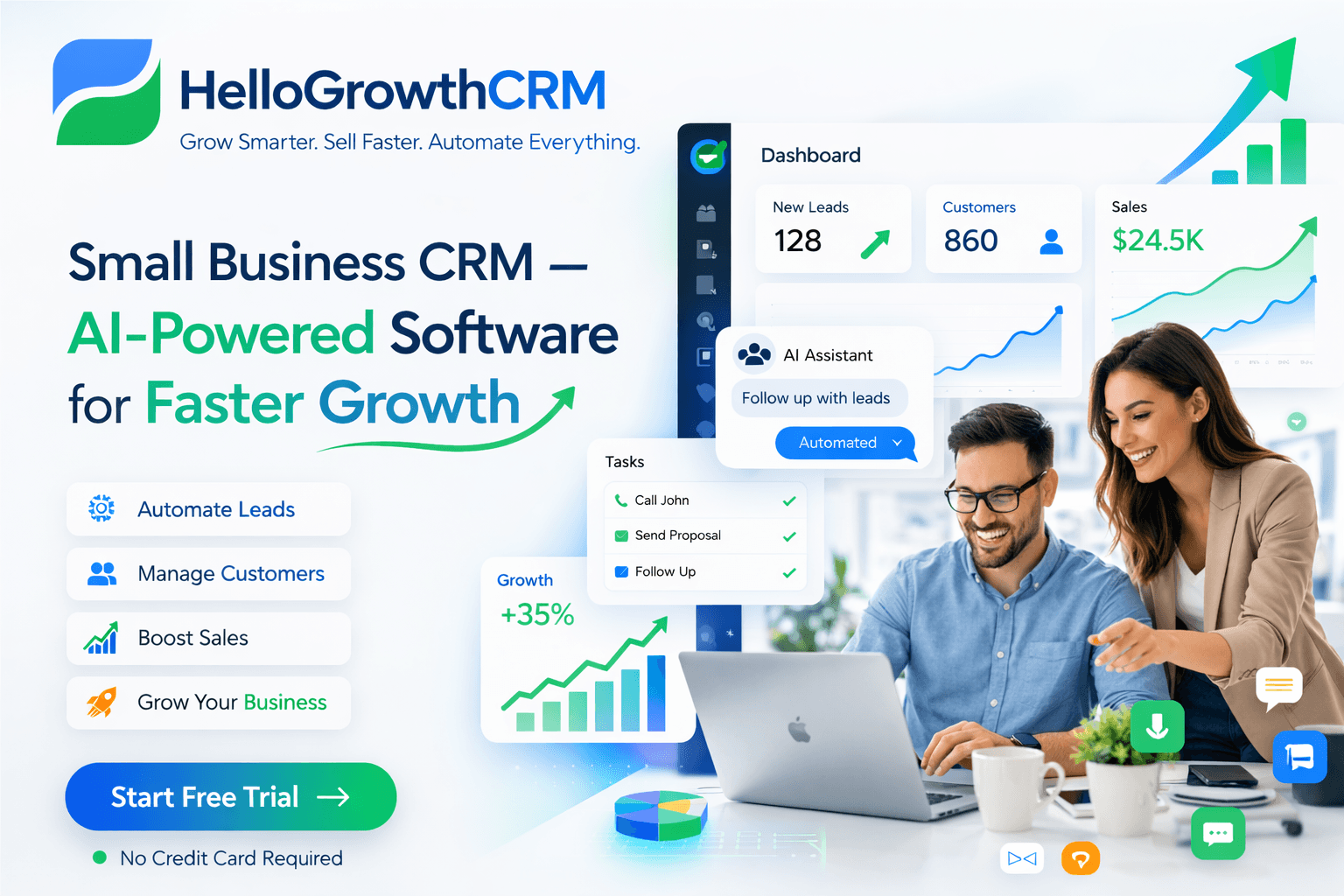
The top manufacturing CRM options in India include Salesforce for enterprises, Zoho and Vtiger for configurable mid-market suites, LeadSquared for field-sales discipline, Kylas, SalesBabu, and Cratio for SME-focused Indian CRM, TranZact for manufacturing operations, and HelloGrowthCRM for dealer-network follow-up, quotation tracking, and GST invoicing at SMB pricing.
HelloGrowthCRM software
Built for real small-business sales teams
HelloGrowthCRM helps reps qualify faster, follow up on time, and close more deals—with practical automation in one place.
- AI lead scoring and pipeline visibility
- Built-in dialer, WhatsApp, and email automation
- Sales forecasting and RevOps-ready reporting
Why manufacturers lose sales differently from everyone else
Manufacturing sales in India has a shape that generic sales advice ignores. A machine-tools maker in Rajkot, an auto-components supplier in Pune, a packaging converter in Ahmedabad, and a pumps manufacturer in Coimbatore all sell through some mix of the same motions: direct enquiries from industrial buyers, a dealer and distributor network that resells, exhibitions and IndiaMART listings that generate raw enquiries, and long quotation cycles where technical specs, price negotiations, and credit terms bounce back and forth for weeks.
The leakage points are just as characteristic. Enquiries arrive at a sales office email, a proprietor's WhatsApp, and an IndiaMART inbox, and no single person sees all three. Quotations go out as PDFs and then age silently — the buyer is comparing three vendors, and the vendor who calls on day four wins against the vendor who quoted first and went quiet.
Dealer relationships run on personal rapport, so when a territory salesperson resigns, a decade of dealer history resigns with him. Payment follow-up is a separate spreadsheet nobody reconciles with the order book. And the factory hears about demand late because the sales side has no system the operations side can read.
None of this is a technology problem in the glamorous sense. It is a follow-up and visibility problem, and it is exactly what CRM software exists to fix. The complication is that "CRM for manufacturing" in India spans everything from global enterprise platforms to Indian SME tools to operations software that is not a CRM at all but gets evaluated alongside them.
This guide profiles nine platforms Indian manufacturers actually shortlist, honestly categorised, followed by a selection framework. The deeper operational playbook lives in our manufacturing CRM guide.
How we selected these platforms
Method first, because manufacturing software listicles are notoriously pay-to-play. This list is an editorial selection based on what Indian manufacturers verifiably use and shortlist, not a ranking by revenue, seat count, or analyst quadrant — none of which is reliably public for this segment.
Four criteria applied. First, real deployment in Indian manufacturing: each platform is demonstrably used by Indian manufacturers or industrial SMEs today, in categories like machinery, components, chemicals, packaging, and building materials. Second, fit for the manufacturing sales motion: dealer networks, long quotation cycles, field visits, and credit-term B2B relationships — not just generic pipeline features.
Third, accessibility across company sizes: the list deliberately spans enterprise, mid-market, and SME price points, because a two-hundred-crore components maker and a four-crore fabrication shop have entirely different budgets and staffing. Fourth, durability: every vendor here has operated long enough that a manufacturer can reasonably bet a multi-year workflow on it.
Two honesty notes. TranZact is included even though it is manufacturing operations software rather than a CRM, because SME manufacturers evaluate it in the same breath and the distinction matters to get right. And HelloGrowthCRM — our own product — appears with its positioning stated plainly, including where it is not the right choice.
Where we describe vendor scale we do so qualitatively from well-established public information, and order within sections does not imply ranking.
The enterprise and full-suite platforms: Salesforce and Zoho
1. Salesforce — The global CRM leader is a real presence in Indian manufacturing, primarily at large enterprises: automotive OEMs and tier-one suppliers, large chemicals and building-materials companies, and exporters selling into global supply chains.
Its Manufacturing Cloud adds industry-specific constructs — sales agreements that track committed volumes against actuals, and account-based forecasting that fits long-term supply relationships better than opportunity-by-opportunity pipelines. The strengths are depth, integration reach, and an ecosystem of implementation partners.
The honest caveats: enterprise pricing, implementation projects measured in months, and a dependence on skilled administrators. For a large manufacturer with an IT function, Salesforce is a defensible default; for an SME, it is almost always more platform than the problem requires.
2. Zoho — Chennai-built Zoho is likely the most commonly shortlisted CRM among mid-sized Indian manufacturers, for straightforward reasons: capable pipeline and quotation management, an ecosystem that includes Zoho Books, Inventory, and Analytics, Indian pricing, and local support and training networks.
A components maker can run enquiry-to-quote-to-order in Zoho CRM and keep accounts in Zoho Books with a clean handoff. The trade-offs are the flip side of breadth — the platform is horizontal, so shaping it to a dealer-network motion takes configuration, and businesses without an admin-minded person on staff often plateau at using it as an expensive contact list.
Our Zoho comparison goes deeper on where it shines and where it is heavier than an SME needs.
India-built platforms for sales discipline: LeadSquared, Kylas, and Vtiger
3. LeadSquared — Bengaluru-based LeadSquared, a unicorn since 2022, is built around high-velocity sales execution, and its field-force capabilities are the manufacturing-relevant core: territory-wise beat plans, geo-tracked visit check-ins, and disciplined follow-up queues for telecallers and field teams.
For manufacturers whose growth engine is a large field team calling on dealers, distributors, and industrial accounts, that process rigour is genuinely valuable. It is a heavier, costlier implementation than SME tools, and its DNA is lead-volume industries, so quotation-centric workflows need configuration. See our LeadSquared comparison for a fuller treatment.
4. Kylas — Pune-based Kylas targets Indian SMEs with a distinctive commercial model: flat platform pricing with unlimited users rather than per-seat charges. For a manufacturer wanting every salesperson, dealer coordinator, and back-office executive inside the CRM without counting licences, that pricing shape is attractive, and the product covers the core SME motions — pipelines, tasks, quotations, and integrations.
It is a younger platform than the giants, with the narrower ecosystem that implies, but it has established itself as a serious Indian SME contender; we compare it directly in our Kylas comparison.
5. Vtiger — Bengaluru-based Vtiger has open-source roots and nearly two decades of history, giving it one of the most complete feature sets in the mid-market: sales pipelines plus quoting, inventory-linked line items, help desk, and projects in one system.
Manufacturers use it precisely because quotes with product line items and after-sales service cases live beside the pipeline. The classic trade-off applies — all-in-one breadth means each module is good rather than category-best, and the interface carries the weight of its completeness.
The SME veterans: SalesBabu and Cratio
6. SalesBabu — SalesBabu is one of the longest-standing Indian cloud CRM vendors for SMEs, selling since the mid-2000s to exactly the audience this article addresses: small manufacturers, distributors, and industrial traders. Its manufacturing relevance is concrete — enquiry management, quotation generation, order tracking, dealer and distributor management, and after-sales service modules, built around how Indian SME sales offices actually work rather than adapted from Western templates.
It will not win design awards, and its ecosystem is small next to Zoho's, but its longevity in a market that churns through vendors says its customers get what they pay for. For a conservative SME buyer who values a vendor that has seen two decades of Indian B2B sales, it belongs on the shortlist.
7. Cratio — Chennai-based Cratio builds mobile-first sales CRM for Indian SMBs, with particular strength in field-sales scenarios: location-tagged visit tracking, mobile lead management, and daily activity reporting designed for salespeople who work from two-wheelers and site visits rather than desks.
For manufacturers whose model is field executives covering dealer territories in tier-2 and tier-3 markets, Cratio's focus on the mobile rep experience addresses the most common CRM failure — field teams simply not using desktop-designed software. It is a focused product from a smaller vendor, which cuts both ways: less breadth than the suites, more attention to the specific problem it solves.
The operations-adjacent platform: TranZact
8. TranZact — Mumbai-based TranZact deserves a clear-eyed entry because SME manufacturers constantly evaluate it alongside CRMs, and it is not one — a distinction that matters. TranZact digitises the operations spine of a small manufacturer: enquiries and quotations flowing into sales orders, then purchase orders, inventory, production planning, dispatch, and GST documentation.
Its pitch is replacing the tangle of Excel sheets between the sales office and the shop floor, and for make-to-order SME manufacturers that tangle is the daily reality.
The overlap with CRM happens at the front of that flow — TranZact handles enquiries and quotations because they trigger everything downstream. But its centre of gravity is operational: what to make, what to buy, what is in stock, what dispatched. It is not built for relationship management — dealer follow-up cadences, WhatsApp sequences, win-back campaigns, or field-visit discipline.
The practical guidance is to match the tool to the bottleneck. If your chaos lives between order and dispatch — production visibility, material planning, inventory truth — TranZact-style software attacks that directly, and a CRM will not. If your chaos lives before the order — enquiries going cold, quotes unfollowed, dealers drifting to competitors — you need a CRM, and operations software will not fix it.
Mid-sized manufacturers often eventually run both, integrated so a won deal becomes a sales order without retyping. Buying one category expecting the other's outcomes is the most common software mistake in Indian SME manufacturing.
Where HelloGrowthCRM fits: dealer follow-up, quotes, and GST invoicing
9. HelloGrowthCRM — This is our product, so here is the pitch with the caveats attached. HelloGrowthCRM is built for small and mid-sized Indian manufacturers whose sales problem is follow-up, not features: enquiries from IndiaMART and exhibitions going cold, quotations ageing without a call-back, and dealer relationships living in one salesperson's phone.
What it does, concretely. Enquiry capture pulls IndiaMART and JustDial leads into one pipeline automatically, alongside website and WhatsApp enquiries, so nothing depends on someone forwarding an email. Quotation tracking gives every quote a stage, an owner, and a next-action date, with WhatsApp, SMS, and email sequences that follow up automatically when a buyer goes quiet — on the WhatsApp Business API, from an official company number.
Dealer-network management treats each dealer as an account with full history, so territory handovers stop meaning relationship resets, and field executives log GPS-verified check-ins from dealer visits. GST invoicing is built in, and Tally integration keeps accounts reconciled; Razorpay handles advance collections.
AI lead scoring helps a three-person sales office call the warmest enquiries first, and the built-in dialer logs those calls without separate telephony software.
Where it is not the right choice: if you need production planning and inventory, that is TranZact-category software. If you are an enterprise with committed-volume agreements, Salesforce Manufacturing Cloud exists for you. HelloGrowthCRM starts at ₹899 per user per month with a free plan, is SOC 2 Type II audited and DPDPA compliant, and is aimed squarely at the manufacturer who knows exactly how many quotations went unanswered last month — because that number is the business case.
The mistakes that kill manufacturing CRM projects
Before the selection framework, it is worth naming the failure patterns, because manufacturing CRM projects fail in predictable ways that have little to do with which vendor was chosen.
The first killer is treating the CRM as a reporting tool for management rather than a working tool for salespeople. When field executives are asked to fill the CRM after the fact — retyping into a laptop at night what they already handled on their phone during the day — they experience it as surveillance paperwork, comply for six weeks, and quietly stop.
The fix is choosing software the salesperson uses during the sale: logging a dealer visit in thirty seconds from a phone, sending the quotation from the same screen, following up on WhatsApp without switching apps. If the CRM saves the rep time, adoption takes care of itself; if it costs the rep time, no management mandate will sustain it.
The second killer is big-bang data migration. Importing five years of messy contact history on day one buries the team in duplicate records and stale entries, and the project stalls in cleanup before delivering a single recovered enquiry. Start with live flow — new enquiries and open quotations — and backfill history only where a live deal needs it.
The third is nobody owning the system. A CRM without a named owner — someone who reviews the quotation-ageing report weekly, merges duplicates, and adjusts pipeline stages as reality teaches — decays into a contact dump within a quarter. The owner does not need to be technical; in most successful SME deployments it is the sales head or the proprietor, spending thirty minutes a week.
These three failure modes, not missing features, explain most abandoned CRM subscriptions in Indian manufacturing.
Choosing and implementing a manufacturing CRM: a 90-day approach
Selection first. Score any shortlisted platform against five manufacturing-specific questions. Does it capture enquiries from your actual sources — IndiaMART, exhibitions, WhatsApp, dealer referrals — without manual re-entry? Does it treat quotations as first-class objects with ageing visibility, not just deals with amounts?
Can field salespeople genuinely use it from a phone in a dealer's shop? Does it coexist with your accounting stack, especially Tally, instead of fighting it? And does the total cost at your real team size survive contact with your finance head? A platform failing two or more of these will end up as shelfware regardless of its brochure.
Then implement in phases rather than all at once. Days 1 to 30: enquiry capture only — route every enquiry from every channel into the CRM with an owner assigned, and change nothing else. This single step usually reveals that a meaningful share of enquiries were previously vanishing untouched.
Days 31 to 60: quotation discipline — send quotes from the system, set automatic follow-up at 48 and 96 hours, and watch the ageing report in the Monday sales meeting. Days 61 to 90: dealer accounts and field visits — load the dealer list, log visits with check-ins, and set reactivation alerts for dealers who have gone quiet beyond their normal ordering rhythm.
Measure one number at day 90: enquiry-to-order conversion versus your pre-CRM baseline. In quotation-driven manufacturing, systematic follow-up moves that number for the simple reason that most competitors still are not doing it. The full playbook, with templates for each phase, is in our manufacturing CRM guide — and if follow-up discipline is your bottleneck, that is precisely the problem HelloGrowthCRM was built to fix.
Frequently Asked Questions
Ready to put this into practice?
Set up your pipeline, WhatsApp follow-ups, and AI lead scoring in minutes — free, no credit card.
Try HelloGrowthCRM freeGet CRM tips in your inbox
Join thousands of sales professionals who get weekly insights on CRM strategy, AI automation, and pipeline optimization.

The HelloGrowthCRM team publishes guides on CRM strategy, AI sales tools, and revenue operations for small business sales teams.