HelloGrowthCRM software
Built for real small-business sales teams
HelloGrowthCRM helps reps qualify faster, follow up on time, and close more deals—with practical automation in one place.
- AI lead scoring and pipeline visibility
- Built-in dialer, WhatsApp, and email automation
- Sales forecasting and RevOps-ready reporting
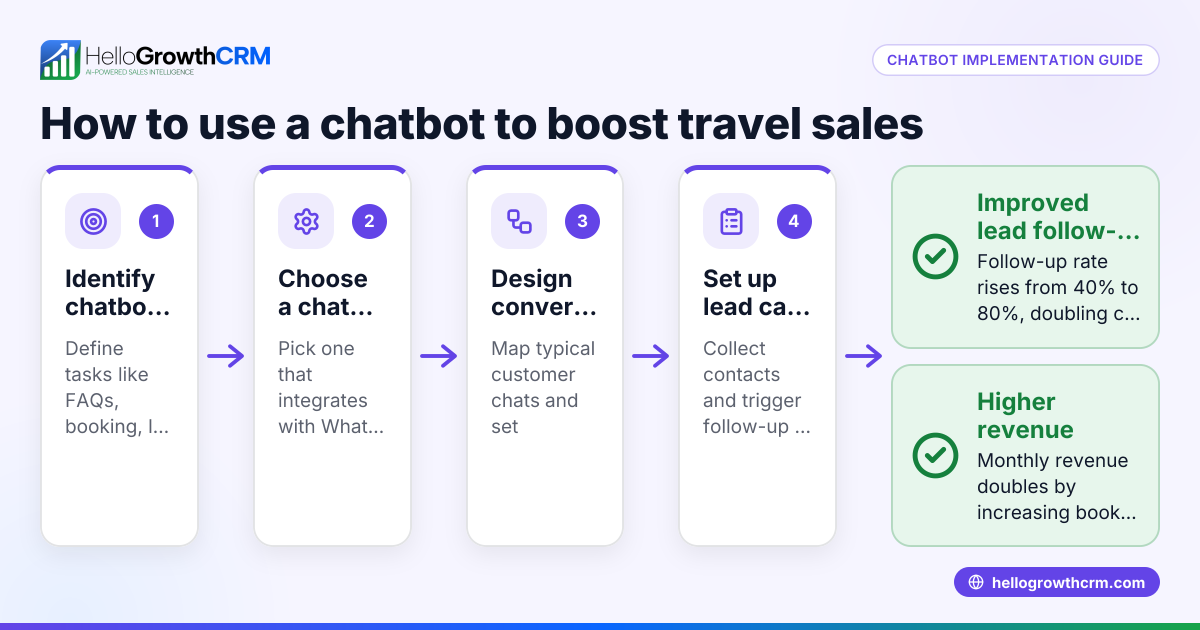
Travel chatbots are automated software tools designed to interact with customers through messaging platforms like WhatsApp, SMS, or website chat. They help travel businesses handle bookings, answer questions, provide personalized recommendations, and offer 24/7 customer support without requiring a live agent. This article covers why small travel businesses use chatbots, how to implement them step-by-step, common pitfalls, a practical example, and answers to frequently asked questions.
Why this comes up / what goes wrong
Many small travel businesses struggle with managing customer inquiries, booking requests, and follow-ups efficiently. These tasks often happen over text messages, emails, or phone calls, which can lead to missed leads or slow responses. Without automation, travel agents spend excessive time on routine questions rather than selling trips or providing personalized service. Travel chatbots address these challenges by automating common interactions and freeing up staff time.
Step-by-step
- Identify repetitive customer interactions to automate: List common questions and tasks such as flight availability, booking status, cancellation policies, or travel recommendations. Check that these are suitable for chatbot handling.
- Choose messaging platforms your customers use: Many travelers prefer WhatsApp or SMS for quick communication. Ensure the chatbot supports these channels to meet customers where they are. See WhatsApp and SMS CRM for examples of platforms used in sales and support.
- Select a chatbot provider that integrates with your sales tools: Look for chatbots that can capture leads directly into your CRM or sales pipeline to avoid manual data entry and lost information.
- Create conversation flows for common scenarios: Design scripts for booking inquiries, travel advice, and follow-ups. Test them for clarity and ease of use.
- Train your team to monitor and intervene when needed: Chatbots handle routine queries, but complex issues require human attention. Establish clear handoff points.
- Track chatbot performance and customer satisfaction: Use reporting tools to check response times, lead capture rates, and customer feedback.
- Continuously update chatbot content based on customer feedback and changing travel policies.
- Ensure compliance with privacy regulations when collecting customer data through chatbots.
Example (fictional figures)
A small travel agency in Phoenix, Arizona, wants to reduce the time spent answering flight availability questions. They estimate 40% of inquiries are about this topic.
- Total monthly customer inquiries: 1,000
- Inquiries about flight availability: 1,000 × 40% = 400
- Average time per inquiry: 5 minutes
- Total time spent monthly: 400 × 5 minutes = 2,000 minutes = 33.3 hours
By implementing a travel chatbot to handle these 400 inquiries automatically, the agency saves 33.3 hours monthly.
Assuming an agent’s hourly wage is $20:
- Monthly savings: 33.3 hours × $20 = $666
If the chatbot costs $100 per month, net savings are:
- $666 - $100 = $566 monthly
This time saved can be redirected to personalized sales efforts, increasing revenue.
Common mistakes
- Trying to automate everything at once: Start with a few key interactions to keep the chatbot simple and effective. Prevent this by prioritizing high-volume queries.
- Ignoring customer preferences for communication channels: Use platforms like WhatsApp and SMS where customers already communicate. Check out WhatsApp and SMS CRM for ideas.
- Not training staff to manage chatbot handoffs: Ensure your team knows when and how to take over conversations. Set clear protocols.
- Failing to update chatbot content regularly: Travel rules change often; outdated info frustrates customers. Schedule regular reviews.
- Overlooking lead capture integration: Without direct CRM integration, leads can be lost. Integrate chatbots with your CRM or sales tools.
- Neglecting to track chatbot performance: Use analytics to improve the chatbot’s effectiveness and customer satisfaction.
Frequently asked questions
What types of tasks can travel chatbots handle? Travel chatbots can answer common questions about bookings, flight status, cancellations, travel guidelines, and provide personalized recommendations. They can also capture leads and schedule follow-ups.
Are travel chatbots suitable for small businesses? Yes, especially for small travel agencies or tour operators with repetitive customer inquiries. Chatbots save time and improve response speed without needing large staff.
Which messaging platforms do travel chatbots support? Many support WhatsApp, SMS, Facebook Messenger, and website chat widgets. Choosing platforms your customers use increases engagement. See WhatsApp and SMS CRM for examples.
How do chatbots integrate with sales and CRM tools? Good chatbot solutions capture lead details directly into your CRM or sales pipeline, reducing manual work and preventing lost leads. Integration ensures smooth follow-up and reporting.
Can chatbots handle complex customer issues? Chatbots handle routine queries well but should escalate complex or sensitive issues to human agents. Training your team on handoffs is essential.
How do I start using chatbots without disrupting my current sales process? Begin by automating a small set of common questions and monitor results. Use a CRM with a built-in dialer to keep calls and messages organized, such as those described in built-in CRM dialer. Gradually expand chatbot use as you learn.
Key takeaways
- Travel chatbots automate common customer interactions, saving time and improving responsiveness.
- Start small by automating high-volume, simple queries.
- Use messaging platforms your customers prefer, like WhatsApp and SMS.
- Integrate chatbots with your CRM to capture leads and track sales.
- Train staff to manage chatbot handoffs and update chatbot content regularly.
- Monitor chatbot performance and customer satisfaction to improve.
To try managing leads and communications efficiently, consider starting on the Free Forever plan (200 leads, no credit card) at HelloGrowthCRM.
Ready to put this into practice?
Set up your pipeline, WhatsApp follow-ups, and AI lead scoring in minutes — free, no credit card.
Try HelloGrowthCRM freeGet CRM tips in your inbox
Join thousands of sales professionals who get weekly insights on CRM strategy, AI automation, and pipeline optimization.

The HelloGrowthCRM team publishes guides on CRM strategy, AI sales tools, and revenue operations for small business sales teams.