HelloGrowthCRM software
Built for real small-business sales teams
HelloGrowthCRM helps reps qualify faster, follow up on time, and close more deals—with practical automation in one place.
- AI lead scoring and pipeline visibility
- Built-in dialer, WhatsApp, and email automation
- Sales forecasting and RevOps-ready reporting
Types of sales funnels are structured paths that guide potential customers from their first interaction with your business to making a purchase. Common types include lead generation funnels that capture contact information, sales funnels that nurture prospects through stages, webinar funnels that use live or recorded events to convert leads, and product launch funnels that build anticipation and sales for new offerings.
Why this comes up / what goes wrong
Many small-business owners in the US struggle to convert leads because they don’t have a clear sales funnel strategy. They may rely on scattered text messages, emails, or spreadsheets, which leads to slow follow-up and lost opportunities. Without understanding the types of sales funnels, it’s hard to design a process that moves prospects smoothly toward buying. This can result in wasted time, missed revenue, and frustration for sales teams trying to keep track of leads manually.
Sales funnels help organize and automate the customer journey, but choosing the wrong type or not setting it up properly causes leads to drop off. For example, a business focused on closing sales might waste effort on a lead generation funnel that only collects contacts without nurturing them. Understanding funnel types helps align your sales process with your business goals.
Step-by-step
- Identify your business goal: Decide if you want to generate leads, close sales, educate prospects, or launch a new product. Clear goals guide your funnel choice.
- Choose the funnel type: Select from lead generation funnels (collect contacts), sales funnels (nurture and convert), webinar funnels (engage through events), or product launch funnels (build excitement and sales).
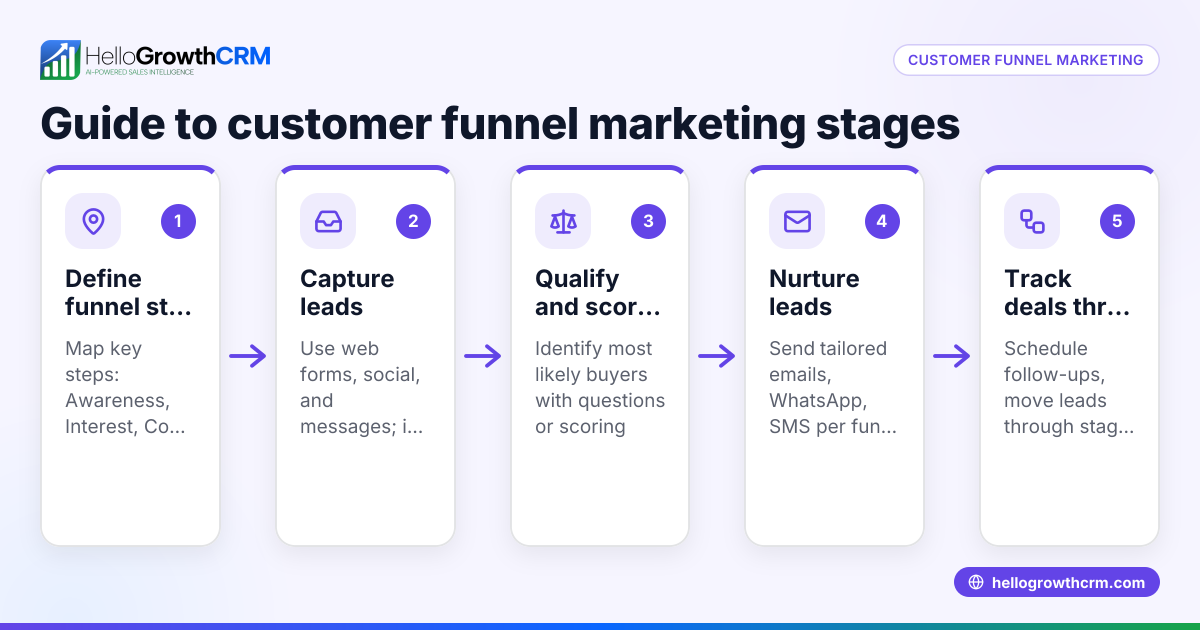
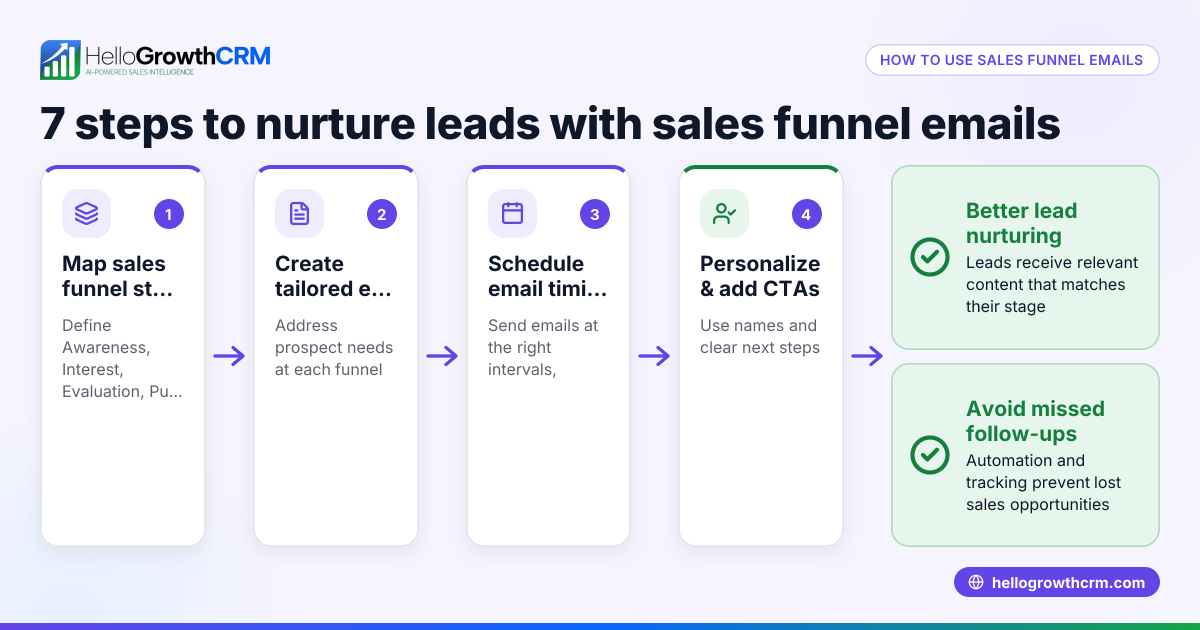
- Map the stages: Define clear stages such as awareness, interest, decision, and action for your funnel. Each stage should have a purpose and measurable outcome.
- Create content or touchpoints: Develop emails, WhatsApp messages, SMS, or calls that correspond to each stage. Use consistent messaging tailored to the prospect’s position in the funnel.
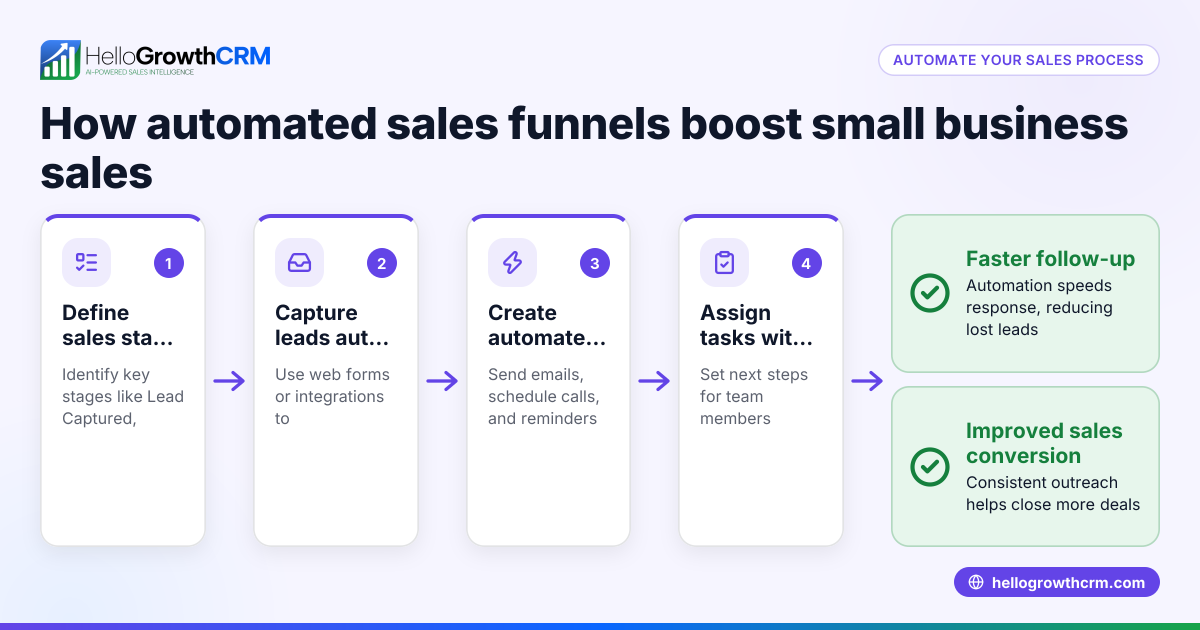
- Set up lead capture: Use web forms or integrations to collect contact info and start the funnel automatically. This reduces manual data entry and speeds follow-up.
- Automate follow-up: Schedule sequences for emails, WhatsApp, or SMS to nurture leads without delay. Automation ensures no lead is forgotten and engagement stays timely.
- Track progress: Use a pipeline tool to monitor deals at each stage and set follow-up reminders. This helps identify bottlenecks and keeps your sales team accountable.
- Review and optimize: Regularly check funnel performance and tweak messaging, timing, or stages based on results. Continuous improvement maximizes conversions.
Example (fictional figures)
A landscaping contractor in Charlotte, North Carolina, launches a lead generation funnel starting 03/01/2026.
- Goal: Get 50 qualified leads in 30 days.
- Web form captures leads at $20 per lead.
Calculation: 50 leads × $20 = $1,000 spent on lead capture
Follow-up sequence converts 20% to paying customers: 50 leads × 20% = 10 customers
Average sale per customer: $2,500
Revenue: 10 customers × $2,500 = $25,000
Profit (revenue - lead cost): $25,000 - $1,000 = $24,000
This example shows how a clear funnel with stages and follow-up can turn leads into revenue, highlighting the importance of managing each step carefully.
Common mistakes
- Not defining funnel stages clearly: Leads get lost without defined steps. Prevent by mapping each stage and its goal.
- Ignoring timely follow-up: Delayed contact causes lost sales. Prevent by automating sequences and setting reminders.
- Using inconsistent communication channels: Mixed messages confuse prospects. Prevent by centralizing messages in one platform like WhatsApp or SMS.
- Failing to track funnel progress: Without tracking, you can’t improve. Prevent by using pipeline tools to monitor deals and stages.
- Overcomplicating the funnel: Too many steps create friction. Prevent by keeping stages simple and focused.
- Neglecting regular review and optimization: Funnels degrade over time. Prevent by scheduling regular reviews and adjusting based on data.
Doing this in HelloGrowthCRM
HelloGrowthCRM helps small businesses manage sales funnels with features like Deals (pipeline) where quotations appear as deals at the 'quote sent' stage with follow-up dates, ensuring no opportunity is forgotten. Territory and field operations tools let distributors log visits from their phones while managers monitor daily activity. Managed RevOps provides weekly support for founders without sales managers, keeping the follow-up queue active and pipelines clean. Learn more about WhatsApp and SMS CRM, the built-in CRM dialer, and HelloGrowthCRM for the United States.
Frequently asked questions
What is the difference between a lead generation funnel and a sales funnel? A lead generation funnel focuses on capturing contact information from prospects, while a sales funnel nurtures those leads through stages to close a sale. Lead generation is often the first step in a broader sales funnel.
How do I know which type of sales funnel my business needs? Identify your primary goal: if you want more contacts, use a lead generation funnel; to convert leads into customers, use a sales funnel; for launching products or hosting events, consider product launch or webinar funnels.
Can I manage sales funnels without software? Yes, but it’s harder to track and automate follow-ups. Using a CRM like HelloGrowthCRM centralizes communication and pipeline management, reducing manual errors and lost leads.
How often should I review and adjust my sales funnel? Regular reviews every 1-3 months help identify bottlenecks or drop-off points. Adjust messaging, timing, or stages based on performance data.
What role does automation play in sales funnels? Automation ensures timely follow-up via email, WhatsApp, or SMS sequences, improving lead nurturing without extra manual effort.
Why use a CRM with pipeline management for sales funnels? A CRM tracks deals visually through stages, sets reminders for follow-up, and stores communication history. This organization prevents leads from being forgotten and helps teams collaborate effectively.
Key takeaways
- Sales funnels guide prospects through stages from awareness to purchase.
- Choose funnel types based on your business goals.
- Map clear stages and automate follow-up to avoid lost leads.
- Track deals and set reminders to keep prospects moving forward.
- Regularly review funnel performance and adjust.
- HelloGrowthCRM offers pipeline management, field operations, and managed RevOps support.
Start building your sales funnel today with HelloGrowthCRM. Start on the Free Forever plan (200 leads, no credit card) and keep your sales organized and moving.
Ready to put this into practice?
Set up your pipeline, WhatsApp follow-ups, and AI lead scoring in minutes — free, no credit card.
Try HelloGrowthCRM freeGet CRM tips in your inbox
Join thousands of sales professionals who get weekly insights on CRM strategy, AI automation, and pipeline optimization.

The HelloGrowthCRM team publishes guides on CRM strategy, AI sales tools, and revenue operations for small business sales teams.