Overview
The Google Maps Platform integration puts location intelligence inside HelloGrowthCRM: address autocomplete on lead and account forms, geocoded records that plot on territory views, and distance-aware planning for businesses whose selling happens in person. For field-sales teams, home-services businesses, real estate, and distribution, "where" is a first-class sales fact — and typing addresses freehand is how CRMs fill with unmappable garbage.
Autocomplete fixes data quality at the point of entry: addresses arrive standardised and geocoded, which is what makes everything downstream work — territory assignment by actual location, route-aware visit planning for field reps, and locality-level reporting that tells a real-estate or services business which areas actually produce revenue.
What data is involved
- Address autocomplete on CRM forms via the Google Places API, standardising entries at capture.
- Leads and accounts geocoded with coordinates stored on the record.
- Territory rules assignable by geography with clean location data.
- Distance and travel context available for field-visit planning.
- Locality and city-level rollups in reporting from structured address components.
- Existing records batch-geocodable to clean historic address data.
Step-by-step setup
Setup at a glance (3-5 bullets)
- Settings → Integrations → Google Maps → API key → enable on project cards.
Sign in or sign up at HelloGrowthCRM. Open the login page, enter your credentials (or use Google), or choose Sign up if you need a new account. You must be signed in before you can open Settings and connect this integration.
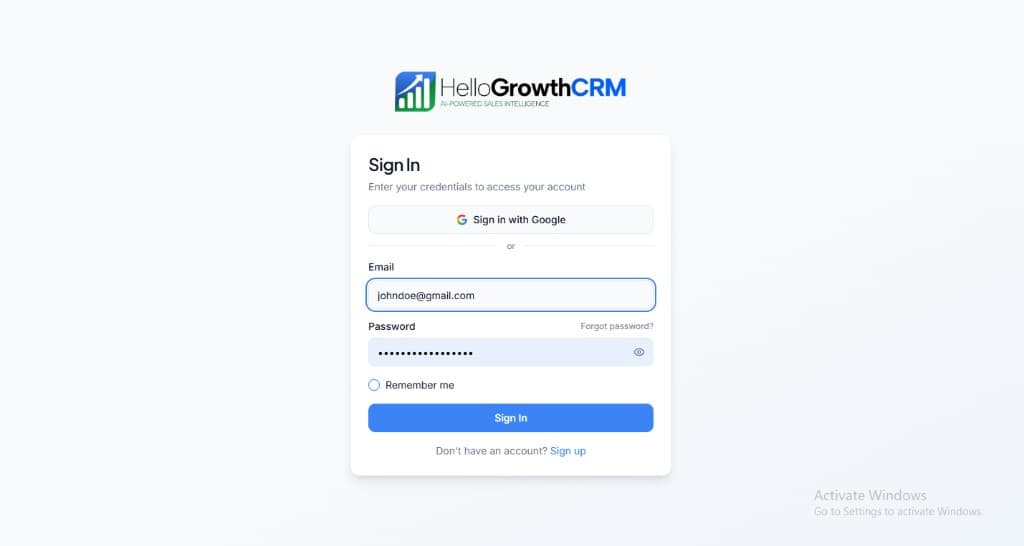
Open login page(opens in a new tab)app.hellogrowthcrm.com/login
Open Settings. In the left sidebar, under Admin, click Settings (you will land on the Settings area; the URL is app.hellogrowthcrm.com/settings).
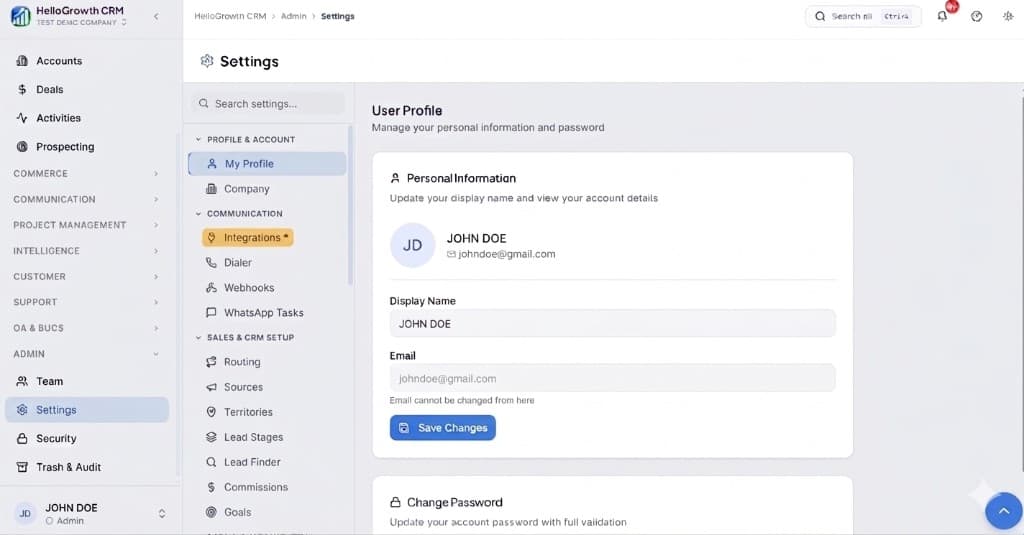
Open Settings(opens in a new tab)app.hellogrowthcrm.com/settings
Go to Integrations. On the Settings screen, use the middle settings menu. Under COMMUNICATION, click Integrations (star icon). Then find and configure this connector—the connector-specific steps below pick up from here.
Open Settings (Integrations)(opens in a new tab)app.hellogrowthcrm.com/settings
- Settings → Integrations → Google Maps → API key → enable on project cards.
Best practices
- Turn on autocomplete for every address field — retrofitting clean addresses later costs more than capturing them clean now.
- Store address components (city, state, pincode) structured, not as one string; reports group on components.
- Batch-geocode the existing base once after setup so territory views include history, not just new records.
- Restrict your Google API key by domain and API — an unrestricted key that leaks becomes someone else's billing.
- Watch API usage in the Google Cloud console the first month; autocomplete sessions are billed by Google and volume assumptions deserve checking.
Best for & common use cases
Visual location context and visit planning.
- Field sales and site visit scheduling.
Expected outcomes
- Faster lead handoff between tools and CRM owners
- Cleaner activity history for follow-up and reporting
- Lower manual copy-paste errors in the pipeline
Troubleshooting
- Autocomplete not appearing: the key lacks the Places API enablement or has referrer restrictions blocking the CRM domain — adjust in the Google Cloud console.
- Billing surprise: unrestricted key used elsewhere or autocomplete on high-traffic public forms — restrict the key and scope autocomplete to internal forms.
- Wrong pins on some records: ambiguous historic addresses geocoded to city centroids — review the flagged records and refine manually.
FAQ
Governance
Treat API keys and webhooks as production secrets. Align field mapping with your privacy policy and regional regulations (GDPR, marketing consent, telemarketing rules). Your admin controls which roles can install or edit integrations.
Related integrations in this category
Creates a planned NoBroker integration page for HelloGrowthCRM so teams can discover Indian rental marketplace workflows in the public integrations directory.
Creates a planned CommonFloor integration page for HelloGrowthCRM so teams can discover Indian real-estate portal workflows in the public integrations directory.
Creates a planned MMT B2B integration page for HelloGrowthCRM so teams can discover India travel/property B2B workflows in the public integrations directory.
Creates a planned Quikr Homes integration page for HelloGrowthCRM so teams can discover Indian classifieds (real estate) workflows in the public integrations directory.
Creates a planned OLX Real Estate integration page for HelloGrowthCRM so teams can discover India classifieds (real estate) workflows in the public integrations directory.
Creates a planned Sulekha Real Estate integration page for HelloGrowthCRM so teams can discover Indian local services workflows in the public integrations directory.
Creates a planned PropTiger integration page for HelloGrowthCRM so teams can discover Indian real-estate portal workflows in the public integrations directory.
Creates a planned PropTiger Builder integration page for HelloGrowthCRM so teams can discover Builder-specific portal workflows in the public integrations directory.