

Skip to content
School Admissions CRM

Follow Up Every School Admissions Enquiry Until the Place Is Accepted

UK schools win or lose families in the gaps between the open morning, the registration form and the offer. HelloGrowthCRM gives every enquiry an owner, a year of entry and a next step, for independent school registrars and for academies and trusts promoting their schools, alongside the MIS you already use.

Last updated:

Free Forever • No Credit Card Required

Live preview

School Admissions CRM

A sample School Admissions workspace. The names and figures are illustrative.

Open pipeline

42

+12% this month

Follow-ups due

9

5 automated

Response SLA

18m

-34% faster

Automation coverage

76%

A pipeline for each entry point

1

School Admissions Account

New enquiry, owner assigned

Rs. 2.4L

Open morning and private tour follow-up

1

School Admissions Opportunity

Qualified, next action set

Rs. 1.1L

Year of entry on every record

1

School Admissions Renewal

Quote sent, follow-up scheduled

Rs. 78K

Household linking

1

School Admissions Follow-up

Parents, guardians and siblings sit together

Rs. 3.2L

Quick answer

School Admissions CRM: what problem does HelloGrowthCRM solve first?

Admission-season enquiry volume triples in six weeks, and the front office triages by whoever shouted on the phone most recently. Every enquiry from your website, ads, and walk-ins enters one pipeline with automatic acknowledgement and counsellor assignment, so the February surge is processed in arrival order with nothing lost, and the principal watches volumes live.
  • Season surge pipeline
  • Post-tour follow-up sequences
  • Document chase automation
  • Grade-wise seat dashboard

See pricingBook a demo

HelloGrowthCRM

Capture. Follow up. Close.

From Enquiry to Customer in One CRMEvery lead captured, followed up and tracked — so nothing goes cold.The path a lead takes inside HelloGrowthCRM, from first enquiry to a repeat customer.
  1. Step 1

    Capture

    Web forms, WhatsApp, calls and ads land in one inbox

  2. Step 2

    Qualify

    AI lead scoring flags who is ready to talk

  3. Step 3

    Assign

    Routed to the right rep automatically

  4. Step 4

    Follow up

    Reminders, sequences and WhatsApp nudges

  5. Step 5

    Track the deal

    Stages, value and next step in the pipeline

  6. Step 6

    Win & retain

    Renewals and repeat business stay on the radar

Every call, message and email is logged on the contact — the history travels with the lead.

One contact record, one pipeline, one clear next step.

01

What K-12 enrolment means in a UK school

The term, translated

K-12 is American shorthand for kindergarten through twelfth grade. In British terms that is Reception to Year 13, and what a US vendor calls enrolment management a UK school calls admissions. This page uses UK vocabulary from here on: enquiries, open mornings, registration, entry points, offers and accepted places.

Two admissions worlds

Independent schools run their own admissions from first enquiry to signed acceptance. State-funded schools, academies included, have their main-round places coordinated by the local authority. Both need to attract families, and both lose them through slow follow-up, but what the admissions office may do, and when, is very different. A CRM has to respect that difference.
02

Independent schools: a long decision with fixed entry points

The registrar's year

Most independent schools admit at set points: Reception, 7+, 11+, 13+ and Sixth Form. The cycle typically begins with open mornings in the autumn, then registration by a published deadline, assessments or pre-tests, interviews, and offers in the new year with a reply-by date. Senior schools taking pupils at 13+ may pre-test them years earlier, with Common Entrance still to come. Each entry point has its own dates and its own rival schools, so each deserves its own pipeline.

Enquiries that arrive years early

A parent enquiring about a Year 7 place for a child now in Year 4 is not someone to convert this term. In a shared inbox that family is answered once and then forgotten. With the year of entry recorded and a task set for the next open morning, they hear from the school at sensible intervals until registration opens.

Fees, bursaries and scholarships

Affordability comes up earlier in the conversation than it once did, particularly now that VAT is charged on independent school fees. Families ask about bursaries and scholarships before they visit. Flagging that interest on the enquiry means the bursar's deadlines reach the right households. The means-testing itself, and every financial document, belongs with the bursary process and not in the CRM.

03

Academies and trusts: promote the school, leave allocation alone

What the local authority coordinates

In England, families apply for Reception and Year 7 places through their home local authority, by the end of October for secondary and by mid-January for primary, and offers follow on the national offer days in March and April. Places are allocated under each school's published oversubscription criteria and the School Admissions Code. Arrangements differ in Scotland, Wales and Northern Ireland. HelloGrowthCRM plays no part in ranking or allocating places and should hold nothing that bears on those criteria.

Where schools do recruit directly

What a school controls is whether families put it on the form at all. Open evenings, tours, prospectus requests and conversations with feeder primaries all happen before the deadline, and all benefit from a named owner and a follow-up. Sixth Form applications usually come straight to the school, nursery places often do, and in-year enquiries may too, depending on local arrangements. With pupil numbers driving funding, those are the points where an academy can act.

One view across a trust

A multi-academy trust often does not know which of its schools is drawing interest until the autumn census. Recording open event attendance and Sixth Form applications by school and by source gives the central team a comparable picture while there is still time to help a school whose numbers look soft.

04

Who enquires, and how

Parents first

The enquirer is almost always a parent or guardian, usually by web form, email or a phone call to the school office, and often to several schools in the same week. The contact to hold is the adult. Linking both parents, any guardian and siblings in one household avoids duplicate records and means a younger child is already a known future applicant.

Feeder schools and nurseries

Prep school heads advise families on senior schools, and primaries and nurseries shape where their leavers go. Holding each feeder as an account, with the head or contact and the visits you have made, shows which relationships are active and which have lapsed since a change of head.

Overseas families, agents and guardians

Boarding schools also receive enquiries from abroad, often through an agent and with a UK guardian involved. Recording who is acting for the family, and their time zone, keeps replies prompt. If you sponsor overseas pupils, those sponsorship duties remain the school's.

05

Open events decide the year

Before the event

An open morning is the largest single source of serious enquiries for many schools. Bookings recorded against the household, with a reminder a few days ahead, reduce empty places on the tour and tell the head how many families to expect.

The week after

What happens next matters more. Every family that attended should have an owner and a next step: a private tour, a taster day, a registration form or a call from the head of year. Families that booked and did not come are worth a second invitation. Without a list, neither group is followed up evenly.

06

Offers, acceptances and occasional places

The reply-by date

Families holding offers from more than one school decide in a short window. Each offer in the pipeline carries its reply-by date and an owner, so the registrar can see at a glance who has accepted, who has declined and who has said nothing. Waiting-list families stay in a stage of their own, ready to contact on the day a place is released.

Mid-year movers

Relocating families ask about occasional places at any time of year and usually need an answer quickly. Tracking them apart from the main round, with the year group and the date a place is needed, stops them queuing behind next September's enquiries.

07

Where responsibility sits

Children's data deserves a narrow record

Your school is responsible for the personal data it holds under UK data protection law, and for its safeguarding duties, whichever software it uses. HelloGrowthCRM is not a management information system and does not replace one. Keep assessment results, reports from a child's current school, medical details, special educational needs information and anything touching safeguarding in the systems your policies already name. In the CRM, hold the parent's contact details, the year of entry, the stage and the conversation history. Record how the family agreed to be contacted, set a retention period for unsuccessful applicants with your data protection officer, and restrict access by role.

Challenges we solve

Common CRM problems in this industry — and how HelloGrowthCRM solves each one

Every team in this space loses revenue to the same recurring gaps. Each card below states one problem and the specific HelloGrowthCRM capability that closes it.

  • Problem: Admission-season enquiry volume triples in six weeks, and the front office triages by whoever shouted on the phone most recently.

    How HelloGrowthCRM solves it: Every enquiry from your website, ads, and walk-ins enters one pipeline with automatic acknowledgement and counsellor assignment, so the February surge is processed in arrival order with nothing lost, and the principal watches volumes live.

    HelloGrowthCRM capability: Season surge pipeline

  • Problem: Parents who toured the campus and loved it never hear from the school again until the deadline has passed.

    How HelloGrowthCRM solves it: Post-tour follow-up sequences thank the family the same evening, share the prospectus and fee structure, and remind them of the application deadline at intervals, so enthusiasm built on the tour is carried all the way to a submitted form.

    HelloGrowthCRM capability: Post-tour follow-up sequences

  • Problem: Applications stall at missing birth certificates and transfer certificates, and chasing them eats the admission office's whole day.

    How HelloGrowthCRM solves it: Document-pending applications trigger automated WhatsApp checklists to parents with exactly what is missing, escalating to a counsellor call only if documents do not arrive, freeing the office to counsel families instead of dialling for paperwork.

    HelloGrowthCRM capability: Document chase automation

  • Problem: Nobody can answer how many confirmed admissions Grade 3 has against capacity until someone counts files on Friday.

    How HelloGrowthCRM solves it: Grade-wise pipeline dashboards show enquiries, tours, applications, and confirmed admissions against seats in real time, so leadership spots an under-filling grade in week two of the season and redirects outreach while it can still matter.

    HelloGrowthCRM capability: Grade-wise seat dashboard

  • Problem: Families with a child already enrolled still receive the same cold pitch as strangers when a sibling reaches school age.

    How HelloGrowthCRM solves it: Sibling details captured at admission feed a yearly campaign that invites existing parents to enrol younger children with a streamlined process, harvesting your most winnable admissions from relationships the school has already earned.

    HelloGrowthCRM capability: Sibling admission campaigns

What you get

Why teams choose HelloGrowthCRM

AI-powered CRM with the features you need to close more deals.

  • A pipeline for each entry point: Reception, Year 3, Year 7, Year 9 and Sixth Form each have their own stages, from first enquiry and visit through registration, assessment, offer and accepted place
  • Open morning and private tour follow-up: every family who books, attends or fails to turn up gets an owner and a next step before the week is out
  • Year of entry on every record: an enquiry for a place two or three years away stays warm with scheduled contact instead of being forgotten until registration closes
  • Household linking: parents, guardians and siblings sit together, so a younger brother or sister is a known future applicant and not a fresh enquiry
  • Feeder school accounts: hold each prep school, primary school and nursery as an account, with the head or contact you deal with and the visits you have made
  • Occasional places and in-year enquiries: track mid-year movers apart from the main admissions round, with the year group and the date a place is needed
  • Bursary and scholarship interest flagged on the enquiry, so deadline reminders reach the right families while their financial details stay out of the CRM
  • Offer and acceptance chasing: every offer carries a reply-by date and a named owner, and unreturned acceptance forms surface as tasks
  • Overseas and boarding enquiries: note the agent or guardian acting for the family and their time zone, so replies are planned and prompt
  • Trust-wide reporting: for multi-academy trusts and school groups, see open event interest, Sixth Form applications and nursery enquiries by school, entry point and source
  • Free plan available with no credit card. Paid plans from $12/user/mo (USD 100/user/year, billed annually).
Watch it work

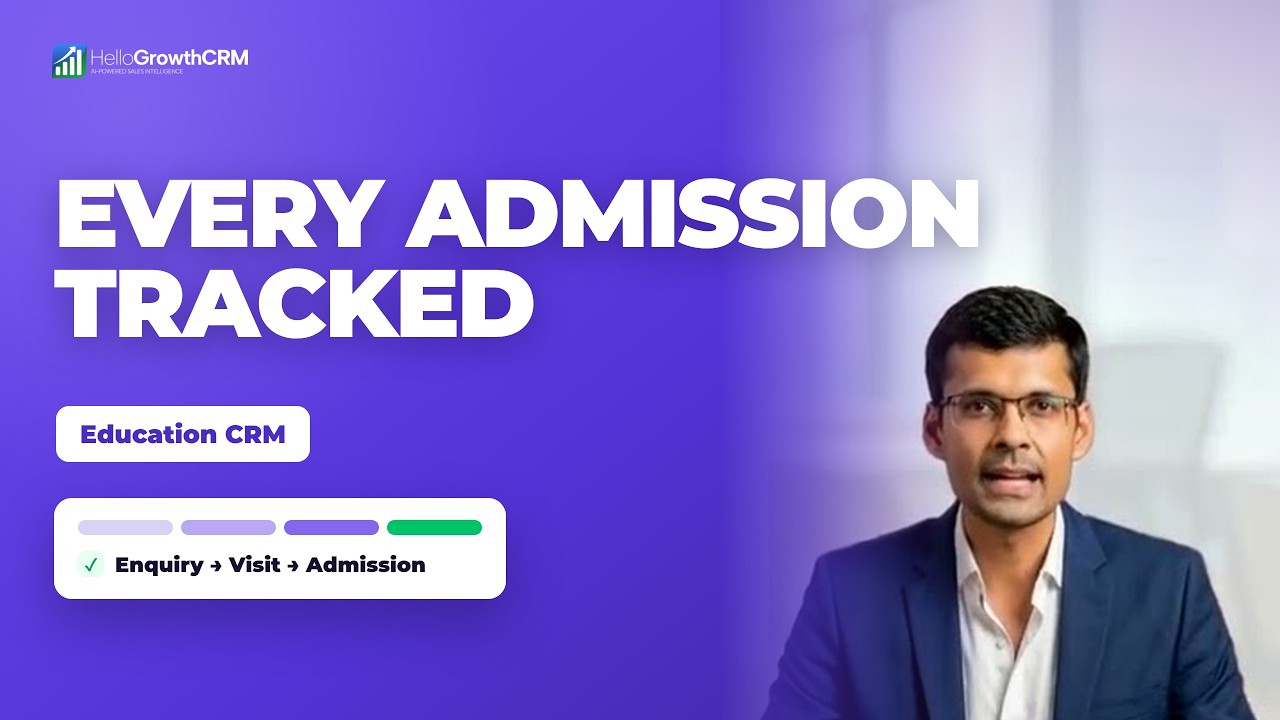
CRM for Education: Enquiry to Enrolment in One Pipeline

CRM for Education: Enquiry to Enrolment in One Pipeline
A short walkthrough of HelloGrowthCRM for education and training.

Key takeaways from this video

  • Every enquiry channel on one board — web forms, WhatsApp, walk-ins, lead ads, listings, fair stalls and the paper register.
  • AI scoring so counsellors call the most serious families first.
  • Four stages — Enquiry, Demo Class, Fee Discussion, Enrolled — segmented by programme, campus and intake year.
  • One student record holding every call, message and note, so counsellor handover is one action.
  • WhatsApp fee reminders before each due date, and cost per admission by source.

Watch the full video on its own page

HelloGrowthCRM by the numbers

$12
per user/month list price — USD 100/user/year, billed annually on annual billing, ₹899/user/mo in India
$0
free forever starter plan — no credit card required
14-day
trial included on paid plans
500+
teams worldwide run their pipeline on HelloGrowthCRM

Frequently Asked Questions

Common questions about using HelloGrowthCRM in your industry.

K-12 is an American term for kindergarten through twelfth grade, the whole span of school education. The UK equivalent runs from Reception to Year 13. Software described as a K-12 enrolment CRM is, in British terms, a school admissions CRM: a place to manage prospective families from first enquiry to accepted place. Everything on this page is written in UK school vocabulary, so you will read about entry points, registrars, open mornings and offers where a US page would talk about grades and enrollment.

No, and it should not be asked to. Your management information system holds the pupil record: attendance, assessment, contacts for enrolled pupils and everything your statutory returns depend on. HelloGrowthCRM sits before that, with the families who are not yet pupils. It tracks who enquired, who visited, who registered, who holds an offer and who has gone quiet. When a place is accepted, the pupil is set up in your MIS through your normal admissions process. The CRM is a follow-up tool for the admissions office, not a system of record for children.

For everything that happens around allocation and never for the allocation itself. Main-round places at state-funded schools in England are coordinated by the local authority and decided under your published oversubscription criteria and the School Admissions Code, and a CRM has no role in that. What you can manage is interest before the deadline: open evening bookings, tours, prospectus requests and feeder primary relationships. Sixth Form applications, nursery places and, depending on local arrangements, in-year enquiries often come straight to the school, and those benefit from an owner and a follow-up date like any other enquiry.

By turning a year of scattered conversations into one list per entry point. A registrar handles enquiries for several year groups at once, some for next September and some for three years out, alongside open mornings, taster days, assessments and offers. With each family in a pipeline stage, an owner and a next-action date, it is clear every Monday who needs a call, who has not returned a registration form and which offers are still unanswered as the reply-by date approaches. It also means the admissions office keeps running when the registrar is away.

Conservatively. Your school decides what personal data it holds and why, and its obligations under UK data protection law apply whatever software is in use. A sensible rule is that the CRM holds the adult's contact details, the year of entry, the pipeline stage and the conversation history, and very little about the child beyond a name and current year group. Assessment results, school reports, medical details, special educational needs information and anything connected to safeguarding belong in the systems your policies already name. Agree the detail, including how long you keep unsuccessful applicants, with your data protection officer before importing anything.

It can track that a family is interested and where they are in the process, which is the part the admissions office needs. A flag on the enquiry and a dated task mean the bursary deadline reminder goes to the right household and nobody discovers in February that a form was never sent. The assessment itself is a different matter. Means-testing involves income and household information that should stay with the bursar and whichever process the school uses for it, and none of that needs to sit in a CRM.

Yes. Pipeline and follow-up tasks are on the free plan with no credit card required. Messaging, the built-in dialer and the AI features are on paid plans, starting at $12/user/mo, or USD 100/user/year, billed annually.

More CRM guides to explore

Browse related HelloGrowthCRM guides and see how different teams run their pipelines.

Ready to grow?

Join small businesses that close more deals with HelloGrowthCRM.

Free Forever • No Credit Card Required

Take the next step

Free Forever • No Credit Card Required

Prefer email? Write to sales@hellogrowthcrm.com